



Miss Peahlo was dressed in khaki, sitting across from me at the Sitatunga Great Plains Private Island Camp. Between us was a generous, carefully plated meal, but she ate cautiously, as if such abundance required permission. I asked her what her name meant. “It means pain and rejection in Setswana,” she said matter-of-factly. “My father left my mother before I was born.”
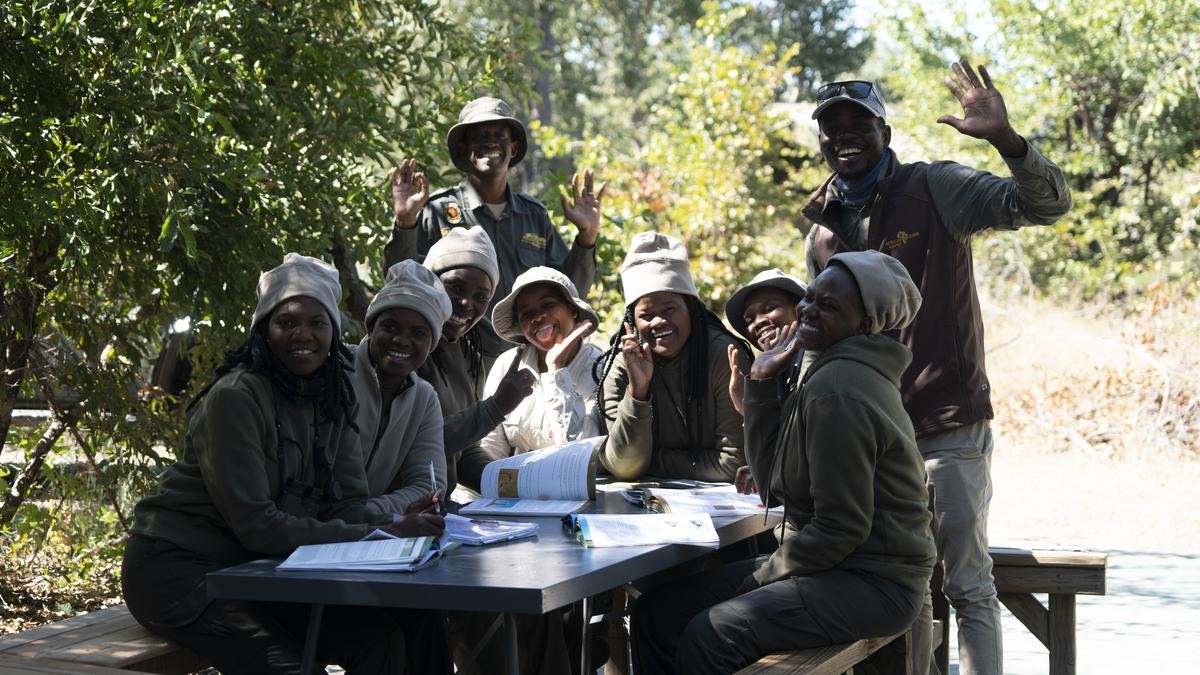
Female rangers at the Sitatunga Great Plains Private Island Camp
| Photo Credit:
Special arrangement
She prefers to be called Miss P. She is a mother to a six-year-old daughter and, like her own mother, is raising her child on her own. The meaning of her name, she says, will not be passed on to her daughter.
Miss P comes from the Bambukushu tribe
| Photo Credit:
Special arrangement
Sitatunga Private Island lies on a rare stretch of land in the Okavango Delta in northern Botswana. This part of the planet is known for its one-of-a-kind landscapes created by the world’s largest inland delta. It is a UNESCO World Heritage Site recognised for its biodiversity and ancient cultures that trace their origins to the earliest periods of human history.
Miss P comes from the Bambukushu tribe. Her ancestors were believed to be the rainmakers of the Okavango. Today, these people, who were once believed to call upon rain through rituals, along with many other tribes, are struggling to survive in the modern world.
Sitatunga Private Island is a UNESCO World Heritage Site recognised for its biodiversity and ancient cultures that trace their origins to the earliest periods of human history
| Photo Credit:
Special arrangement
According to a 2025 article published in Daily News Botswana, the country’s oldest and primary government-owned newspaper, the youth unemployment rate in Botswana was declared a national emergency at 38.2%. In the Okavango Delta, work is scarce and largely limited to remote luxury safari camps. For women like Miss P, the barriers are even higher. Restricted access to education and deep-rooted gender inequality keep many out of the formal economy.
But jobs are not the only thing lost in this landscape. The big five once roamed here in vast numbers, and they did so for centuries. Along with many other species, they were pushed to the brink of extinction by relentless hunting for horns, hides, and mere wall trophies.
Female rangers on the boat patrol
| Photo Credit:
Special arrangement
For perspective, at the turn of the 20th Century, the global rhinoceros population was estimated at 3,00,000 to 4,00,000. In the latter years of that century, only about 2,000 remained worldwide.
Around the same time, Botswana lost its last rhinoceros. It was shot in 1985.
In the Okavango Delta, work is scarce and largely limited to remote luxury safari camps
| Photo Credit:
Special arrangement
This was the inheritance from which the Great Plains Foundation began its work. The Foundation is the non-profit arm of Great Plains Conservation, a tourism company focussed on ethical and sustainable wildlife tourism. It was established in 2006 by Dereck and Beverly Joubert. The duo, National Geographic Explorers, has spent more than four decades documenting and protecting wilderness in Kenya, Zimbabwe, and Botswana. Today, Great Plains Conservation operates 20 camps across these three countries.
Hope for women of ancient cultures and for endangered wildlife found a common thread in one of the foundation’s initiatives, the Female Ranger Programme.
In 2017, an accident left Beverly Joubert hospitalised in the Okavango Delta for an extended period; she grew close to the women who cared for her. “I grew very close to the women who cared for me during this time. Though their lives were vastly different, their stories reflected the same patterns of limited opportunity, economic dependence, and vulnerability. I wanted to do something for them,” Dereck says, while adding, “We needed boots, eyes, and ears on the ground. Hiring female rangers as biodiversity monitors also helps to shift gender stereotypes and create role models for other young girls.”
The thinking was two-fold. Joubert explains that one female ranger’s salary can sustain up to 10 family members. Women also proved more effective than men at reducing human-wildlife conflict, drawing on their deep ties to communities and maternal instincts.
Routine boat patrol
| Photo Credit:
Special arrangement
In 2022, when Great Plains advertised 24 ranger positions for women in Botswana and Zimbabwe, more than 200 applications arrived within a single day.
Those selected entered a demanding six-month training programme. By the end of the programme the rangers, like Irene Kamwengo, were equipped with skills they did not think were within their grasp.
“I am proud to be a female ranger because having this opportunity has given me many opportunities to learn a lot of things which I did not know or never had, such as having a driving licence, learning more about Nature, in which I did a Nature guiding course, boat training course, first aid course, and photography course,” she proudly states.
In 2022, when Great Plains advertised 24 ranger positions for women in Botswana and Zimbabwe, more than 200 applications arrived within a single day
| Photo Credit:
Special arrangement
It takes $15,000 to cover the cost of one ranger’s salary and training.
“The salary is better than most jobs available to women here,” Miss P says. “Accommodation and food are covered, so most of what I earn goes to my family. For me, it means getting my daughter into a good school.”
For Agonneone Oneh Botshelo, who joined the Great Plains Foundation in 2022, being a ranger means, “I now have medical cover, professional certifications, and long-term employment, which has allowed me to build a home.”
Today, Great Plains remains the only tourism-based company in Africa running a Female Ranger Programme.
Great Plains remains the only tourism-based company in Africa running a Female Ranger Programme
| Photo Credit:
Special arrangement
Rangers like Miss P now spend their days collecting data and educating communities across the delta. Recently, she and her team have been tracking reintroduced rhinoceroses in the Duba Plains Camp.
As the rhinos return to an unfamiliar land and people relearn how to live alongside them, vigilant monitoring has become essential.
“We have to track and count each one every single day to make sure they are okay. As a mother myself, I understand how the rhinos’ behavioural patterns change during pregnancy and after birth.”
As the rhinos return to an unfamiliar land and people relearn how to live alongside them, vigilant monitoring has become essential
| Photo Credit:
Special arrangement
Rumbidzai Musembwa, who is currently pursuing her Master’s degree, says, “I also love the interdisciplinary nature of conservation science, where I get to work with ecologists, local communities, and policymakers to create solutions that benefit both people and the planet.”
But for women, the job comes with its own challenges, especially during their menstrual cycles, when they are sleeping in open forests with a lack of bathrooms. “We never show our male counterparts that we cannot handle this. We try to stay brave”, Miss P.
For women, the job comes with its own challenges, especially during their menstrual cycles
| Photo Credit:
Special arrangement
Her being brave has helped in other ways. During a routine boat patrol, Miss P was aboard with two Botswana Defence Force officers and another ranger. She was the only woman. On the return journey, the boat operator suddenly lost consciousness. Miss P was the only person capable of manoeuvring the vessel through hippo-filled waters. As she took control, a hippo charged the boat, forcing water into it and causing it to sink. She used her training in swimming and boat manoeuvring to save three other lives.
Back home, Miss P is involved in a children’s camp project, a role she took on because she knows how to drive.
Women proved to be more effective than men at reducing human-wildlife conflict
| Photo Credit:
Special arrangement
“It is not every day that these children get to see a woman behind the wheel of a Land Cruiser. When a girl came and asked me how to get the uniform and the vehicle, I felt that I had done my job.”
Travel diary
Flight mode
Companies like Cozymoons specialise in luxury safaris. Ethiopian Airlines flies directly from Mumbai and New Delhi to Addis Ababa, from where you can connect to Victoria Falls in Zimbabwe or Maun in Botswana. From there, Cozymoons takes over, arranging the entire safari experience with handpicked lodges, bush flights, road transfers, or helicopters as per your budget/itinerary.
Website: cozymoons.com
Stay safe
Great Plains Conservation are high-end, sustainable private concessions. Guests can move between regions across its portfolio of 15 camps in Africa. A well-balanced itinerary could include Mpala Jena in Zimbabwe, Zarafa Camps at the Selinda Reserve in Botswana, and Sitatunga Private Island in the Okavango Delta, Botswana. Rack rates for this three-property journey, including transfers, start at ₹15 lakh per person for a two-night stay at each property.
Website: greatplainsconservation.com


