



The city of Dunedin in New Zealand has a public tap outside a working brewery that pumps spring water straight up from beneath the building for the public, for free.
People pull over on Rattray Street with empty containers to fill; its untreated, non-chlorinated, and non-fluoridated water make it an ideal base for beer, carrying the very act of brewing out of the brewery and back into the city. The tap is siphoned through Speight’s Brewery, a Dunedin institution founded in 1876 and still operating on the same site.
The 150-year-old beer-making operation has outlived every local competitor and still shapes how the city drinks and remembers itself.
The Scottish settlement in the south island of New Zealand, dubbed the “Edinburgh of the South” (named after the Gaelic for Edinburgh: Dùn Èideann), is a steep, windy university city of roughly 130,000 people. Its Scottish inheritance shows up in its stone civic buildings, Presbyterian churches, and local beer culture, which is deeply-rooted in daily life.
New Zealand’s brewing scene is positioned comfortably in the global circuit, exporting hops as much as ideas, even as multinational brands localise production. Guinness, for instance, is brewed under licence across multiple countries, with major production hubs outside Ireland where it is consumed and produced at scale. While the iconic stout perfected in Dublin has long travelled the world by adapting to place, in Dunedin, local breweries have spent decades doing the opposite, rooting themselves so firmly in the textures of the city that the beer might not taste the same outside of it.
Views from the St. Clair Esplanade in Dunedin, New Zealand
| Photo Credit:
Ayaan Paul Chowdhury
Speight’s carries a bulk of that history, with a trusted brand name built over nearly a century and a half. It produces a range of popular beers led by its Gold Medal Ale, a draught-style lager that has for decades been one of the most widely consumed beers in New Zealand. And so, “Speight’s” in Dunedin refers both to a specific beer and to a broader institution that anchors social life, whether that is a pint after work, a post-match drink tied to the region’s strong rugby culture, or the default weekend pub haunt for Otago Uni students.
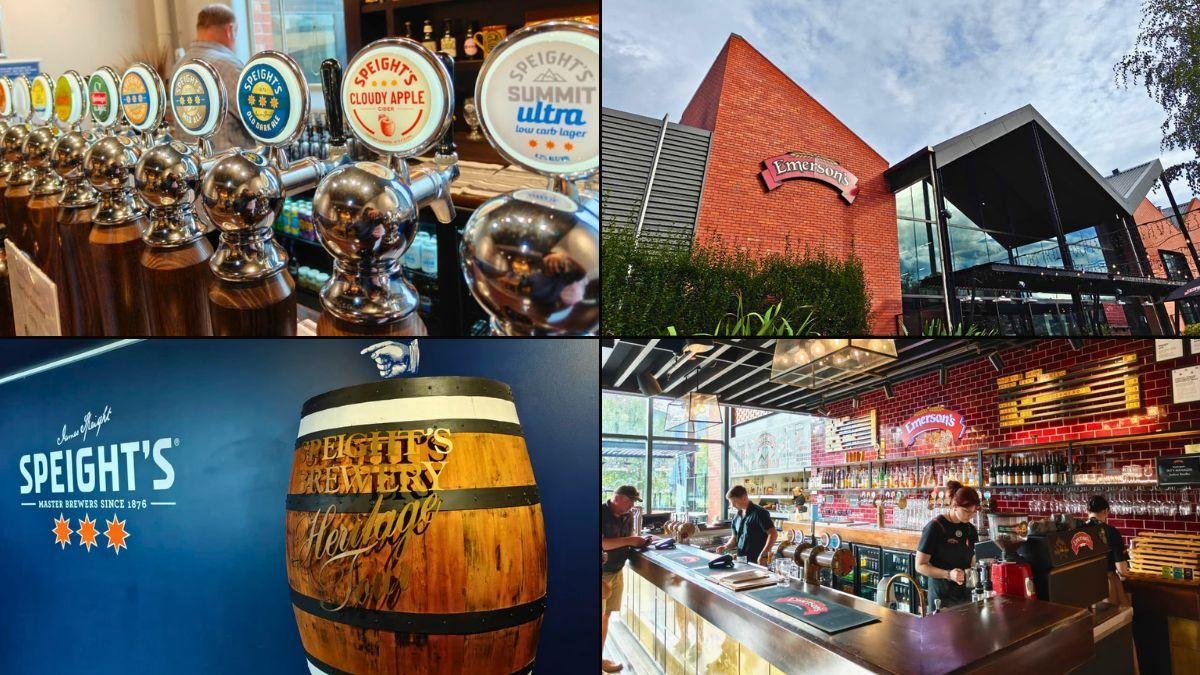
Today, Speight’s inextricable presence in the city shares space with a newer but equally rooted counterpart in Emerson’s Brewery — founded in 1992 by local brewer Richard Emerson — which produces a range of craft beers including pilsners, pale ales, and stouts. Emerson’s situates itself within a different segment of the market focused on varied styles and smaller batches, while still brewing primarily within the city and drawing heavily on New Zealand-grown ingredients; it now produces millions of litres annually and runs a popular taproom near the city centre.
Speights is one of the most widely consumed beers in New Zealand
| Photo Credit:
Ayaan Paul Chowdhury
The contrasting philosophies between the two makes for healthy rivalry, because Dunedin’s scale allows both breweries to remain visible and accessible. But what’s more interesting is how closely they overlap, since both operate under Lion — the Australasian beverage company owned by Japanese brewing giant Kirin — which means they appear in the same portfolio alongside other major beer brands, sharing distribution networks, and avoiding direct competition in certain markets, even as they continue to produce distinct beers and cultivate separate identities. The two also collaborate on occasional brews and often move through the same supply chains, yet both still manage to present themselves with signature personalities.
The people who speak for these breweries help clarify how they operate within Dunedin’s culture:
The Pride of the South
Marty McPate, a representative at Speight’s who works closely with visitors and public tours, describes the brewery as “the largest selling beer in the country… If you mention Speight’s, everybody knows it,” framing its role as a Kiwi favourite, as well as a symbol of Dunedin.
Its origin story carries a bracing recklessness that fits the Otago Gold Rush period that transformed Dunedin from a straggling village into New Zealand’s largest and most prosperous city at the time. In 1876, James Speight, a travelling salesman, Charles Greenslade, a maltster, and William Dawson, a brewer — all employees at Dunedin’s Well Park Brewery — walked out and set up their own operation in a disused bottling and malt house on Rattray Street, brewing their first batch weeks before securing a lease, and months before obtaining a licence. That gamble paid off quickly, with early awards boosting demand to the point that by the 1890s they had become New Zealand’s largest brewery, even running their own merchant ship to send beer north each week.
A special gilded mirror at Speight’s Brewery in Dunedin, New Zealand
| Photo Credit:
Ayaan Paul Chowdhury
“A day’s brew is 164,000 litres of product, which is 1,250 litre kegs per brew. We brew 24×7 on three different shifts, and they all overlap by half an hour for a handover from brewer to brewer,” Marty explains. The pressures of production forced them to adapt to modern demand, and Marty describes how the old brew floor could manage only a handful of batches per day and required manual cleaning between different beers, while the current system runs on automated cycles that allow 6-8 brews in a 24-hour period. The company also maintains continuity through people as much as process, with brewers who have spent decades on site, carrying forward techniques even as the machinery surrounding them has evolved.
Marty notes that the company now holds “a good 75% of the market share” against its main competitors and has expanded aggressively into the North Island after building a major Auckland facility, shifting from a brand once defined as the “Pride of the South” to one that now aims to “dominate the country.” Even where the beer goes is tightly controlled: “we don’t export our beer at all; one of the reasons behind that is we own a lot of other breweries in Australia, so we don’t want to be competing against that market and taking that market away from them,” Marty explains.
Marty McPate, a Speight’s representative, stands at the taps at the end of the tour at Speight’s Brewery in Dunedin, New Zealand
| Photo Credit:
Ayaan Paul Chowdhury
But Speight’s secured its place in New Zealand’s cultural imagination beyond the glass itself. The brewery’s ties to rugby run deep and early, starting with sponsorship of Dunedin’s club championship in 1977 and extending into long-standing partnerships with the Otago Rugby Football Union and the Highlanders, where the brand has appeared on jerseys and stadium signage. That visibility fed directly into its “Southern Man” campaign, a series of ads built around a stoic, hypermasculine South Island archetype, embedding the brand well into a wider sense of pop cultural identity that still holds across the country.
A poster from the “Southern Man” campaign at Speight’s Brewery in Dunedin, New Zealand
| Photo Credit:
Ayaan Paul Chowdhury
Crafting new frontiers
Dunedin’s beer culture later diversified with the arrival of Emerson’s in the early 1990s, which introduced a different beer-making rhetoric rooted in experimentation. Richard Emerson started brewing out of frustration after discovering European-style beers in Scotland that simply did not exist back home. He returned to Dunedin in the early ’90s to brew his own, first on a kitchen stove and then in makeshift setups using repurposed dairy equipment. Soon the small, improvised operation scaled quickly as demand caught up, forcing moves from one site to another without ever leaving Dunedin, keeping the brewery tied to the city even as it grew.
The Emerson’s Brewery in Dunedin, New Zealand
| Photo Credit:
Ayaan Paul Chowdhury
Ella Walker, a tour guide at Emerson’s who leads tastings and explains brewing processes to visitors, provides a detailed account of this operation, noting that the brewery produces approximately 2.7 million litres of beer annually, with its Pilsner alone accounting for about half of total production at weekly volumes of 20–30,000 litres. While those numbers demonstrate how craft does not necessarily mean small, the continued focus on flavour profiles and brewing choices ensured that the expanding scale didn’t erase distinction. Ella explains how choice ingredients shape the flavour of their brews, with New Zealand hops producing citrus notes and American hops introducing tropical characteristics.
A hops bud inside the Emerson’s Brewery in Dunedin, New Zealand
| Photo Credit:
Ayaan Paul Chowdhury
The beers themselves carry stories of their conception, which becomes part of how Emerson’s situates itself within Dunedin’s culture; Walker explains that “it’s good for these beers to have that bit of backstory,” and those stories range from personal references such as the ‘Bookbinder’, named after a Dunedin bookbinder friend; to local favourites like the ‘Bird Dog’, which borrows directly from a song by Dunedin band The Verlaines; to broader cultural gestures like the ‘Orange Roughy’, which was first brewed for the 2017 Port Chalmers Seafood Festival and named after the fish subject to overfishing. But the brewery’s first beer, the dark, malty ‘London Porter’ still holds as one of the most delicious stouts you’ll taste anywhere.
A variety of craft beers on tap at the Emerson’s Brewery in Dunedin, New Zealand
| Photo Credit:
Ayaan Paul Chowdhury
The effect is cumulative, as each beer contributes to a network of associations that connect the brewery to personal histories and shared experiences. Ella illustrates how Emerson’s is as one of Dunedin’s busiest social nodes, pointing out how it “get hundreds of people in when there’s a game on,” with crowds moving in from the nearby Forsyth Barr Stadium and the Octagon, drawing a mixed demographic of students, workers, families, and visitors of all age groups, because of its proximity to both the university and the city centre. The brewery also often plays host for city events like the Dunedin Marathon, where the finish line effectively feeds into the venue itself.
Despite Speight’s chokehold on the city and much of the country, Emerson’s has carved out its own space, brewing a different kind of loyalty just a few streets away. Walker acknowledges the rivalry plainly, saying, “we definitely do see them [Speight’s] as competition at times, but we sell different styles of beer — Speight’s is more mainstream and this is definitely more niche, but we are both sister breweries”.
So the next time you’re in Dunedin, remember that a person’s pint gives them away — just ask what they’re having. Whichever way it goes, it’s bound to be a jolly good pour.
This writer was in New Zealand on the invite of Tourism New Zealand


