



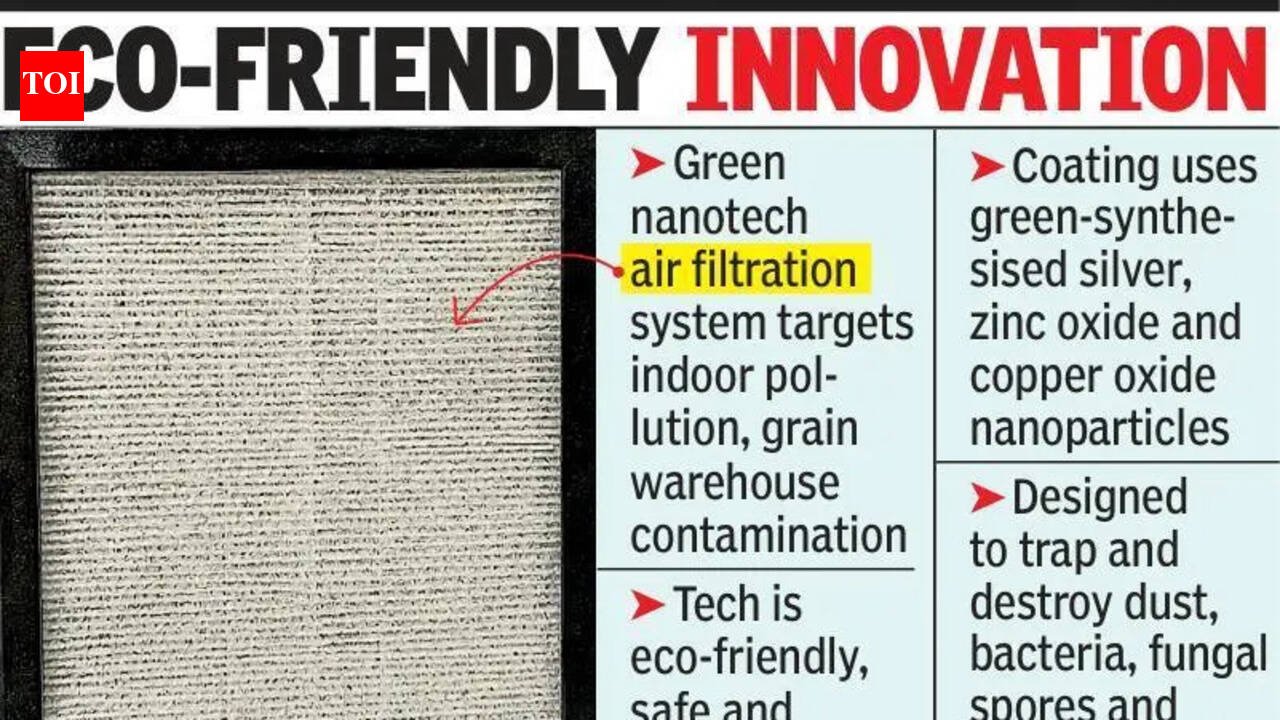
Nagpur: A team of researchers from Nagpur has received an official patent publication from Government of India’s Patent Office for developing an indigenous green nanotechnology-based air filtration system for indoor pollution and grain warehouses. The innovation is expected to significantly improve indoor air quality, reduce microbial contamination in grain storage facilities.Besides outdoor pollution, indoor air pollution has become a growing concern in schools, colleges, hospitals, offices and other public buildings, where airborne bacteria, fungal spores and biological particles pose serious health risks. Similarly, fungal contamination in grain storage facilities results in substantial post-harvest losses every year, threatening food security.The research team comprises Prof Darshan Talhande, assistant professor, Department of Botany, Sharadchandra College, Naigaon (Nanded); Ajinkya Borkar, researcher at Brijlal Biyani Science College, Amravati; Prof Dr Suvarna Patil, HoD, Botany, Taiwade College, Koradi, Nagpur; and Prof Dr Sachin Tippat, HoD, Environmental Science, Narsamma College, Amravati.The researchers developed a specialised antimicrobial filtration system coated with green-synthesised silver (AgNPs), zinc oxide (ZnO) and copper oxide (CuO) nanoparticles. Produced using plant extracts, these nanoparticles provide an eco-friendly coating that enables the filters not only to trap dust and microorganisms, but also destroy them.Field trials conducted in classrooms and office spaces recorded a 72.7% reduction in airborne bacterial load, with bacterial counts declining from 3,024 CFU/m³ to 824 CFU/m³. Fungal contamination dropped by 66.9%, from 2,082 CFU/m³ to 688 CFU/m³. In grain storage warehouses, bacterial and fungal loads were reduced by 68.3% and 68%, respectively.The study also demonstrated the effective control of harmful micro-organisms, including Aspergillus, Penicillium, Cladosporium, Alternaria, Bacillus, Staphylococcus and Pseudomonas, all of which are associated with many respiratory ailments, food contamination and grain spoilage.According to researchers, filters coated with silver nanoparticles proved most effective against bacteria, while zinc oxide nanoparticle-coated filters delivered best performance in controlling fungal growth. Since the nanoparticles are synthesised through green technology, the filtration system is environmentally friendly, safe and cost-effective.


