



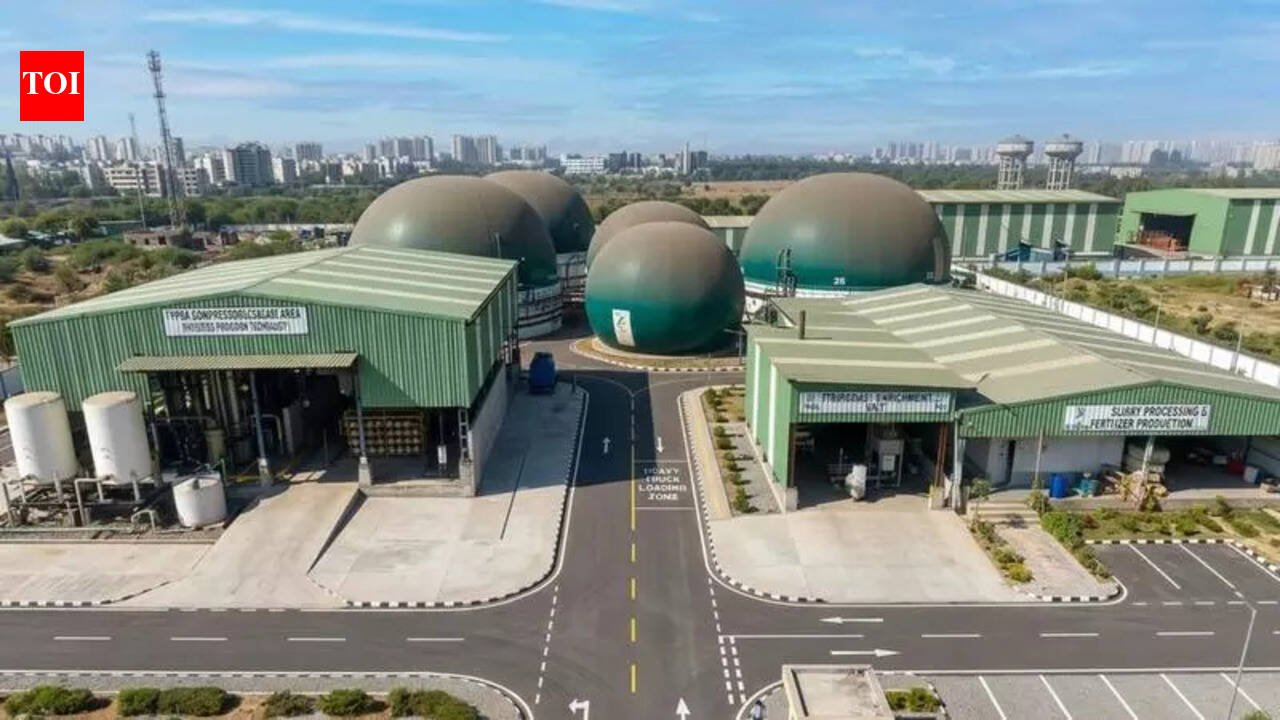
Surat: As the war disrupts the global fuel supply chain, affecting industries and households alike, the Diamond City has begun producing compressed biogas (CBG) from waste. Amid the ongoing gas crisis, the locally generated fuel will now be supplied to commercial gas distribution companies.Gas production at the Surat Municipal Corporation’s plant has reached two tonnes a day from around 50 tonnes of waste. With output crossing the two-tonne-per-day threshold, supply to the distribution company has begun. The project has been developed by the Surat Municipal Corporation (SMC) in public-private partnership with Biofics, an infrastructure developer that converts municipal organic waste into CBG and organic fertilizer. At full design capacity, the plant is expected to process 120 tonnes of waste per day and produce up to five tonnes of CBG daily. “The price of gas ranges between Rs 69 and Rs 90 per kilogram depending upon its quality. At full capacity, the output is equivalent to the daily fuel needs of around 130 CNG buses or the cooking energy needs of approximately 6,000-7,000 households,” said a Biofics official. “The project development started around a year ago and for the past six months it has started generating gas. It is an important project through which we are generating energy from waste,” said P H Umrigar, medical officer of health, SMC. The waste is sourced from around 500 bulk generators, including hotels, residential societies, commercial complexes, vegetable markets, food processing units and institutional kitchens. It is collected directly from the point of generation and transported to the plant for processing. “Waste should not go to landfills, but it should power economies. With the right infrastructure, cities can convert daily waste into a stable and reliable domestic energy source,” said Jayesh Patil, marketing head of Biofics. The project also produces slurry, which is processed into organic fertilizer for sustainable farming. “The plant and its core systems are indigenously designed and largely manufactured in India, aligning with the Make in India initiative and reducing dependence on imported technologies,” Patil added.


