






Srinagar, Aug 03: “There is no dichotomy between development and conservation. Nature itself is infrastructure,” Lieutenant Governor Manoj Sinha said on Monday, as he called for placing nature-based solutions at the centre of development planning to build climate resilience in the Himalayan region.
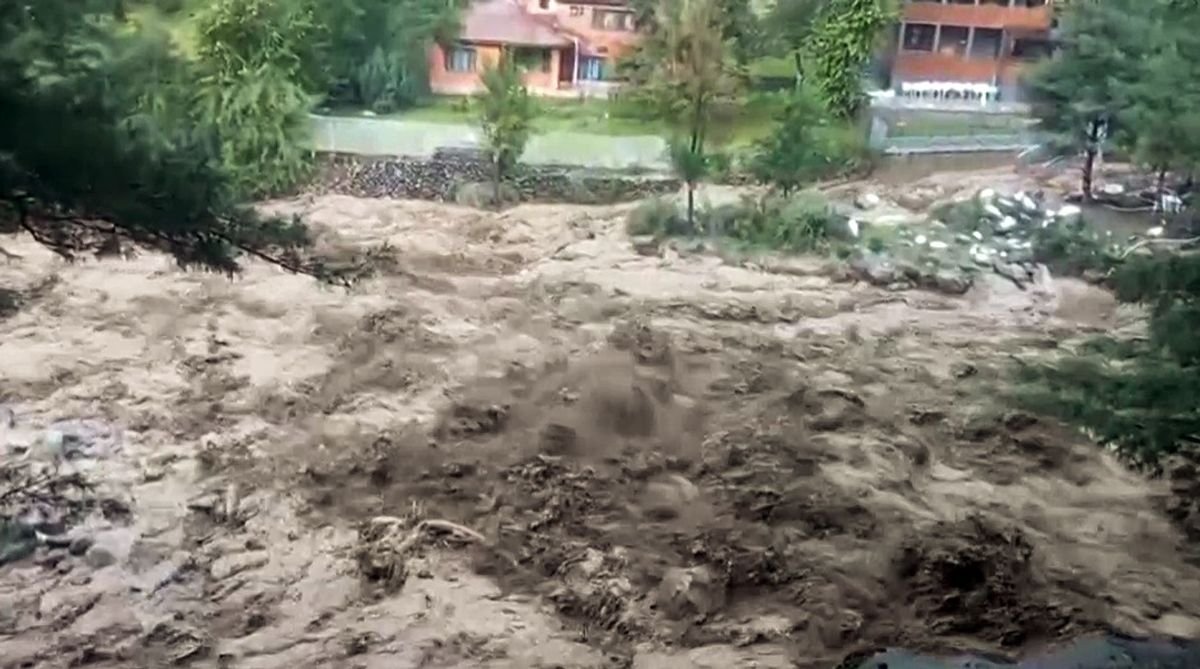
Addressing the Islamic University of Science & Technology (IUST) conference on Strengthening Climate Resilience and Livelihoods in the Himalayan Region through Nature-based Solutions, the Lieutenant Governor highlighted the alarming pace of climate change in the Himalayas, saying that between January and August last year, the region witnessed a natural disaster almost every day. In Jammu and Kashmir alone, flash floods and cloudbursts have damaged public infrastructure, disrupting roads, water supply schemes, and power feeders.
“Constructing a watershed is also an effective flood-control system. It is infrastructure that also serves as a water purification system and forms the basis of an irrigation system,” Sinha said. “Similarly, a wetland is nature’s vast reservoir because it absorbs excess water during the monsoon and then slowly gives life to surrounding areas during the dry months. A dense forested mountain slope is in fact like a strong wall that protects the entire mountain from collapsing onto the villages below.”
“Therefore, I believe that when we destroy these natural systems, we are playing with the future. But when we conserve and restore these natural systems, we are investing in a bright future,” he added.
The Lieutenant Governor placed six major recommendations before policymakers, scientists, and engineers. First, he called for the use of modern technologies like remote sensing, geospatial mapping, and AI to track glacier retreat, spring flow, soil health, and forest cover, and to ensure this data informs every development project in the region. Second, he urged that Nature-based Solutions be embedded into project budgeting, appraisal, and monitoring. Third, he stressed that farmers, shepherds, orchard owners, and tribal communities must be made equal stakeholders, as their generational knowledge of rivers, mountains, and forests is invaluable. Fourth, he recommended that annual budget reviews should include whether forests and ecosystems have grown richer or weaker, ensuring accountability for environmental wealth. Fifth, he called for the establishment of platforms for long-term cooperation among scientists, policymakers, and communities. Sixth, he advised moving beyond concrete embankments to restore floodplains and wetlands, combining built structures with natural systems.
LG Sinha urged universities to elevate Nature-based Solutions into a multidisciplinary subject, spanning ecology, hydrology, engineering, economics, disaster management, and traditional knowledge. He stressed that future professionals must understand the interconnectedness of ecosystems, economies, technologies, and societies.
Recalling the Green Jammu Kashmir Drive launched in 2020, which raised forest cover to nearly 55 percent, Sinha reiterated the importance of sustainable living. He envisioned a Himalaya where watersheds are healthier, wetlands thrive, and rivers flow naturally, sustaining biodiversity and culture.
“By placing nature at the centre of development, integrating modern technology with traditional wisdom, and involving communities as equal partners, the Himalayan region can build resilience against climate change. We must remember that Himalayas are not merely a geographical entity but a living heritage that demands foresight, patience, and responsibility,” he said.
On the occasion, the Lieutenant Governor inaugurated the Civil and Mechanical Engineering Block at the main campus, IUST’s Larmoo Campus, and the Law School. He congratulated IUST for their initiatives and lauded the University’s policy brief on the Drug-Free Jammu Kashmir campaign.
The LG also released the special edition of IUST’s monthly magazine ‘Times Echo’ on the 100-Day Anti-Drug campaign and the Policy Brief on Nasha Mukt Jammu Kashmir Abhiyan, prepared by various experts of J&K. Certificates were also handed over to PMKVY trainees.
Justice Sanjeev Kumar, Chief Justice (Acting), High Court of Jammu Kashmir and Ladakh; Prof Shakil A. Romshoo, Vice Chancellor, IUST; Prof Shamim Ahmad Shah, Registrar, IUST; Prof Javed Hussain Mir, Convener of the Conference; eminent scientists, experts, senior officials, faculty and students attended the conference.


