



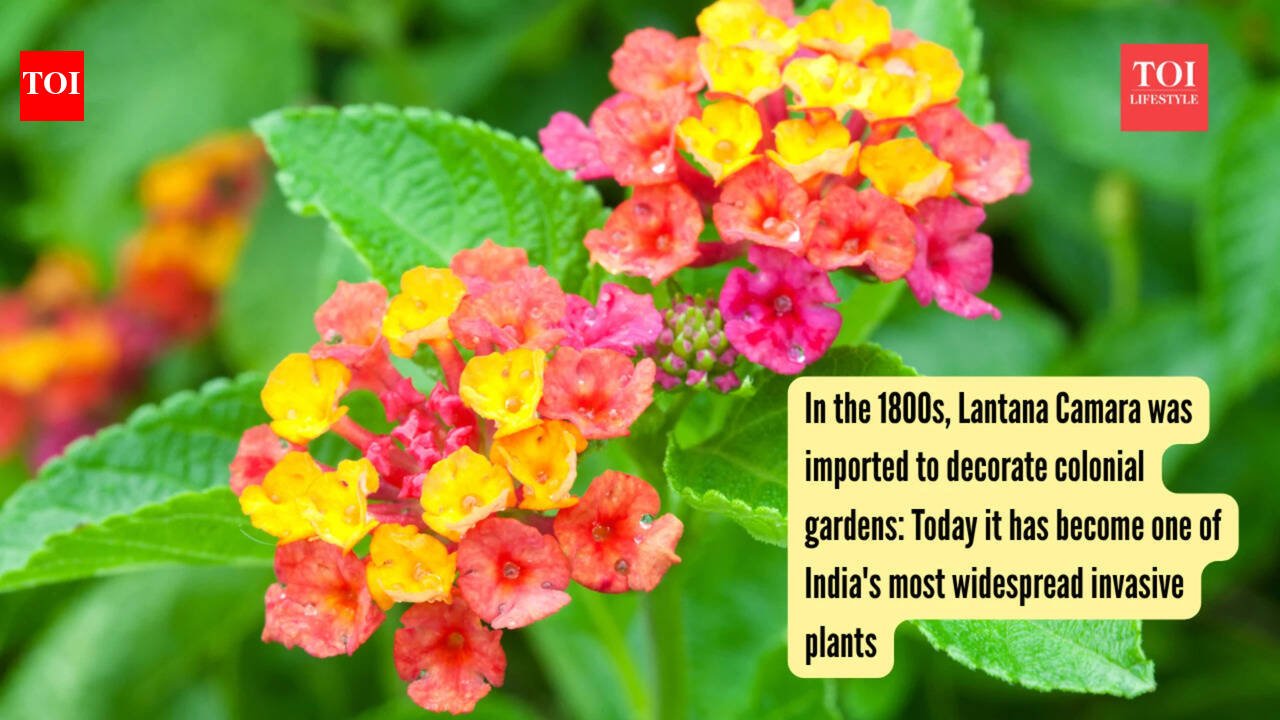
Two centuries ago, a British gardener probably admired its clustered pink-and-yellow blooms and thought it would look lovely around a garden hedge.Nobody could have guessed that this ornamental shrub would go on to outcompete some of India’s oldest forest cover on the ground, choke the undergrowth that herbivores depend on, and become one of the country’s most expensive conservation headaches.This yellow-pink clustered flower, Lantana camara, is easily spotted anywhere and grows recklessly without even being taken care of, so much so that every human eye keen on adoring nature’s beauty must have spotted it.This humble-looking plant, which was initially brought from the Americas in the 1800s only to adorn houses, has now taken over the forest cover that caters to a massive Tiger population of the country
A garden ‘jewel’ that turned into a forest predator
Lantana camara arrived in India as an ornamental plant in the early 1800s, for its bright, clustered flowers. Multiple hybrid varieties were brought in over time, and across 200 years these have interbred into a hardy complex capable of growing in several forms at once, as a woody vine climbing into the canopy, spread out as a shrub on the forest floor, or a dense entangling thicket. It now ranks among the world’s ten worst invasive species and is officially a species of major concern in India, competing aggressively with native vegetation for space, light, nutrients, and also changing and degrading soil chemistry wherever it settles.
Lantana now covers over 40% of total tiger habitat in India
A studypublished in Global Ecology and Conservation, led by researcher Ninad Mungi and colleagues, used data from India’s National Tiger Estimation Project to map the scale of the problem. Forest staff and biologists sampled over 117,000 plots across roughly 200,000 sq. km of forest in 18 tiger states. The results showed that lantana already occupies around 154,000 sq. km, or more than 40% of India’s tiger range, with the Shivalik Hills, fragmented central Indian forests, and the southern Western Ghats being the most impacted. Even Madhya Pradesh, which has India’s largest forest cover, has been substantially invaded.
Why lantana feels more at home in India than in America
Oddly, lantana appears to be thriving in India better than it does in its native Central American range. The study found that nearly 60% of its Indian population now grows outside the climatic niche it originally evolved in, tolerating warmer temperatures and higher moisture than it would naturally prefer.This adaptive flexibility helps it exploit changing climate conditions faster than native species can adjust. And when combined with forest degradation from roads, mining, and human disturbance, this gives lantana an edge. And degraded, warm, humid patches of forest are precisely where it spreads fastest, creating a feedback loop between human disturbance and invasion.
Lantana Camara decorating a garden hedge
The pretty looking flowering bush may now spread to other parts of India as well
Roughly half of India’s forests remain uninvaded so far, mostly in the northeast and pockets of Odisha, Chhattisgarh, Jharkhand, and Maharashtra. But models suggest an additional 44% of forest area is now at risk.Many of these last strongholds happen to overlap with land demarcated for dams, coal mining, and other development projects, meaning the very fragmentation these projects cause could open the door for lantana to move in.And what makes it majorly dangerous is that where it does invade, animals lose native forage plants, and those that eat lantana leaves risk muzzle allergies, diarrhoea, liver damage, or worse.
Fighting back is slow, costly, and only half-effective
Removing lantana is gruelling work. The plant must be uprooted rather than cut, since cutting alone triggers regrowth from the rootstock. Follow-up weeding is needed for at least two years afterward because seeds are already in the soil, and fresh ones dropped by birds like bulbuls keep reseeding cleared patches. Researchers estimate that clearing just one sq. km costs around 14 lakh rupees, meaning a nationwide effort would need roughly Rs.9,60,95,95,00,000.


