



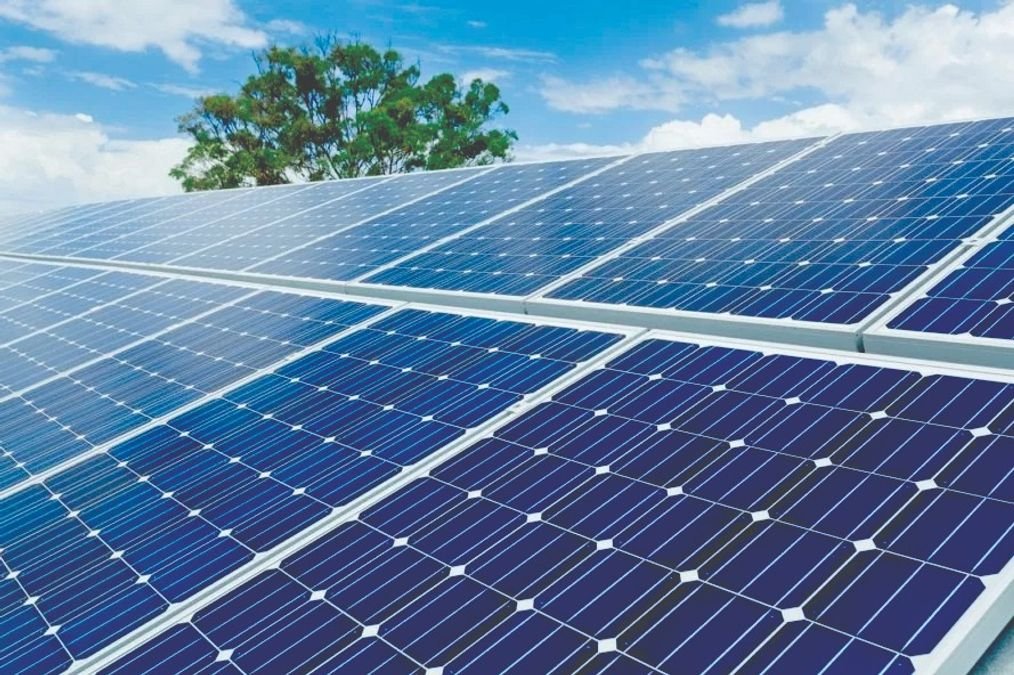
Srinagar, Sep 04: Jammu and Kashmir has stepped up efforts to identify large tracts of land for setting up large-scale solar parks, with potential sites being examined in Jammu, Samba, Poonch and other districts as the administration assesses their connectivity to the power grid and suitability for large-scale generation.
The Jammu and Kashmir Energy Development Agency (JAKEDA) has initiated the process of identifying sizeable land parcels for setting up utility-scale solar parks across the Union Territory.
An official from JAKEDA informed Rising Kashmir that the agency has written to Deputy Commissioners (DCs) in multiple districts to facilitate identification of large and suitable patches of land for development of solar parks, also known as utility-scale solar parks.
“Lands have been identified at several places, and their feasibility is being checked. We have written to the Deputy Commissioners of multiple districts to help identify more sizeable land patches,” the official said.
The official said the suitability of the land would depend on several factors, including availability of power infrastructure, proximity to grid stations, road connectivity and orientation of the land.
“The availability of a nearby grid station, road access and other transformation infrastructure are important considerations. The land should also be south-facing for a utility-scale solar project,” the official said.
He informed that land parcels have been identified in areas including Akhnoor, the Jammu belt, Samba and Poonch, while the feasibility assessment of these sites is in progress. The land requirement for such projects was substantial, with approximately 35–40 kanals required per MW of installed capacity, he said.
“Many lands have been identified so far, but feasibility has to be checked before any site can be considered suitable for a solar park,” the official said.
JAKEDA is also exploring possibilities for identifying land parcels in Kashmir. However, the official said some of the smaller patches identified in Budgam may not be suitable for a utility-scale solar park because of the requirement for a contiguous and sufficiently large land parcel.
“If we come up with a small project, it won’t be fruitful. For a utility-scale solar park, we need sizeable and suitable land,” the official said.
The agency is simultaneously looking at the possibility of smaller decentralised solar projects under emerging government schemes. The official said some components of schemes likely to be introduced, including PM KUSUM 2.0, could provide opportunities for farmers to establish smaller solar projects.
“Some ministry schemes are likely to be launched, and components of these schemes may provide relief. Farmers could potentially establish small projects of around one MW, which can help in promoting solar generation on smaller land parcels,” the official said.
The ongoing exercise is aimed at determining the technical and logistical feasibility of sites before any final decision is taken on the establishment of utility-scale solar parks in J&K.
A few months ago, Chief Secretary Atal Dulloo reviewed the feasibility of establishing a large-scale Solar Park in Jammu & Kashmir under the Ministry of New & Renewable Energy’s (MNRE) Solar Park Scheme and directed the divisional administrations to expedite the identification of suitable, encumbrance-free land parcels for the project.
Taking a district-wise review, the Chief Secretary had stressed the importance of identifying sizeable land patches that are not earmarked for other developmental works and can be swiftly transferred for establishing clean energy infrastructure in the UT.


