



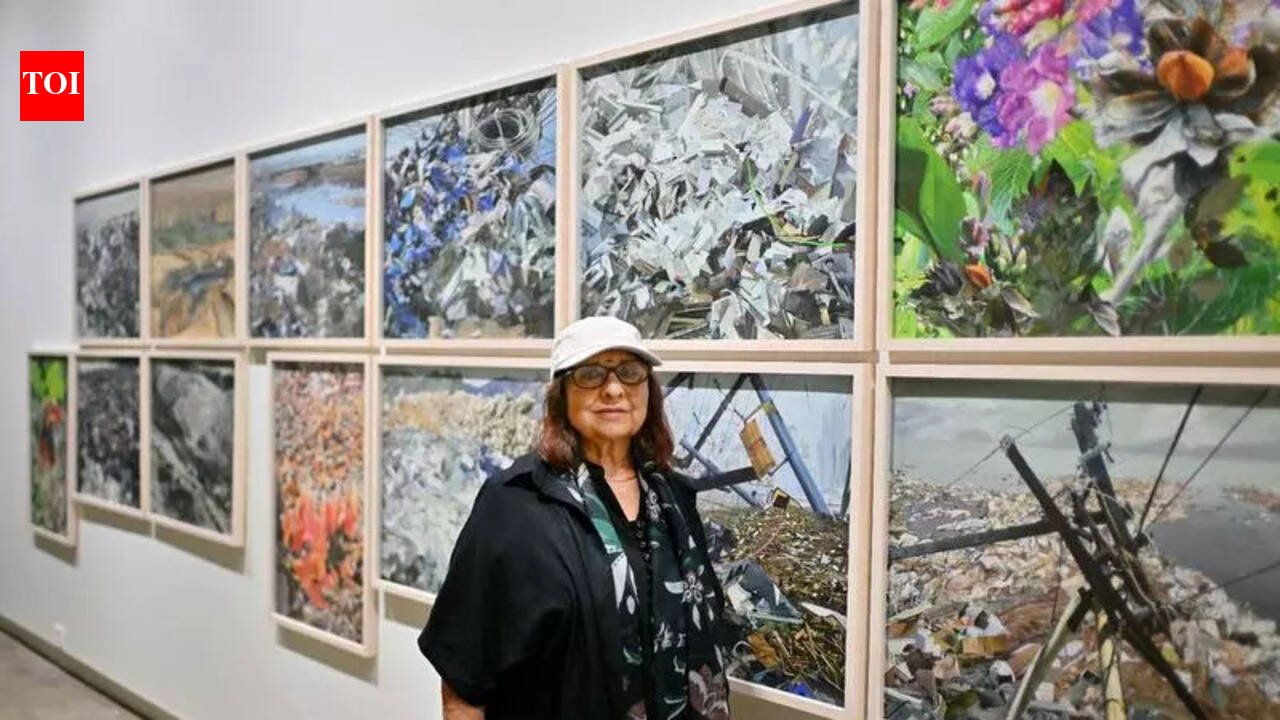
Landfills first revealed themselves to artist Navjot Altaf not in a city, but in a forest. She and activist friends from the Koyla Satyagraha travelled through Bastar several years ago when they stopped at a viewpoint along a tributary of the Mahanadi River, where elephants usually paused to drink. It was a beautiful place, and Altaf took in the view.“As I was looking at the landscape, I saw a huge pit to my left, as large as half a taalaab (pond). And in it were broken TV sets, radios… at least two truckful,” says the artist, who lived and worked in Bastar since 1997. “We saw ash dykes for miles in the area because of coal mining. But now, we started to see the same waste in forests that we saw in cities. And not just any waste, but electronic waste. That’s when I started looking at landfills carefully.“She began studying them with the compound eye of an environmentalist, cultural historian, material archivist, and social activist—reading in those palimpsests of cardboard packaging, leaking batteries, plastic food tubs, and tangled wire both contemporary history and prophecy. “I started looking at landfills not just as sites of discard, but as layered histories of human desire; histories that are inscribed in the very matter of that earth.”She presents this exegesis in a new body of work titled Waste Archives as Landscape, now on view at the Chhatrapati Shivaji Maharaj Vastu Sangrahalaya (CSMVS). The exhibition, curated by Puja Vaish, comprises 30 works in gouache on paper, along with two installations and two video works created over the past three years.One installation, Take-Make-Waste, resembles a kind of Tetris made of large pipes mounted on the ceiling and operated by a hidden motor. It mimics supply chains that convey product parts in an unending ballet of production, only to spew out a steady stream of mounting waste at one end. “I took the title from the linear economy, which believes that you can extract as much as you can, shape it into objects for brief use, and then discard them.” The maze also alludes to global waste trade routes that ship waste from richer economies to poorer ones, risking their public health and environmental safety. As landfills multiply, they begin to transform from geological lookalikes into actual landscapes. This gradual usurpation consumes potential habitats, stifling spaces where biodiversity might otherwise have thrived. “The landfill, to me, appears as a sublime grotesque,” she writes. “A theatre where beauty and horror entwine. It is a landscape that insists on presence, that refuses to vanish even when buried.”Altaf’s field studies took her to the landfills at Deonar and Kanjurmarg in Mumbai, and to the Pirana Landfill (Mount Pirana) near Citizen Nagar in Ahmedabad. The latter is the setting for Instinct, an animated short that captures the cries of a dying dog, presumably affected by something toxic it consumed at the landfill.The artist’s new work extends themes she explored in earlier projects such as Soul Breath Wind and Barakhamba, which “look at things that are destroying the ecological rhythm.” Mined minerals eventually reappear as mountains of e-waste, in a kind of Frankensteinian reshaping of the earth.Ultimately, Altaf notes, it is not only power systems—industrial and govt, global and regional—that create markets and landfills for ‘things’, but consumers who are also complicit in this ‘landscaping’. We became dependent on conveniences that generate such waste, she says. “Even in villages, what appears like fields of white flowers are actually plastic as you draw near.”Flowers also appear in her gouache works—a first for Altaf—tightly framed and juxtaposed with images of trash. When the leaves of a plant fall, she says, they may appear like ‘waste’ on the ground. “But what this waste does and what that waste does,” she says, referring to landfill waste, “is that the minutest component of that waste can contaminate the soil and the water, while on this side, fallen leaves and flowers sustain biodiversity.” The ecofeminist lens Altaf brings to her work reminds viewers “to nurture the environment in ways that allow all living beings to exist.” Embedded in this worldview is the principle of consuming less. “I’m against the model of progress driven by the global economy where you have relentless production, relentless consumption, then relentless waste,” she says. “The way to prosperity is not the accumulation of goods—that’s the patriarchal way.“


