



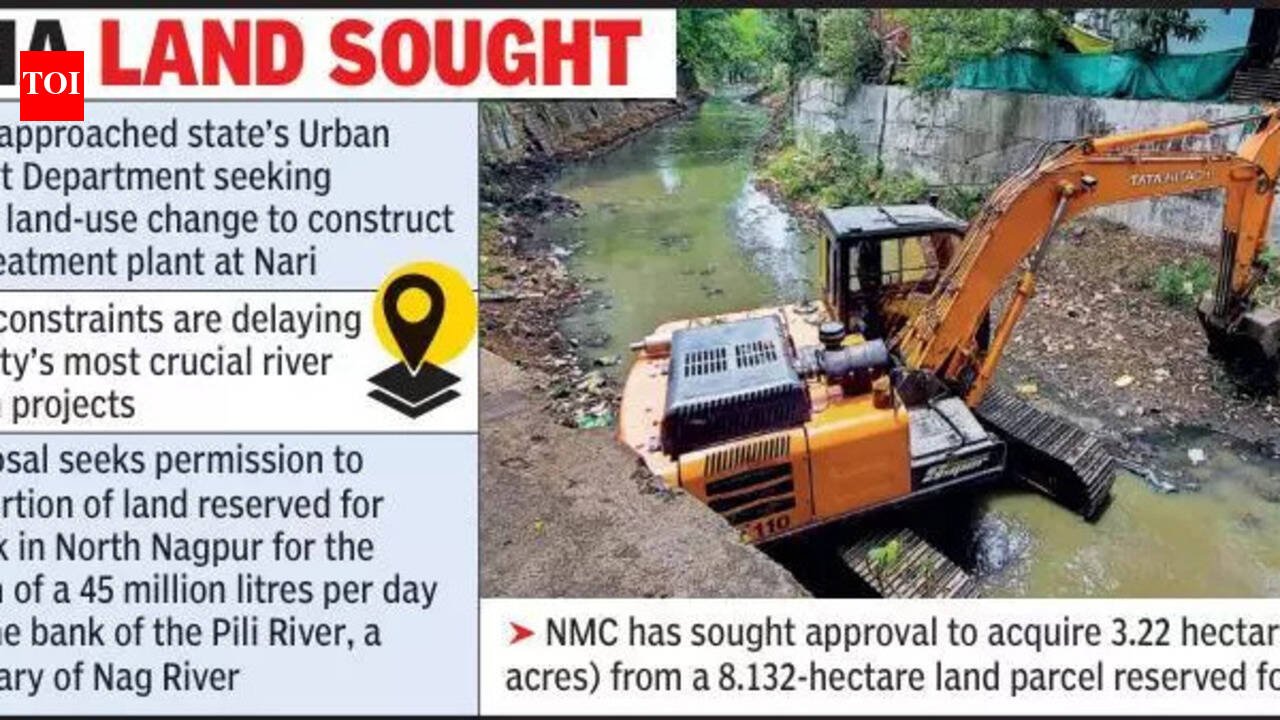
Nagpur: With the on-ground work of ambitious 1,927 crore Nag River Pollution Abatement Project yet to take off, the Nagpur Municipal Corporation (NMC) has approached the state’s Urban Development Department (UDD) seeking approval for land-use change to construct a sewage treatment plant (STP) at Nari. The move highlights the land constraints delaying one of the city’s most crucial river rejuvenation projects.The proposal, recently sent to the UDD in Mumbai, seeks permission under Section 37 of the Maharashtra Regional and Town Planning (MRTP) Act to convert a portion of land reserved for a public park in North Nagpur for the construction of a 45 million litres per day (MLD) STP along the bank of the Pili River, a major tributary of the Nag River.The project is part of the Nag River Pollution Abatement Project, which aims to intercept untreated sewage flowing into the river and divert it to treatment plants before discharge. The initiative was widely projected as a dream project of Union minister Nitin Gadkari to revive Nagpur’s polluted river system.Despite receiving administrative approval from the Maharashtra govt on March 14, 2023, the project is yet to witness any major on-ground pollution abatement work.Under the latest proposal, the civic body sought approval to acquire 3.22 hectares (around 8 acres) from a 8.132-hectare land parcel reserved for a park. The land falls under the planning jurisdiction of the Nagpur Improvement Trust (NIT), which has already issued a no-objection certificate to the civic administration.Officials said the proposed land parcel involved around 22 different landowners, including three govt agencies such as NMC and NIT, making the acquisition process complicated and time-consuming.The delay in securing land also affected plans to construct other sewage treatment plants under the project. Initially, the NMC proposed setting up a 12 MLD STP on five acres at Visvesvaraya National Institute of Technology (VNIT) and another 35 MLD facility on six acres at Dr Panjabrao Deshmukh Krishi Vidyapeeth (PDKV) to treat sewage generated in central parts of the city before it entered the Nag River.However, both institutions reportedly expressed their inability to spare land for the facilities, forcing the civic administration to look for alternative locations.The NMC’s public health engineering department, in coordination with Tata Consulting Engineering, worked on identifying suitable sites and forwarded proposals to the town planning department and the UDD for necessary approvals.Once implemented, the project is expected to significantly reduce the flow of untreated sewage into the Nag River by intercepting wastewater and diverting it through sewer networks to treatment plants.However, with land acquisition issues still unresolved and construction yet to begin nearly two years after administrative approval, concerns are growing that the much-publicised river clean-up project may face further delays.


