






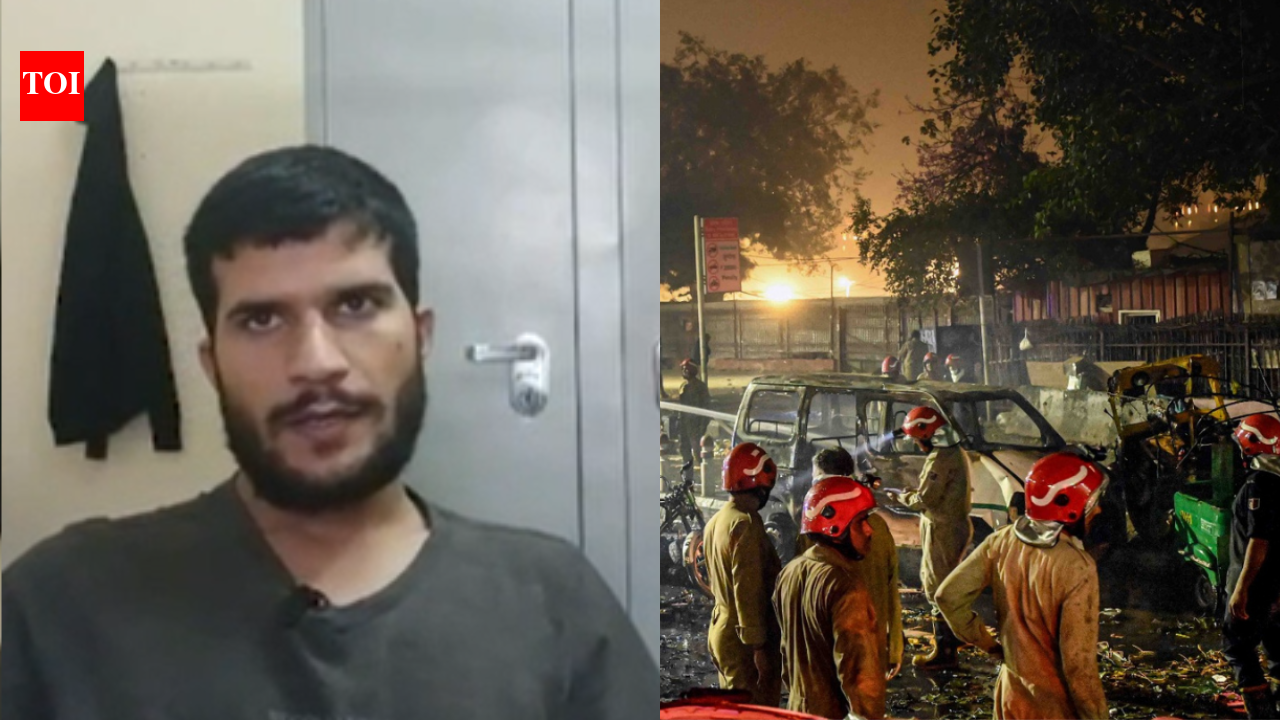
NEW DELHI: On Nov 10 last year, 13 minutes before the explosive-laden i20 exploded near Red Fort, bomber Umar-un-Nabi tried to park the car near ‘Lal Mandir’ in Chandni Chowk — suggesting it was the first target — but was diverted due to heavy traffic and police presence there. CCTV footage captured him attempting to park at 6.37pm, after which he took a U-turn and reached near Gate No. 4 of Red Fort, where he triggered the IED at 6.50pm.The details are part of the chargesheet recently filed by National Investigation Agency (NIA) in connection with the Red Fort blast. The chargesheet provides extensive details of the planning and execution of the first-ever vehicle-borne IED (VBIED) attack reported in the national capital.NIA has said the VBIED was detonated through a remote ‘command mechanism’ fitted in one of the shoes of the bomber, Umar-un-Nabi. A metal piece attached to the heel of one shoe was found adjacent to the i20 used by Umar, and it tested positive for triacetone triperoxide (TATP), potassium and ammonium nitrate. The other exhibits from this car included a nasal orifice swab matched with the DNA of Umar’s pare-nts, confirming his iden-tity as the bomber, the chargesheet stated.Further, a forensic report of the blast reported in Nowgam, J&K, on the explosives seized from Umar’s associates from Faridabad also tested positive for the same chemicals, confirming the module’s existence.“The yield (impact) of TATP and its stability also depends on its storage in a cold environment and presence of 10% water. Witnesses have deposed that Umar used to keep his room extremely cool, and that a foul smell used to emanate from it. He and others had also purchased collapsible water bags, which were used to keep the prepared TATP under wet conditions to keep it safe. Water was regularly added to the IED to keep the explosive mixture stable,” the chargesheet said.The post-mortem reports of the victims furnished by the hospital ascertain the cause of death to be “high-intensity blast wave effect”. The blast, the chargesheet said, led to the death of 11 people and injuries to 29. Damage to the nearby structures amounted to Rs 17.7 lakh, as assessed by authorities like DMRC, ASI and PWD, it added.NIA found that on Oct 30, Umar met an acquaintance behind Al Falah hospital, gave him his room key and asked him to bring his “shoes” from the almirah in the room. “He was already wearing his shoes at the time. He was visibly distressed as J&K police had raided the module by then,” said the chargesheet.While on the run, Umar was storing his urine in a polythene bag, as observed by the woman who owned the house in Nuh where he had sought shelter. “He did not go outside to dispose of it and thus a foul smell was emanating from the room, prompting the woman to complain to her husband,” the chargesheet said.“Interestingly, an innovative method for preparing explosive substances using urea nitrate has been elaborated in a PDF material seized from the pen drives of the accused wherein an alternative method for the source of urea is mentioned as — ‘extracting urea from urine’.”It also mentioned the seizure of a terror manual, “Lone Mujahid Pocket Book”, which was published in “Inspire” magazine, affiliated with Al-Qaeda in the Arabian Peninsula (AQAP), being followed by the module. NIA said the manual provided operational information related to explosives, weapons, vehicles, arson and covert activities, with detailed chapters on TATP and remote-control mechanisms for detonating IEDs.On Nov 7, Umar also bought a new T-shirt, a wine-coloured shirt and green-coloured cargo pants by making payment in cash to a shop in Nuh, the chargesheet said.


