



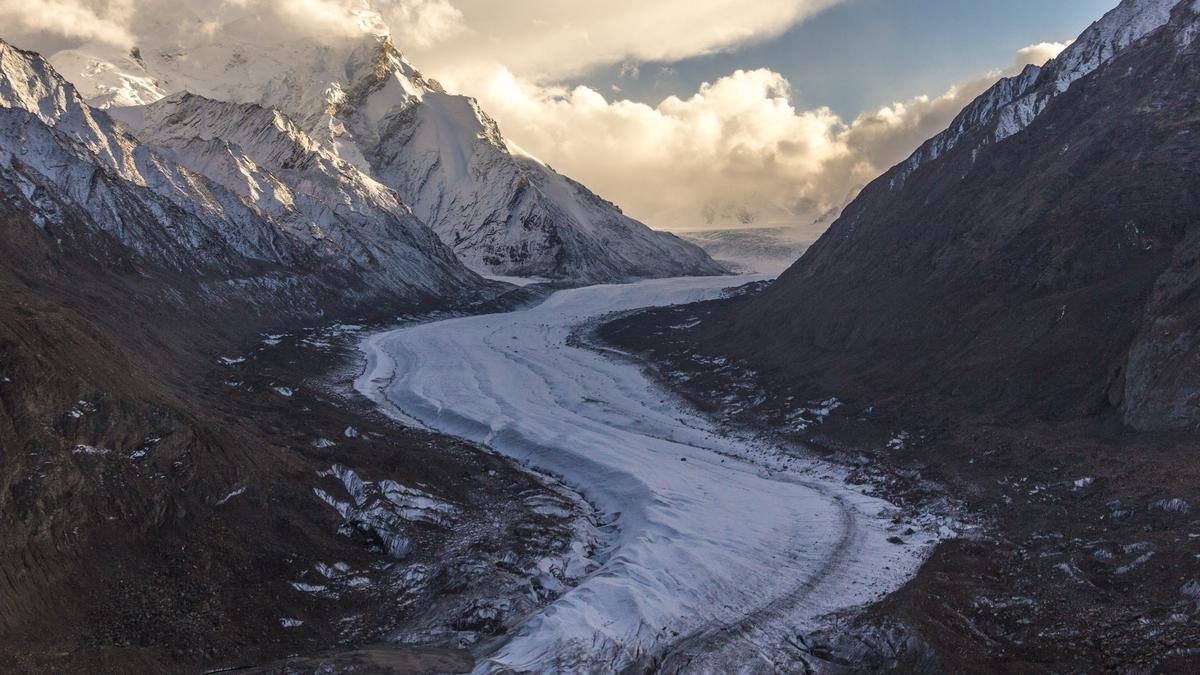
Glaciers look still — but in reality they are constantly moving as they slowly carry ice from high mountains to the lower reaches.
A new study has reported that glaciers in the Zanskar region of Ladakh are now moving more slowly than they did 30 years ago, offering new clues about how climate change is affecting these giant ‘rivers of ice’.
The Zanskar region is home to some of the largest, most extensive glaciers in the Himalaya. They are natural reservoirs of freshwater, which they release as meltwater in the warmer months. This seasonal supply sustains rivers, ecosystems, agriculture, and local communities in the otherwise arid environment of Ladakh.
The glaciers “receive most of their snowfall from the mid-latitude westerly disturbances during winter,” study co-author and IIT-Bombay doctoral student Tirthankar Ghosh said. “Most of the glaciers are located at quite a high altitude compared to other regions. This unique climatic setting means that their response to climate change can differ from glaciers in the eastern or central Himalaya, making them valuable natural indicators of environmental change.”
Rate of slowing
In their paper, in the journal The Cryosphere, the researchers described investigating how glacier flow changed from 1992 to 2023 across 12 glaciers in the Zanskar Himalaya and how these changes relate to ongoing glacier thinning due to climate change.
They used satellite data to derive the glaciers’ surface velocities, which determine how efficiently ice is transferred from the high accumulation zones to the lower elevations, where melting is greatest.
“When a glacier loses more ice than it gains over many years, it generally becomes thinner,” Mr. Ghosh said. “Thinner ice exerts less driving force, causing the glacier to flow more slowly. This is why changes in glacier velocity can reveal important changes within a glacier.”
The researchers found that glaciers were moving more slowly across the terrain, having slowed by 2.4 m/year per decade on average. The team also found the pace of surface thinning had increased from around 0.22 m/year between 2000 and 2005 to around 0.57 m/year between 2015 and 2020.
The study also reported that the glaciers were not all responding to warming in the same way. Factors such as glacier geometry, debris cover, and conditions at the glacier’s terminus (or snout) can all influence how quickly it flows, Mr. Ghosh said.
‘The study helps explain not only what is happening to Himalayan glaciers but also the physical mechanism behind those changes.’
| Photo Credit:
Tirthankar Ghosh
‘Ice transport slows’
Mehnaz Rashid, a lecturer of environmental management and sustainability at the University of Teesside, the U.K., said a major strength of the study is its long observational record, covering more than 30 years. Dr. Rashid was not associated with the study.
While most Himalayan studies have focused on glacier retreat or mass loss, which are important indicators of climate change, Dr. Rashid said the new study linked three processes — mass loss, glacier thinning, and glacier flow — to show that thinning is not just a consequence of warming but also changes the glacier’s ability to move.
“As glaciers become thinner, the driving stress decreases, and ice transport slows,” she explained. “That means the lower parts of the glacier receive less replenishment from higher elevations, which can make continued shrinkage more likely. In that sense, the study helps explain not only what is happening to Himalayan glaciers but also the physical mechanism behind those changes.”
On a different note, Rayees Ahmed, project scientist at the Divecha Centre for Climate Change, Indian Institute of Science, Bengaluru, said the study focused on 12 representative glaciers whereas the Zanskar basin hosts around 1,755. So while the glaciers the researchers studied do cover a range of settings, he advised caution before extending the findings to every glacier in Ladakh.
“Surface velocity observations derived from satellite imagery also cannot directly reveal processes occurring beneath the glacier, such as subglacial hydrology or basal sliding, which can strongly influence glacier motion,” he said. “In addition, long-term field measurements of ice thickness, glacier mass balance, and bed conditions remain limited in this region, making it difficult to fully attribute all observed changes.”
Effect on Indus basin
That said, according to Dr. Ahmed, glacier thinning and slowdown have important long-term implications for the Indus basin, where glacier melt contributes significantly to river flows during the dry summer months. More melting may temporarily increase runoff, a phenomenon called peak water — but once glaciers lose a substantial fraction of their stored ice, the meltwater contributions are expected to drop.
“This does not mean the Indus basin will immediately experience water shortages solely because glaciers are slowing down. River flows also depend on snowfall, rainfall, groundwater, and water management,” Dr. Ahmed explained. “Nevertheless, continued glacier thinning and slowdown are clear indicators that long-term glacier water storage is declining, which could have important implications for water security, agriculture, hydropower, and downstream ecosystems in the coming decades.”
Similar glacier slowdowns have been reported across the European Alps, Alaska, the Canadian Arctic, the Andes, and parts of the Tibetan plateau. Most of these regions have a similar dominant mechanism: as glaciers become thinner, they experience lower driving stress, causing them to flow more slowly.
“However, there are important exceptions,” according to Dr. Ahmed. “Some glaciers can temporarily accelerate due to increased meltwater reaching the glacier bed, glacier surges or interactions with proglacial lakes or marine environments. Therefore, while glacier slowdown is becoming increasingly widespread, local glacier characteristics still play an important role in determining individual glacier behaviour.”
The experts emphasised in their paper that they need long-term observations to understand how glaciers respond to climate change over decades. And while satellite observations have greatly improved glacier monitoring, Mr. Ghosh said more ground-based measurements of glacier thickness, mass balance, ice temperature, and meltwater discharge are required to validate satellite data and improve glacier models.
“Continuous weather observations at high elevations are also critical because climate conditions can vary considerably across mountainous terrain,” he added.
Hirra Azmat is a Kashmir-based journalist who writes on science, health, and environment.


