






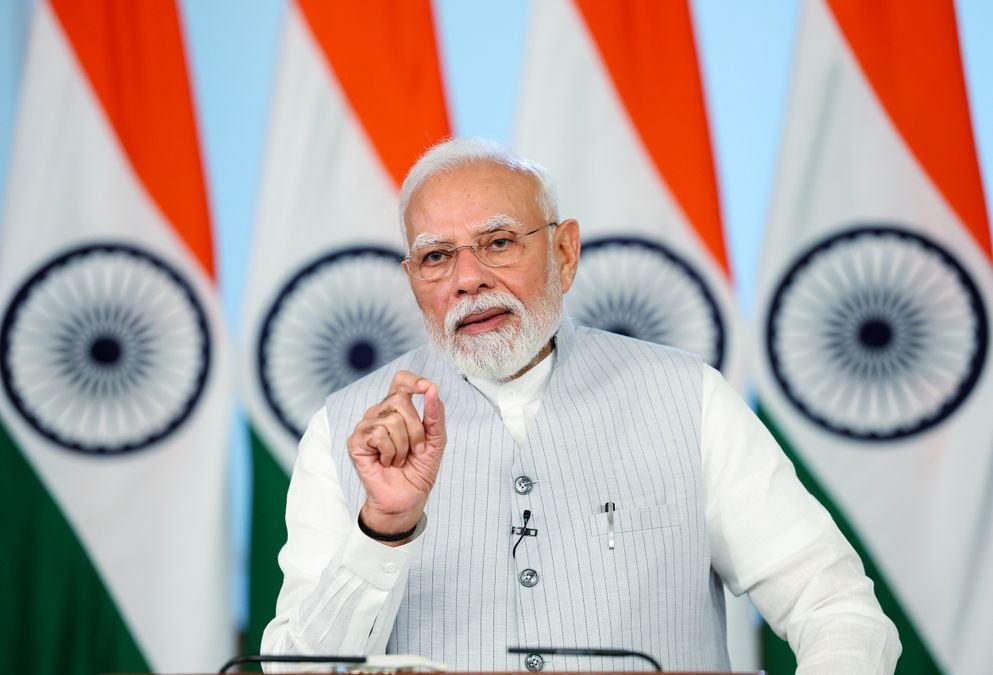
Leh, Oct 15: Asserting that Ladakh’s development is a top priority for the Centre, Prime Minister Narendra Modi on Thursday virtually inaugurated five development projects worth around Rs 3,350 crore, spanning airport infrastructure, strategic road connectivity, hydropower, transmission and heritage conservation. The PM cited figures to show the Union Territory’s road network has more than doubled since 2019, major bridges have risen from 19 to around 75, tap-water coverage has expanded from 3.5 per cent to nearly 99.9 per cent of households, and helipads have increased from seven to more than 40.
Addressing the UT after the inaugurations, Modi said special attention is being given to the youth of Ladakh so that they get quality education, gain opportunities to learn new technologies, and no longer need to migrate to other cities. Highlighting the construction of a major centre of excellence in Leh alongside advancing proposals for satellite campuses of IIT Jammu and IIM Jammu, he said these premier institutions will equip local students with advanced research and modern technological skills at their doorstep.
“Our special focus is on the new generation of Ladakh. The youth of Ladakh will now be able to get better opportunities for higher education, research, and new skills right in their own region,” he said.
The projects inaugurated include a new passenger terminal at the Kushok Bakula Rimpochee Airport in Leh, built at a cost of around Rs 640 crore. Incorporating geothermal energy to enhance energy efficiency and reduce its carbon footprint, it is India’s first airport terminal equipped with geothermal heating facilities. Modi said the facility would raise the airport’s annual passenger-handling capacity from around 10 lakh to 35 lakh, with the number of flights potentially rising threefold, giving a significant boost to tourism and business.
The Prime Minister also dedicated to the nation the 298-km-long Nimmu-Padum-Darcha Road, constructed by the Border Roads Organisation (BRO) at a cost of approximately Rs 2,500 crore, which is expected to cut journey time on the route from nearly 12 hours to around three hours, benefiting residents, trade and the movement of goods. He also inaugurated a 9 MW Hanu small hydroelectric project and the 66 kV double-circuit Dah-Hanu-Khaltsi transmission line, stressing that reliable electricity could transform everyday life by improving education, healthcare and small businesses. Work on harnessing geothermal energy in the Puga Valley, he said, was also progressing.
Besides, Modi inaugurated India’s first Petroglyph Conservation Park at Sindhu Ghat in Leh and 40 water bodies developed across 40 villages under Project Him Sarovar, which he said would help meet irrigation needs and support farmers.
“Today, the development of Ladakh is a top priority for the Central government. I extend my heartiest congratulations to all the people of Ladakh for these projects. I also congratulate all the engineers, workers and local colleagues involved in these projects. I especially appreciate the colleagues of the BRO,” Modi said.
Citing figures to underline the scale of infrastructure expansion since 2019, the Prime Minister said Ladakh’s road network had grown from around 1,800 km to more than 4,000 km, major bridges had increased from 19 to around 75, helipads from seven to more than 40, and hospital bed capacity had doubled. He also pointed to the ongoing Zojila Tunnel project, saying it would improve year-round connectivity between Ladakh and the rest of the country once completed.
Addressing a long-standing regional demand for closer judicial access, Modi said the government in August officially approved the establishment of a high court bench for Ladakh, which will streamline both governance and legal recourse for citizens. “This will make the justice system accessible alongside administration,” he said.
On livelihoods in remote border villages, he said more than 40 border settlements are being upgraded under the Vibrant Villages programme to stimulate grassroots economic activity and create employment even in far-flung villages. He said the number of homestays in Ladakh had increased from around 150 to nearly 3,000, while the region now has approximately 11,000 greenhouses, creating new opportunities for farmers.
Modi also said Ladakh has immense potential in sports, with the youth carving out a unique identity in ice hockey, winter sports and mountaineering. He expressed pleasure that efforts are being made to promote sporting talent through the new sports policy. “Our effort is to ensure that the youth receive better training and facilities, and achieve new accomplishments at national and international levels,” he said.
Emphasising the role of digital connectivity in driving modern commerce for hotels, restaurants, homestays and local crafts, Modi detailed the expansion of BharatNet and high-speed internet across remote pockets. Continuous efforts are underway, he said, to ensure seamless access to e-governance, online education and global market integration for local entrepreneurs. “Today, online business is opening new avenues of income,” he said.
Praising the craftsmanship of local artisans and farmers, the Prime Minister shared how he frequently gifts Ladakhi products to world leaders, including the German chancellor and the Swedish prime minister. He stressed that the government is actively strengthening Pashmina’s global identity and expanding market branding for regional goods, and highlighted the commercial potential of pashmina, seabuckthorn, handicrafts and apricots, noting that the Geographical Indication tag for Ladakh’s apricots could improve branding and ensure better returns for producers.
Alongside economic development, Modi stressed the need to protect Ladakh’s cultural heritage, saying the petroglyph conservation park would help preserve ancient rock carvings and introduce future generations and international visitors to the region’s history.
Expressing optimism for the UT’s trajectory, he said, “Together, we will take Ladakh to new heights of development.”


