



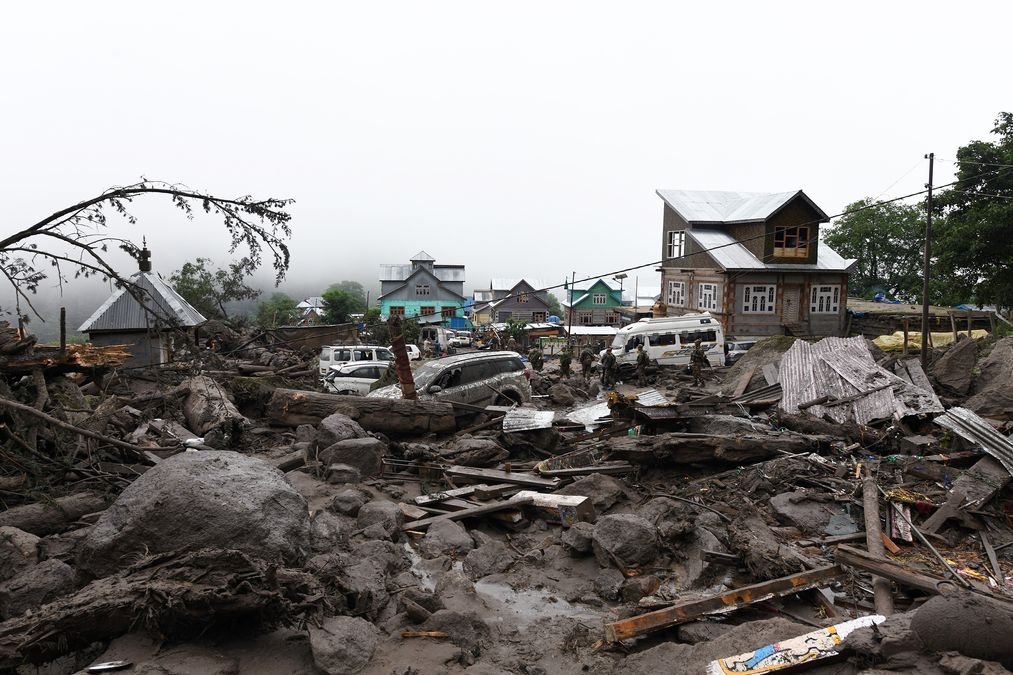
Srinagar, Aug 09: Jammu and Kashmir’s climate is undergoing a dramatic transformation, with Kulgam, Shopian and Baramulla districts emerging as the Valley’s newest cloudburst hotspots in what experts describe as an alarming shift in extreme weather patterns.
Official data reveal that 40 cloudburst incidents have been reported across Jammu and Kashmir since June 1 this year, claiming 34 lives and causing widespread damage to homes, roads, bridges, agricultural land and public infrastructure. While the mountainous districts of Doda, Kishtwar and Ramban have historically remained vulnerable to such disasters, this year has seen an increasing number of cloudbursts striking areas of south and north Kashmir that were previously considered relatively less prone.
Recent weeks have witnessed cloudburst incidents in Kulgam’s Nandimarg, Shopian’s Pehripora and Baramulla’s Uri besides several other locations across the Union Territory. The changing geographical spread has raised fresh concerns among scientists and disaster management experts, who warn that extreme weather events are becoming both more frequent and less predictable.
Climate expert Dr Touseef Ahmad Bhat said the growing number of cloudbursts reflects the impact of a rapidly warming atmosphere.
“Warmer air can hold significantly more moisture. When that moisture is released over mountainous terrain, it often results in short-duration, extremely intense rainfall capable of triggering flash floods and cloudbursts. Kashmir is witnessing the fingerprints of climate change much more clearly than before,” he said.
Dr Bhat said the expanding pattern of cloudbursts in districts like Kulgam, Shopian and Baramulla suggests that no part of the Valley can now be considered immune to such events.
“We need to move beyond treating cloudbursts as isolated disasters. They are becoming part of a changing climatic reality, demanding better forecasting systems, scientific hazard mapping and stronger community preparedness,” he added.
Senior environmentalist Dr Tanvir Ahmad Khan said the increasing frequency of cloudbursts is being amplified by ecological degradation and unplanned development.
“Our fragile mountain ecosystems have been weakened by shrinking forests, encroachment on natural drainage channels and unchecked construction. Climate change is intensifying rainfall, but human interference is magnifying its destructive impact,” he said.
He stressed that protecting forests, wetlands and natural watercourses should become a central part of disaster mitigation strategies.
“If we continue disturbing natural landscapes, the intensity of disasters will only increase. Ecological restoration must go hand in hand with climate adaptation,” Dr Khan said.
Independent weather forecaster Faizan Arif said weather patterns over Jammu and Kashmir have changed considerably over the past few years.
“The atmosphere has become much more unstable during the summer months. Increased moisture incursion, rising temperatures and local topography are creating favourable conditions for high-intensity rainfall events. Places that rarely experienced cloudbursts are now witnessing them with increasing frequency,” Arif said.
He emphasised that improved weather monitoring, timely public advisories and greater awareness at the community level would be crucial in reducing the loss of life during future extreme weather events.
Experts say the emerging trend demands a shift in disaster management policies, with greater focus on climate resilience, early warning systems, watershed management and regulating construction in vulnerable zones.
As climate change accelerates across the Himalayas, they warn, Kashmir’s new cloudburst hotspots may offer a glimpse of a future where extreme weather becomes the norm rather than the exception.


