



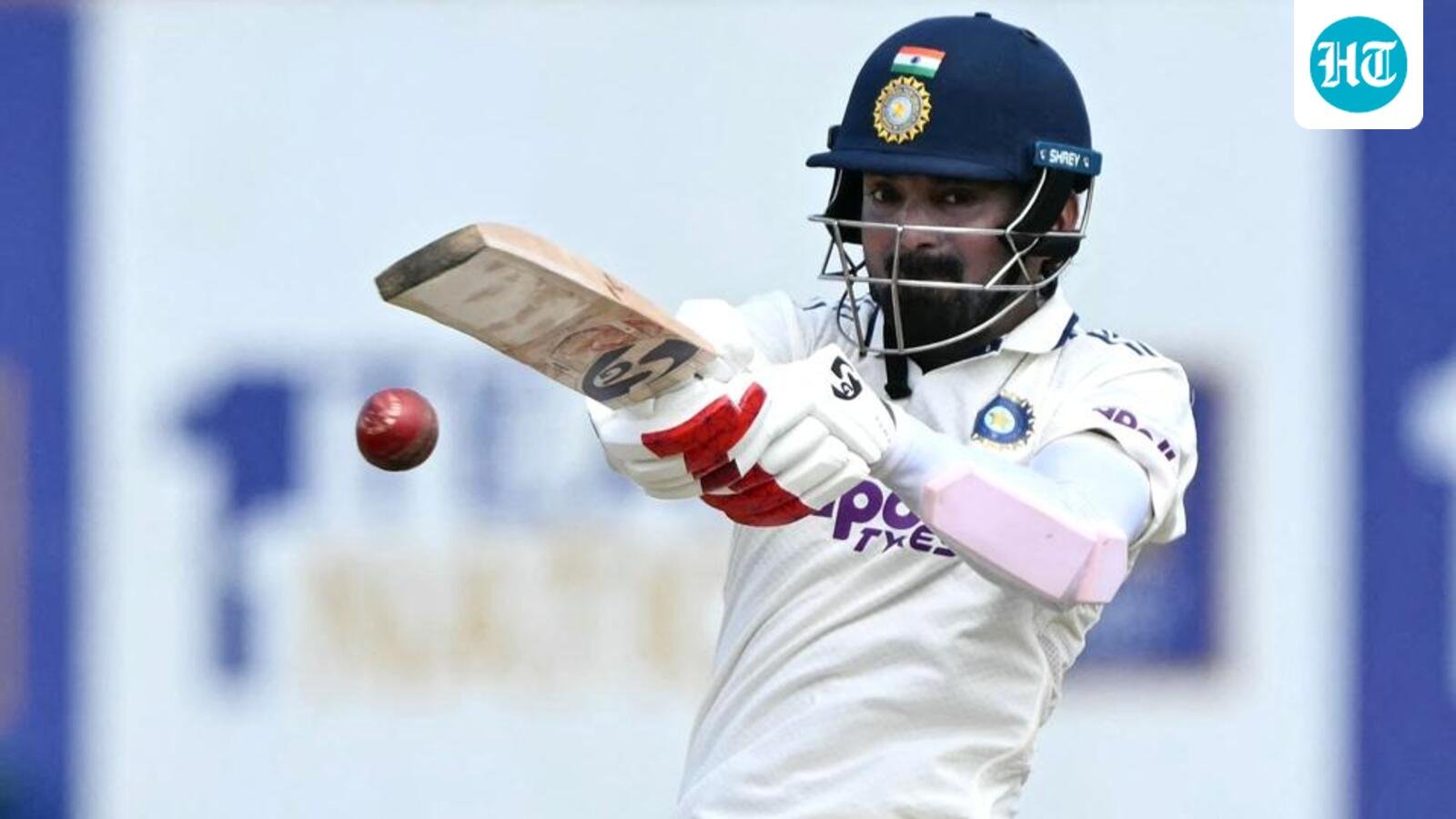
Kolkata: By the time tea arrived, KL Rahul had done something that doesn’t always receive enough credit in present day Test cricket — he had quietly weaponised patience. Yashasvi Jaiswal had already brought his own rhythm to the partnership, and Devdutt Padikkal had contributed in a manner more naturally aligned with the tempo of modern Indian batting.
And in keeping with his temperament, Rahul was anchoring India’s batting through the first two sessions on a Galle pitch that historically behaves the best on the first day.
He absorbed the early movement and the long spells of spin, allowing the more expansive batters around him to play their games without making every attacking stroke carry the burden of holding the innings together. That is why Rahul’s innings matters beyond the unfinished 77.
Rahul’s first instinct was repeatedly to leave, defend and wait. When the bowlers erred, he cashed in. There was the swivel-pull off pacer Lahiru Kumara, the cover drive against left-arm spinner Prabath Jayasuriya, and the controlled sweep and occasional charge down the pitch. But barring the unfortunate mix-up with Jaiswal that led to a run out, Rahul didn’t seem to try and manufacture runs, underscoring his presence as an anchor.
The word strike-rate has acquired an almost pejorative quality in limited-overs cricket, becoming a shorthand for effectiveness. In Test cricket, however, the job description expands. With time, Rahul, 34 and playing his 69th Test, has also adjusted to it well. The clearest evidence came in the Perth first Test win in 2024 where his 77 (176 balls) in the first innings helped India negotiate a difficult opening phase before Jaiswal took over.
Rahul and Jaiswal also put together an unbeaten century stand in the second innings, with Rahul reaching his fifty from 124 balls while Jaiswal accelerated at the other end. At Brisbane, Rahul followed it with another important 84 from 139 balls, again providing India with a substantial first-innings platform. The pattern is revealing — Rahul doesn’t need to dominate an innings to influence it.
Like in the past, he allowed Jaiswal to be himself — inventive, aggressive, willing to attack spin as well as pace. With Padikkal too using his long levers to clear the infield easily, Rahul was happy taking calculated risks. And when the conditions demanded, Rahul quickly went into defence mode, exactly how India would have liked it.
The temptation in constructing a modern Test side is to assemble as many attacking players as possible. But aggression also works best when it’s backed by an anchor. Without that, one wicket can become two, two can become three, and suddenly an innings that looked dominant is fighting for survival. It wasn’t a coincidence that India pottered down that path after Rahul had to retire due to cramp soon after tea.
Because, if anything, the dismissal of Shubman Gill came against the run of play — the India captain failing to meet the ball at its pitch but still going for it against Prabath Jayasuriya and holing out to mid-off when Sri Lanka were desperately looking for a breakthrough. Conditions were ideal for Gill to settle in and capitalise, yet India now have Rishabh Pant at the crease. (Padikkal and Pant saw through to the stumps, India reaching 288/2.)
The knowledge that Rahul is resting up for another crack at his innings must be comforting for India as he is shaping up to be the batter who makes everyone else braver. Rahul’s innings was disrupted not because Sri Lanka had solved him, but because his body intervened. He had already complained of cramp in his right forearm before tea and continued to bat after some attention.
At tea, after 162 balls and 77 runs, he had done his principal job. But there is another part loading soon.


