






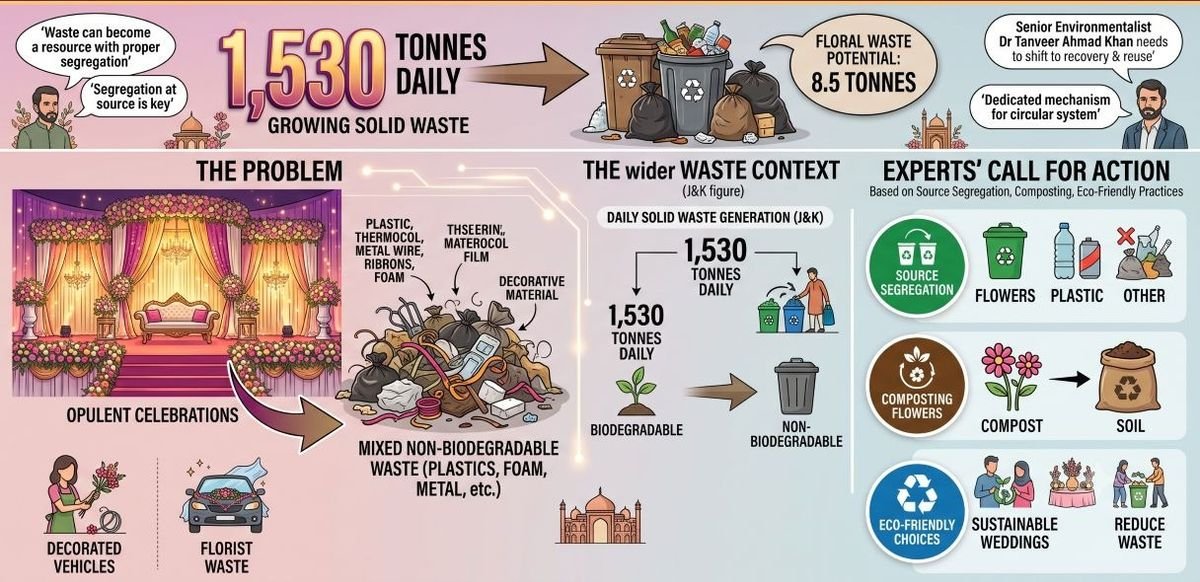
Srinagar, Sep 20: Kashmir’s increasingly elaborate wedding celebrations are leaving behind more than memories and photographs, with discarded flowers, food, plastic, thermocol and decorative material adding to the Valley’s growing solid-waste challenge.
From elaborate stage decorations and floral entrances to table arrangements, bouquets and car decorations, flowers have become an integral part of weddings across Kashmir. But once the celebrations end, large quantities of floral material are removed and generally discarded with other municipal waste.
Environmentalists say the flowers themselves are not the problem. Being organic and biodegradable, they can be composted and converted into useful material. The bigger challenge is that flowers are often mixed with plastic, thermocol, ribbons, wires and other decorative material, making recovery difficult.
“Flowers are biodegradable, but when they are mixed with plastic, thermocol, wires and other decorative material, their environmental value is lost. We need segregation at source so that floral waste can be composted and returned to the soil rather than ending up in landfills or being dumped in open areas,” climate expert Dr Touseef Ahmad Bhat said.
The scale of the wider waste challenge is already significant. Jammu and Kashmir generates around 1,530.8 tonnes of solid waste every day, including approximately 936 tonnes of biodegradable waste and 443.17 tonnes of recyclable waste. Around 352 tonnes a day is reportedly left untreated, highlighting gaps in collection, segregation and scientific processing.
There is no official estimate available for floral waste generated specifically by weddings in Kashmir. However, the Department of Floriculture’s ‘Waste to Wonder’ initiative demonstrates the potential for recovering flower waste.
A recent report on the initiative said floral-waste collection under the programme has reached 8.5 tonnes, with the waste being put to productive use rather than simply being discarded.
The figure is not a measure of wedding waste alone, but highlights the volume of floral material that can be diverted from the conventional waste stream through dedicated collection and processing. For wedding venues, environmentalists say segregation can be introduced with relatively simple arrangements. Separate bins for flowers, food waste, plastics and other material could prevent organic waste from becoming contaminated before collection.
“Every wedding venue should have a basic waste-management plan. Flowers, food waste, plastic and other materials should not be thrown together. What is being treated as waste can actually become a resource if it is properly segregated and processed,” Dr Bhat said.
The problem becomes particularly visible after the dismantling of wedding stages. Floral arrangements are frequently held together with metal wires, plastic sheets, ribbons, foam and other decorative material. When everything is thrown together, extracting flowers for composting becomes more labour-intensive and costly.
Senior environmentalist Dr Tanveer Ahmad Khan said the focus needs to shift from merely collecting waste to recovering and reusing different components.
“Wedding waste is no longer limited to food leftovers. Large quantities of flowers and decorative material are generated during such functions, and the absence of proper segregation means biodegradable and non-biodegradable waste often gets mixed,” he said.
He said flowers should ideally be diverted towards composting instead of becoming part of mixed municipal waste.
“Once flowers are mixed with plastic sheets, foam, ribbons and metal wires, separating them becomes labour-intensive and expensive. The easiest solution is segregation where the waste is generated,” Dr Khan said.
The challenge assumes significance as Srinagar and other urban areas continue to generate increasing quantities of municipal waste. The J&K Government has also moved towards strengthening waste-processing infrastructure, including a proposed 800-tonnes-per-day Integrated Solid Waste Management facility at Achan for Srinagar.
Environmentalists, however, maintain that expanding processing capacity alone will not solve the problem unless waste is segregated at source.
Florists and wedding decorators say elaborate functions can consume substantial quantities of flowers, particularly when several stages, entrances, dining areas and vehicles are decorated. Once the function ends, much of the material has little commercial value and is removed as waste.
Dr Khan said a dedicated collection mechanism for floral waste could create a circular system. “A dedicated mechanism for floral waste can create a circular system in which flowers are collected, composted and converted into useful material. This would reduce pressure on the municipal waste system and also create awareness among citizens,” he said.
Such a system could bring wedding halls, decorators, florists and municipal authorities together. Floral waste could be collected separately and sent for composting, while plastic, wire and other material could be recovered for recycling.
Dr Bhat said the change would also require a shift in public behaviour. “We must move towards sustainable celebrations. A wedding is a celebration of life, and it should not leave behind an environmental burden. Even small changes in how flowers and other waste are handled can make a difference,” he said.


