






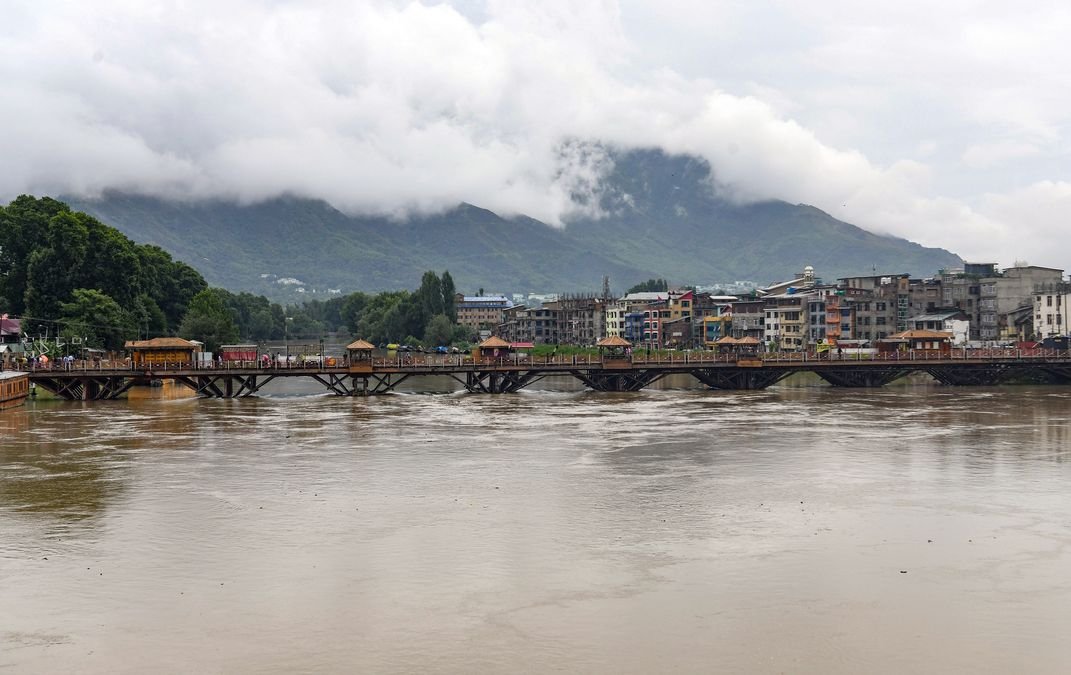
Srinagar, Sep 20: The Jhelum River basin needs a new generation of climate and hydrological modelling to prepare for a changing water regime, with researchers calling for better data, higher-resolution climate models and multiple modelling approaches to reduce uncertainty in future streamflow projections.
A study published in an international journal, ‘Discover Applied Sciences’, has recommended a comprehensive overhaul of future research on the basin, stressing that improving the spatial resolution of climate models should be a priority to capture regional and local climate variations more accurately.
The research notes that while climate models provide valuable projections, the complex terrain and varied landscape of the Jhelum basin require finer-scale modelling to better understand how climate change will influence precipitation, temperature, runoff and river discharge.
The study has called for enhanced representation of land-surface processes and their interaction with atmospheric conditions. Such improvements, it said, would help researchers better understand the processes that determine how rainfall and snowfall translate into runoff and ultimately affect river flows.
A major recommendation is to move beyond reliance on a single hydrological model. The researchers advocate employing more than one hydrological model to assess the range of possible future outcomes and determine the degree of uncertainty surrounding streamflow projections.
This, the study argues, would provide policymakers with a more robust scientific basis for water-resource planning, particularly as future projections can vary depending on climate models, hydrological models and their underlying assumptions. The researchers have further recommended the use of fully distributed hydrological models for water management and environmental decision-making in geographically diverse and complex landscapes.
The recommendations assume significance in view of the study’s projections for the Jhelum basin under different Shared Socioeconomic Pathways (SSPs). “The analysis found that mean temperatures are projected to rise throughout the century under all scenarios, while precipitation is also expected to increase,” the study notes.
However, more precipitation does not necessarily mean more water in the river throughout the year. The study projects a significant seasonal shift in streamflow, with flows expected to decrease during summer and increase during winter compared with the historical period. Under the future scenarios, high flows are projected to mostly decline, while low flows are expected to rise during the near, mid and far future periods.
The researchers also found that the emergence of future low-flow conditions could occur earlier than the emergence of changes in high flows, suggesting that the timing and distribution of water could become an increasingly important issue for the basin.
The study’s flood-frequency analysis also projected a reduction in 30-year flood levels in the future, implying that the severity of such events, according to the model projections, could decrease. However, the researchers’ emphasis on improving models highlights the importance of accounting for uncertainties before translating projections into policy.
The research said its findings can advance understanding of the potential impacts of climate change on future discharge and serve as a guide for developing watershed water-resource management policies. For the Jhelum basin, therefore, the researchers’ message is clear–future water management cannot depend solely on historical river behaviour.
“Instead, authorities and researchers need to combine finer climate data, better representation of land-surface processes, multiple hydrological models and fully distributed modelling systems to understand how the basin may respond to a warming climate,” it adds.
The study ultimately calls for a more scientifically robust approach to water-resource management—one that can account for changing seasonal flows, local climatic variations and the uncertainties inherent in long-term climate projections.


