






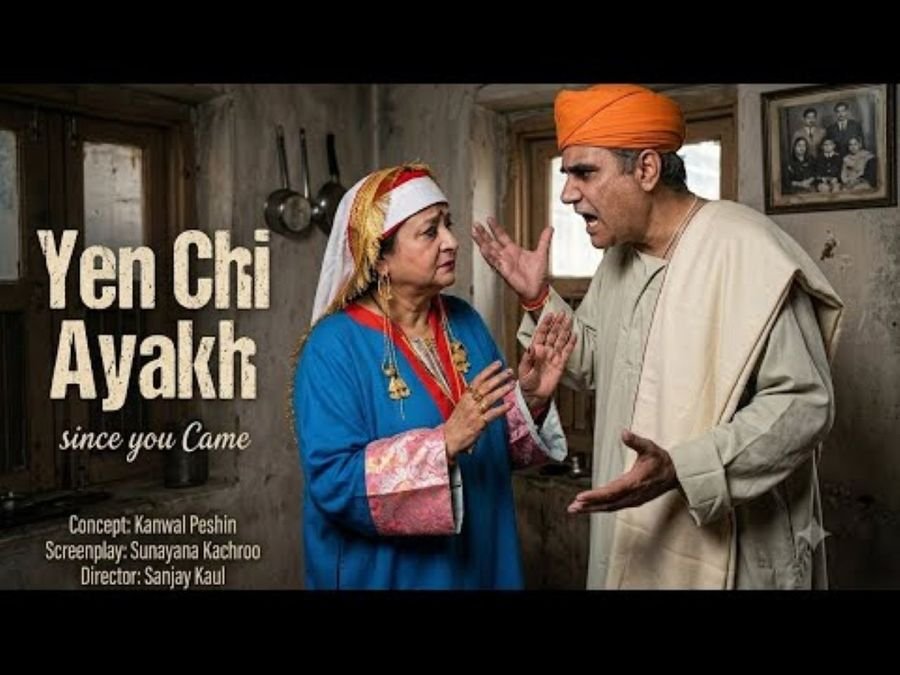
Script & Direction: Sanjay Kaul
Screenplay: Sunayana Kachroo
Concept: Kanwal Peshin
A group of Kashmiri Pandit Artists based in Boston, USA, led by Sanjay Kaul, in an attempt to revive Kashmiri Live Theatre, performed at the SAATH Theatre Festival in Boston. The play depicted a family room setting in a Kashmiri-American home in the United States. The central theme is about homecoming to Kashmir for those who were forced out of there. The seven characters in it play family dynamics, maintaining the original Kashmiri comic exchanges, while making the dialogue more theatrical to enhance the central theme of homecoming. For Non-Kashmiri audience, subtitles in English were provided.
The festival was organised by Off-Kendrik, an organisation dedicated to promoting Art and Culture, under its arm, South Asian American Theatre (SAATh). Off-Kendrik has realised the necessity of creating a platform for opening dialogues and building partnerships between communities. The theatre festival ran from September 18-20th, 2026 and was held at the Mosesian Centre for the Arts in Watertown, Massachusetts. SAATh is a celebration of the coming together of diverse communities in South Asia and beyond through Theater and Storytelling. This festival included performances in various languages, including Kashmiri, Kannada, Punjabi, Hindi, Gujarati, Bengali, Marathi, Malayalam, and English.
The Kashmiri play was part of the festival’s inaugural day celebration. The central character of the play, Raj, played by Sanjay Kaul, is frustrated about not being able to go back to Kashmir. The inability of Raj to vent out his anger for what has been done to him and his community in Kashmir, he directs and takes it out on his wife Lovely-Ji (played by Bela Kaul) by blaming her for everything and keeps mentioning to her “YEN CHI AYEKH” that since she arrived in his life “things have changed.” Raj laments about the loss of home and hearth in Kashmir by relating it to the loss of flavour and lifestyle.
The gathering occurs in Boston, where the family has spent decades building a life in the United States of America after leaving Kashmir during the genocide and exodus of 1989-90. Despite the distance, a new life and home has been built, but it has not erased the emotional connection to their homeland, Kashmir. Their memories have survived through their food, family traditions, stories of struggle and survival and experiences they continue to share with one another. The possibility of returning to Kashmir is carried through generations, many of which have already perished in 37 years of their exodus, with hope and uncertainty. In the play, memories surface naturally through their conversations.
One of the most emotionally resonant elements of the play is that of Mata (Raj’s mother), played by Phoola Salman. She has never come out of the shock of having to flee from her home in Kashmir to safeguard life with her family. She oscillates between a desire to go back home to Kashmir and expressing herself as if she is in her home in Kashmir. Her longing for her home brings the family’s past into the present and reminds her children that the idea of lost home can remain powerful even after decades of separation.
The gathering grows as Vicky (Raj’s brother, played by Dr. Sudesh Kaul), Deepa (Vicky’s wife, played by Kamal Tiku), Behna (Raj’s Sister played by Arti Kaul) and Sridhar (Behna’s husband, played by Arvind Kaul) join the family for a visit. The relatives came after a long gap, and their arrival changes the rhythm of the room. The family used these anecdotes to recall “sweet days” and shared memories.
The family catches up on life, remembering people and places by sharing their stories. The conversation included reunion updates, jokes, and plans to someday return to Kashmir. The family gathering evokes strong memories of Kashmir and a sense of lost belonging. All recall their trauma of leaving home in Kashmir and the ongoing longing for it.
The audience did not just see seven characters play a role, but they felt watching a family go through their pain and loss and a desire to go back to their lost home.
The play preceded by Ladishah, a folk Kashmiri poetry in story telling format, an art form which is slowly dying. Sunayana Kachroo performed this segment.
In the end, there is a monologue by Sanjay Kaul, which expressed the longing of his community for a homeland in Kashmir where they can practice their religion freely and live their culture and heritage without the fear of genocide and extinction.
Kashmiri language, which is part of the 18th schedule of India’s Constitution, is a dying language as it is influenced by other languages and the original inhabitants of Kashmir prefer speaking other languages over Kashmiri. This play helps start a conversation to garner interest in preserving the language.
Arti Kaul is an award winning and renowned singer from Kashmir. Bela & Sanjay Kaul hail from Srinagar, Kashmir. They have been working on Kashmir-related causes and projects for the last three decades and have arranged presentations, seminars and symposiums on Kashmir. Mr Kaul has served Kashmiri Overseas Association as its international president for two terms.
CAST
RAJ: SANJAY KAUL
LOVELY JI: BELA KAUL
MATA (Raj’s Mother): PHOOLA SALM AN
VICKY (Raj’s Brother): SUDESH KAUL
DEEPA (Vicky’s Wife): KAMAL TIKU
BEHNA (Raj’s Sister): ARTI KAUL
SRIDHAR (Behna’s Husband): ARVIND KAUL
Technical Help: MEENAKSHI KAUL
Ladishah: SUNAYANA KACHROO


