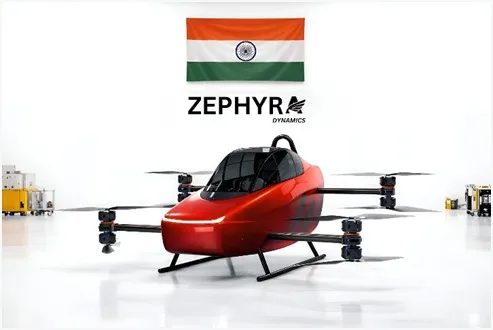
Srinagar, Feb 27: At a time when India’s rapidly expanding cities are struggling with traffic congestion and strained road infrastructure, a young aerospace engineer from Budgam, Jammu and Kashmir, is turning to the skies for solutions.
Sadiq Ali Mir, an alumnus of RV College of Engineering, where he graduated in aerospace engineering, has founded Zephyra Dynamics, an emerging aerospace startup focused on developing next-generation electric vertical take-off and landing (eVTOL) aircraft tailored for Indian cities. In addition to his work in electric aviation, Sadiq is an astronaut candidate for a planned 2029 space mission, underscoring his deep engagement with advanced aerospace systems.
Speaking about his vision, Sadiq said, “India’s cities are expanding rapidly, but our road infrastructure cannot scale at the same pace. We need to start looking at the third dimension — the skies — to solve future mobility challenges.”
At the centre of the startup’s vision is the Kestrel X2, a fully autonomous, single-passenger, multi-rotor eVTOL aircraft designed to support Advanced Air Mobility (AAM) in urban environments. Compact and electrically powered, the aircraft is being engineered to offer approximately 25 minutes of flight endurance with a practical range of up to 35 to 40 kilometres on a single charge.
Explaining the design approach, Mir said, “We have deliberately optimised the Kestrel X2 for realistic urban missions. Instead of chasing exaggerated range figures, we focused on practical commute distances within Indian cities.”
Sadiq’s journey into electric aviation began during his early semesters at RV College of Engineering, where he became increasingly aware of the global momentum surrounding urban air mobility. “When I started studying aerospace engineering, I realised that eVTOL technology was not just a global trend but a necessity for densely populated countries like India,” he said.
Motivated by this vision, he formed a multidisciplinary student team at the college, bringing together peers interested in electric aviation and future mobility systems. What started as an academic initiative soon evolved into structured design projects involving aerodynamic modelling, propulsion analysis, battery performance studies, and conceptual prototype development.
Following graduation, Sadiq transitioned what started as the student-led initiative into a full-fledged startup. He is now joined by two mentors from RV College of Engineering, Dr Promio Charles F and Dr Ravindra S. Kulkarni, who are guiding Zephyra Dynamics on its technical and strategic roadmap.
Emphasising the technological foundations of the sector, Sadiq said, “The domain of eVTOL aircraft has had to be developed from first principles. Unlike conventional aviation platforms that evolved incrementally, urban electric aircraft demand a complete rethinking of aerodynamics, propulsion integration, flight control, and energy systems.”
“At present, we are fundamentally limited by battery energy density, which constrains endurance and payload capability. However, as high-energy-density battery technologies mature, eVTOL aircraft will become significantly more efficient, more capable, and more viable for large-scale urban deployment,” he added.
Highlighting the importance of self-reliance in innovation, Sadiq said, “Urban air mobility cannot simply be imported. It must be engineered for India, by India.”
As Zephyra Dynamics continues refining the Kestrel X2 from concept to prototype development, the venture represents a growing wave of Indian innovation in electric aviation. If successful, it could contribute to reshaping how people move across the country’s increasingly crowded urban centres, not just on roads, but in the skies above.