






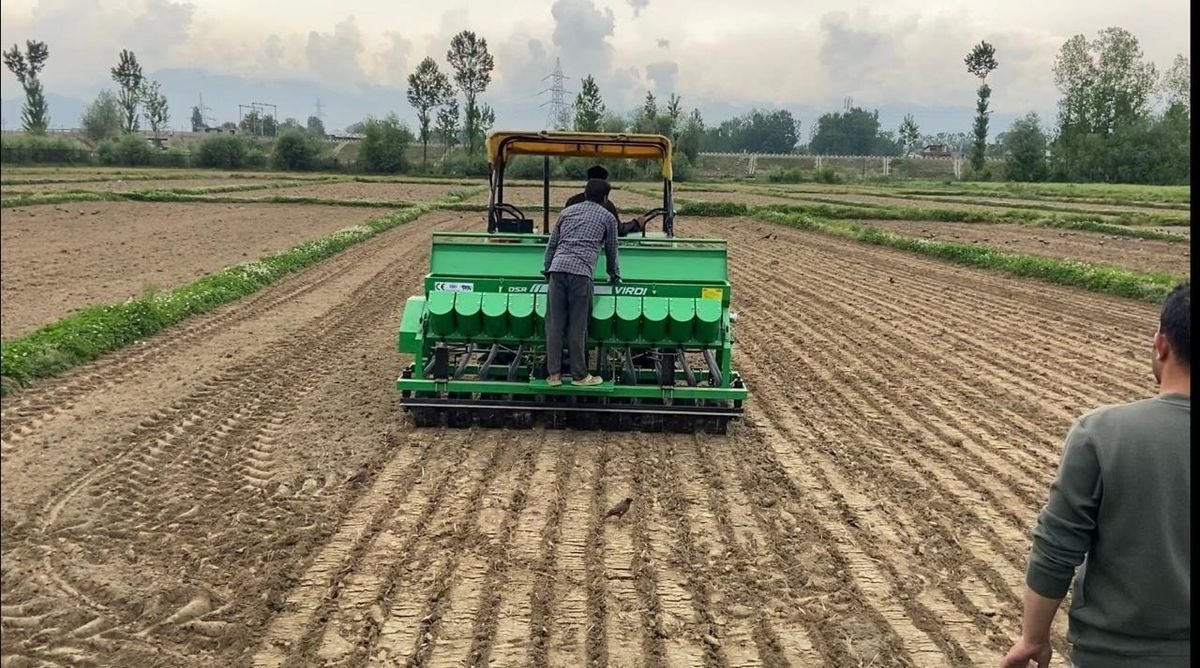
First Time in Kashmir: SKUAST-K Demonstrates Mechanised Direct-Seeded Rice at Khudwani
Khudwani (Kulgam), Oct 03: For the first time in the Valley, rice has been sown by machine straight into the main field, skipping the nursery, the puddling and the transplanting that have defined paddy cultivation in Kashmir for generations.
At the Mountain Research Centre for Field Crops (MRCFC), SKUAST-Kashmir, in Khudwani, scientists this season demonstrated mechanised Direct-Seeded Rice (DSR) over one hectare, with half the plot under DSR and the other half under conventional puddled transplanted rice, grown side by side under identical conditions for direct comparison.
Dr Tasneem Mubarak, the project’s Principal Investigator, said the demonstration marked a historic first for the Valley, where direct-seeded rice, known locally as “Votur,” was sown through a machine for the first time.
“The technique is not entirely new to Kashmir,” Dr Mubarak told Rising Kashmir. “Before the Green Revolution, farmers in the Valley practised a form of direct sowing they called ‘Vothur’, broadcasting pre-germinated seed by hand across the field. But the method came with serious drawbacks.”
The biggest problem farmers faced was weeds, he said, explaining that without proper tilling and a lack of novel herbicides, weeds overran the fields. Since sowing was done by hand rather than with any precision method, the crop grew patchy in some places and too dense in others, with birds also damaging the broadcast seed.
“There was no suitable herbicide at the time that could control every category of weed, which meant farmers had to weed the fields repeatedly through the season by hand, in addition to thinning the crop where it grew too dense,” Dr Mubarak said, describing it as a laborious form of farming that consumed large amounts of human labour.
By the 1960s, as the Green Revolution reached Kashmir, farmers shifted almost entirely to transplanted rice, which allowed better control over plant population and made it easier to manage weeds through proper tillage, standing water and herbicide application.
Direct seeding fell out of use, Dr Mubarak said, “not because it was a flawed idea, but because the tools needed to make it work well simply did not exist at the time.”
He said farmers lacked a suitable variety with the right potential, and precision sowing methods were not available either, adding that weed management and, more recently, shrinking water resources, remained the other major gaps.
The machine used at Khudwani sows seed at an exact, adjustable spacing, anywhere from 10 centimetres to 25 centimetres apart depending on the variety and the field, while placing fertiliser directly beneath the seed in the same pass.
“The spacing can be modified in the machine according to the situation, the variety and the location, which is why the method is called precision sowing,” Dr Mubarak said.
Because the method eliminates nursery-raising, puddling and transplanting entirely—operations that each consume significant water, time and manual labour—the savings compound quickly.
“Thirty-five to forty per cent of water is saved through the technique in general,” Dr Mubarak said, adding that this season, thanks to evenly distributed rainfall, the demonstration plot saved as much as 50 per cent of the water a conventional transplanted crop would have needed.
He said eliminating the nursery raising, puddling and transplanting alone cuts labour requirements by roughly 40 to 45 per cent, and once the crop is harvested and threshed mechanically as well, total labour savings cross 50 per cent compared to the traditional method.
After sowing, the field gets one irrigation immediately, then none for the next 10 to 15 days while the seedlings emerge, followed by intermittent irrigation monitored through water-level tubes installed below the surface.
“Novel herbicides now available can control a much wider range of weed species than what farmers had access to decades ago, cutting down the weeding labour that once made direct seeding so demanding,” Dr Mubarak said.
The technology also has an environmental payoff. Standing water in conventional transplanted rice drives significant methane emissions, averaging around 200 kg per hectare, Dr Mubarak said. Under DSR, with less standing water through the season, that figure drops to around 60 kg per hectare, a reduction of 60 to 80 per cent.
The research behind the technology has been published in journals including Scientific Reports (Nature group), BMC Plant Biology, Advances in Weed Science, and Sustainability.
Dr Mubarak, along with Prof Ashaq Hussain and Dr Intikhab Aalam, who worked on the project, were conferred the “Achiever of the Year” award by SKUAST-Kashmir in January 2026 in recognition of the work.
Dr Mubarak said the Khudwani demonstration, carried out under an ICAR-IIRR project, is meant to be the first step toward testing how the technology fits into Kashmir’s existing cropping systems.
Since DSR sowing has to be done in May, the team is now studying which rice varieties and cropping sequences will work best around that timeline.


