






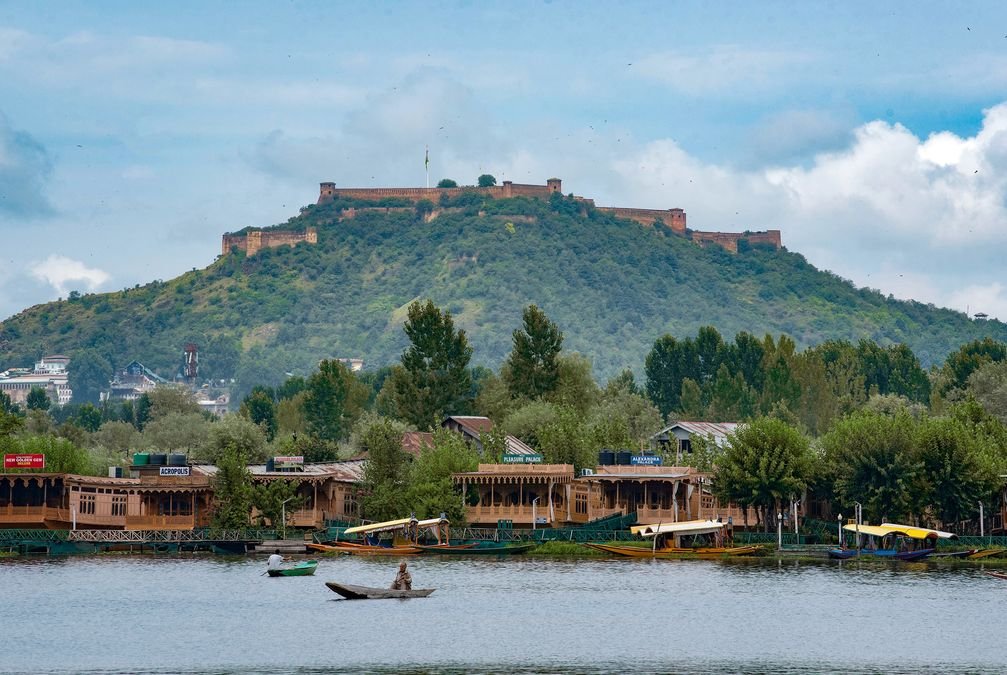
Before Kashmir wakes to the noise of its roads, markets and everyday concerns, it has already spoken. In the fragile hour between darkness and daylight, when the mountains are still wrapped in the last shadows of night, and the first light has barely begun to touch the valley, the air carries sounds that seem older than memory.
From a mosque comes the Azaan, rising gently over the rooftops, while from a nearby temple the ringing of bells and the first chants of morning worship begin to mingle with it. In many parts of Kashmir, where mosques and temples stand close to one another, these sounds have for generations formed part of the natural rhythm of the morning. Heard together in the stillness of dawn, they create an atmosphere that is difficult to describe in ordinary language. One does not merely hear them; one feels them.
There is something deeply beautiful about a land beginning its day in remembrance. Before human activity divides the morning into occupations and obligations, the valley seems to belong to a quieter order of existence. The Azaan calls the faithful towards worship, while the rituals of a nearby temple begin with their own ancient cadence. Their languages, traditions and forms are different, yet both arise from the same human longing to reach beyond the limitations of the individual self. In that early silence, neither sound needs to compete with the other. Each occupies its own space, and together they become part of the valley’s distinctive spiritual soundscape.
Perhaps this is one reason Kashmir has always seemed to possess a character beyond its physical beauty. Its mountains, rivers, springs, temples and shrines are not merely picturesque features of a landscape. They have accumulated memories, associations and meanings across generations. The land has been looked upon, inhabited and experienced not only with the eyes but with a sense of reverence that has found expression in different religious and mystical traditions. Its spirituality is therefore not confined to a particular building or ritual; it has entered the atmosphere itself.
The temples of Kashmir have long been woven into the life of its communities. Their bells have marked the beginning of mornings, their lamps have illuminated evenings, and their courtyards have witnessed generations arriving with flowers, offerings and folded hands. A temple is not simply a place where a ritual is performed. It can become a repository of memory, where the presence of those who worshipped there before us seems to linger in the very stones. The sound of a bell travelling through a quiet village can evoke something that no written description can adequately capture.
The mosque carries its own equally powerful presence. The Azaan, particularly in the early morning, has a quality that can transform the atmosphere around it. Its call does not merely announce a time of worship; it momentarily draws attention away from the concerns of the waking world and towards something beyond them. For generations of Kashmiris, it has been part of the sound of home, village and neighbourhood, woven naturally into the rhythm of everyday existence.
Where a mosque and a temple happen to stand close to each other, their proximity can offer a particularly moving image of Kashmir’s cultural landscape. The two places of worship need not become identical for their presence beside one another to acquire meaning. Their very coexistence reflects a land in which different communities have shared streets, neighbourhoods, memories and seasons. The morning sounds emerging from them can remind us that human beings may approach the Infinite through different names, symbols and traditions while still being united by the impulse to seek something greater than themselves.
The natural landscape deepens this experience. Kashmir’s mountains have a silence that seems almost deliberate. They stand above the valley without haste, watching the passage of seasons and generations. Snow gathers upon them, melts into streams and eventually becomes part of rivers that travel through the land. Their presence places the human being within a larger measure of time. Standing before such mountains, one becomes conscious of how brief an individual life is and how enduring the rhythms of nature can be.
The rivers offer another kind of wisdom. They move continuously, touching villages, fields and towns without belonging permanently to any of them. They accept whatever comes into their course and continue towards a destination beyond what the eye can see. Their movement carries an implicit lesson about change. Nothing remains exactly as it was, yet continuity is not lost. Perhaps this is why the sight of a river can awaken reflection without demanding it. Its movement speaks quietly of time, surrender and renewal.
Then there are Kashmir’s springs, emerging from the earth with an almost mysterious simplicity. Some have been associated with shrines and traditions for generations, while others remain familiar parts of local memory. Their waters seem to rise from a hidden depth and make the invisible visible for a moment. They remind us that beneath what we see there are forces and movements beyond ordinary perception. The spring does not explain its origin; it simply continues to emerge, offering itself to the world.
This relationship between landscape and inwardness has deep roots in Kashmir’s intellectual and spiritual traditions. Kashmir Shaivism developed a profound understanding of consciousness and the relationship between the individual and the universal, while the poetry of Lal Ded repeatedly directed attention away from external appearances towards inner realisation. Her verses, like much of Kashmir’s mystical inheritance, suggest that the ultimate journey is not necessarily towards a distant destination. It is a movement towards awareness, towards the discovery of what lies behind the restless surface of existence.
The valley’s spiritual character can therefore be encountered in the simplest moments. It may appear in the first ray of sunlight touching a snow-covered peak, in the sound of water moving beneath a bridge, in the fragrance of flowers carried towards a shrine, in the ringing of a temple bell, or in the Azaan travelling across a still neighbourhood. None of these experiences demands elaborate interpretation. Their power lies precisely in their simplicity.
For those separated from Kashmir, however, these experiences can acquire another meaning. Distance changes the nature of memory. A temple that once stood within walking distance may become something one can reach only through remembrance. A familiar mosque, a village spring, a riverbank or an ancestral courtyard may exist physically somewhere in the valley while becoming increasingly distant from one’s everyday life. Yet the sounds and images associated with them can remain remarkably alive. The Azaan heard in childhood, the temple bells of an early morning, the fragrance of incense, the sight of mountains from a familiar window—all can return unexpectedly, carrying with them an entire world.
Memory in such moments is not merely an archive of the past. It becomes a bridge between what was and what continues to live within us. A place may be physically distant and yet remain intimately present. The geography outside may change, but the geography carried within the heart can preserve its own landscapes.
Perhaps this is what makes Kashmir more than a beautiful valley. Its deepest beauty lies not only in its mountains or waters but in the way the land has taught generations to experience the visible and the invisible together. Here, a morning can begin with the Azaan from a mosque and the bells of a temple; a river can become an image of life’s passage; a mountain can teach stillness; a spring can suggest hidden depths; and an old ritual can connect the present with generations that have long since disappeared.
As the day advances, the sounds of ordinary life gradually overwhelm those quieter notes. Roads fill, conversations begin, shops open, and the valley resumes its daily rhythm. Yet something of that early morning remains. For a brief while, before the world became busy, Kashmir seemed to remember that beneath all our differences there exists a shared human impulse to look beyond ourselves.
Perhaps that is the enduring music of the valley: many voices, many traditions, many paths, yet one landscape holding them within its embrace. And perhaps, when dawn speaks in many voices, Kashmir offers its finest lesson—not in words, but in the simple possibility of listening.
(The author is RK columnist and can be reached at: sanjaypanditasp@gmail.com)


