



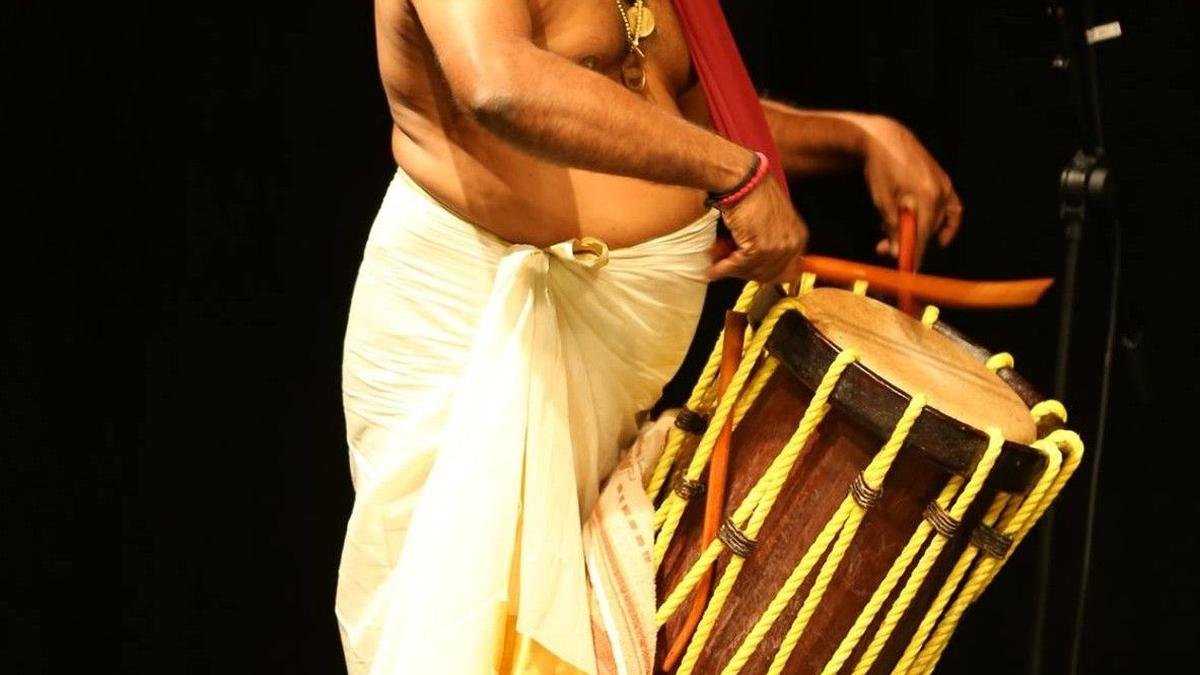
Kalamandalam Krishnadas
| Photo Credit: Special Arrangement
During his five-decade association with the chenda, Kalamandalam Krishnadas has played a pivotal role in redefining the percussive aesthetics of Kathakali. This, however, has not distanced him from his childhood bond with Kanyarkali, a folk and ritualistic dance-drama performed across temples in his native eastern Palakkad.
Krishnadas has been living in Thiruvananthapuram for the past 40 years. The Margi Academy, in the State capital, employed him soon after he completed his training in chenda at Kalamandalam in 1985. Ever since, Krishnadas has been a vital presence in the Kathakali circuits — south and central belts of Kerala. Recently, he celebrated his 60th birthday in Margi, where he serves as the Principal.
Krishnadas grew up playing the chenda for the night-long Kanyarkali. The Pallassana village, where he hails from, is renowned for thayambaka and melam.
Kalamandalam Krishnadas with Kalamandalam Gopi
| Photo Credit:
Courtesy: R. Jayaram
His uncle, Pallassana Chandra Mannadiyar (1925-99), a 20th-century Kathakali percussionist, was equally adept in Kanyarkali. In his prime, he taught Kathakali chenda at Kalamandalam, around the time his 14-year-old nephew joined as a student. At Kalamandalam, Krishnadas, already familiar with the basics, trained under stalwarts such as Krishnankutty Poduval, Achunni Poduval and Varanasi Madhavan Namboothiri, in addition to Mannadiyar. Three months later, during Onam, he made his Kathakali chenda debut, performing for the invocatory purappad dance.
The rigour at Kalamandalam was demanding, yet far more tolerable compared to Pallassana. “At home, we were woken at 3.30 a.m. for chenda exercises. After school, seniors would make us practice till midnight,” he recalls. “At Kalamandalam, we could sleep better. Yet, the dawn-drill was followed by errands,” he adds.
Kalamandalam Krishnadas with his daughter Margi Rahifha
| Photo Credit:
Courtesy: Hareesh Nampoothiri
When he moved to the senior level, Krishnadas began playing for Kathakali students at cholliyattam classrooms, where exponents such as Ramankutty Nair, Padmanabhan Nair and Gopi taught. “This intensive training helped me when I joined Margi as an apprentice. Yet, the Mankulam style at Margi differed from the Chengannur idiom taught at the Kalamandalam’s southern wing,” he says.
By the early 1990s, Krishnadas was fairly established. He was further mentored by Thiruvananthapuram’s chenda masters such as Raman Namboothiri and Sadanam Vasudevan. The iconic actor Kalamandalam Krishnan Nair made Krishnadas a part of his troupe for lecture-demonstrations, while Ramankutty Nair and Gopi guided him through finer nuances. As fellow percussionist Vellinezhi Anand observes, “Krishnadas is capable of conjuring surprises; his outcomes are sometimes unpredictable.”
Krishnadas pre-plans certain rhythmic phrases and rehearses them. “My uncle continues to be my exemplar, but times have changed. The percussive pieces sound more ornamental; even the chenda’s timbre has altered significantly,” he says, also referring to his percussionist daughter, Margi Rahitha. “The founding principles cannot be diluted. I have been the sole chenda player for an entire night of Kathakali. You must wield total control over the momentum of a scene.”
Published – June 05, 2026 02:18 pm IST


