



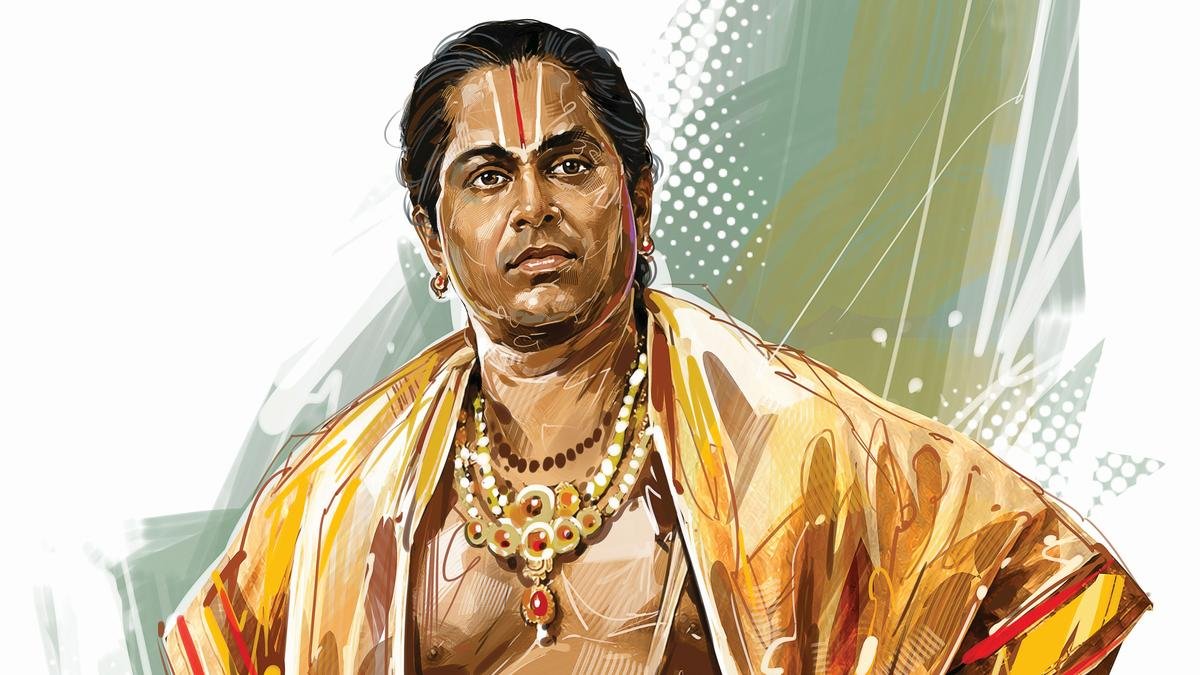
C. Cunniah.
| Photo Credit: Illustration: B. Sainath
C. Cunniah was one of Tamil theatre’s greatest legends in the early decades of the 20th century. His productions were known for their grandeur, and he was considered a forerunner to the likes of Nawab Rajamanickam Pillai and R.S. Manohar in the mythological genre. A brief profile of this legend, compiled by T.C. Vadivelu Naicker, a noted theatre artiste and one of the pioneers of early Tamil cinema, was published in the drama book of Cunniah’s last magnum opus theatrical work, Bhagavad Gita.
Cunniah was born in 1877 (though curiously, the Government of Tamil Nadu celebrated his birth centenary in 1973). His interest in studies was limited, for, his formal education lasted only till the fourth standard. Aware of the need to learn a craft with which he could earn a livelihood, his parents enrolled him in the Parur Thyagaraja Sastri Press on Govindappa Naicken Street in George Town, Chennai, where he learnt composing and became a Telugu compositor. He later joined the government press and worked in the same capacity. The acting bug bit him around this time, when he started watching plays being performed by Subbaraya Achari, a noted theatre practitioner of those times. Deciding to become an actor, he quit his job and joined an entourage of performers led by Gopala Rayar on a year-long tour to Singapore. On his return, he joined a drama company run by Narayanaswamy Pillai as an actor at a monthly salary of Rs. 2. His association with the company lasted for nearly seven years, during which time he essayed a variety of small roles and soon started making a name for himself.
Pursuing wider opportunities, Cunniah quit Narayanaswamy Pillai’s company and went to Rangoon, where he joined a drama company as a lead actor. The brief stint saw him gain recognition. On his return to Madras, he launched the Sri Krishna Vinodha Sabha, which went on to become one of the premier performing theatre companies of the early 1900s. One of its earliest productions was Sakunthala, with Cunniah performing the role of Dushyanta. Spurred by its success, Cunniah embarked on a series of mega productions over the course of the next few years such as Sampurna Ramayanam (where he essayed six roles, including that of Kaikeyi and Surpanakha), Kandirajan, Chandravali, Sathya Harischandra, Lankadhanam and Vasanthika with the Royal Theatre at Salt Cotaurs as his base.
Nawab Rajamanickam Pillai, one of the pioneers of Tamil theatre.
| Photo Credit:
The Hindu Archives
Cunniah appointed noted comedy actor of those times, C.S. Samanna Iyer as the troupe’s manager and toured many places across South India, earning accolades from prominent personages such as the royal family of Thanjavur. That Cunniah was greatly influenced by Parsi theatre’s production values is evidenced by the fact that he appointed Ameer Ali of the New Albert Parsi Theatre Company as Krishna Vinodha Sabha’s music director. He also appointed Hussain Bakhsh, an artiste from Lahore, for a huge salary. He was made in-charge of the troupe’s scenes and settings. Notable actors of the Krishna Vinodha Sabha included the likes of comedian K. Sarangapani, C.V.V. Pantulu and Maharajapuram Krishnamurthy. However, the biggest name of them all was S.G. Kittappa, who, along with his brothers formed a fruitful association with Cunniah.
Kittappa’s musical genius propelled Krishna Vinodha Sabha to greater heights. Productions such as Dasavatharam (said to have been produced at a cost of more than a lakh of rupees) and Krishna Leela owed much of their success to Kittappa’s singing, which drew many classical musicians such as Kanchipuram Naina Pillai, Fiddle Govindaswamy Pillai, Marungapuri Gopalakrishna Iyer and Konnakkol Pakkiria Pillai to watch the plays. Interestingly, Cunniah travelled to Penang in 1926 and helped the renowned Ganesananda Dramatic Troupe of the Federated Malay States produce and stage Dasavatharam.
Veteran theatre actor R.S. Manohar.
| Photo Credit:
The Hindu Archives
Mridangam exponent Pudukkottai Dakshinamurthy Pillai and dholak player Venu Chettiar were part of the Sabha’s music retinue. Cunniah was also an admirer of harikatha exponent C. Saraswathi Bai and once invited her to perform for his troupe and presented her with a gold cup. He was in awe of her ability to bring alive many deities through her expositions, a task which he remarked was undertaken by many together in his troupe.
A staunch Vishnu-bhakta, Cunniah was especially devoted to the mystic-poet Andal (he even staged a play titled Andal Thirukalyanam-Ramanuja Vaibhavam) and donated a golden pot to the Srivilliputhur temple. He also donated liberally to other Vaishnavite shrines such as Thirukannapuram, Thirukannamangai, the Parthasarathy temple at Triplicane and the Ramanuja shrine at Sriperumbudur. Organisations such as the Ramakrishna Mission Students’ Home too benefited by his benevolence.
Well-known actor S.G. Kittappa, who along with his brothers formed a fruitful association with Cunniah.
| Photo Credit:
The Hindu Archives
In 1930, Cunniah embarked on an ambitious project — to dramatise the Bhagavad Gita. It took over a year for the production to take shape, with Cunniah pouring his heart and soul into it. However, behind the scenes, a life of relentless activity was slowly starting to take its toll on Cunniah and he seemed to have had an inkling that it would be his last offering. He was supposed to have remarked to those around him that no matter what happened to him, the show must go on. It proved to be eerily prophetic, for he passed away at his residence on Mint Street on August 31, 1931, a week after the production’s inauguration. Chinnammal, his wife, ran the troupe for a while before it was finally wound up.
Unfortunately, Cunniah’s achievements remain a distant footnote in the annals of Tamil theatre.
Published – June 05, 2026 05:02 pm IST


