



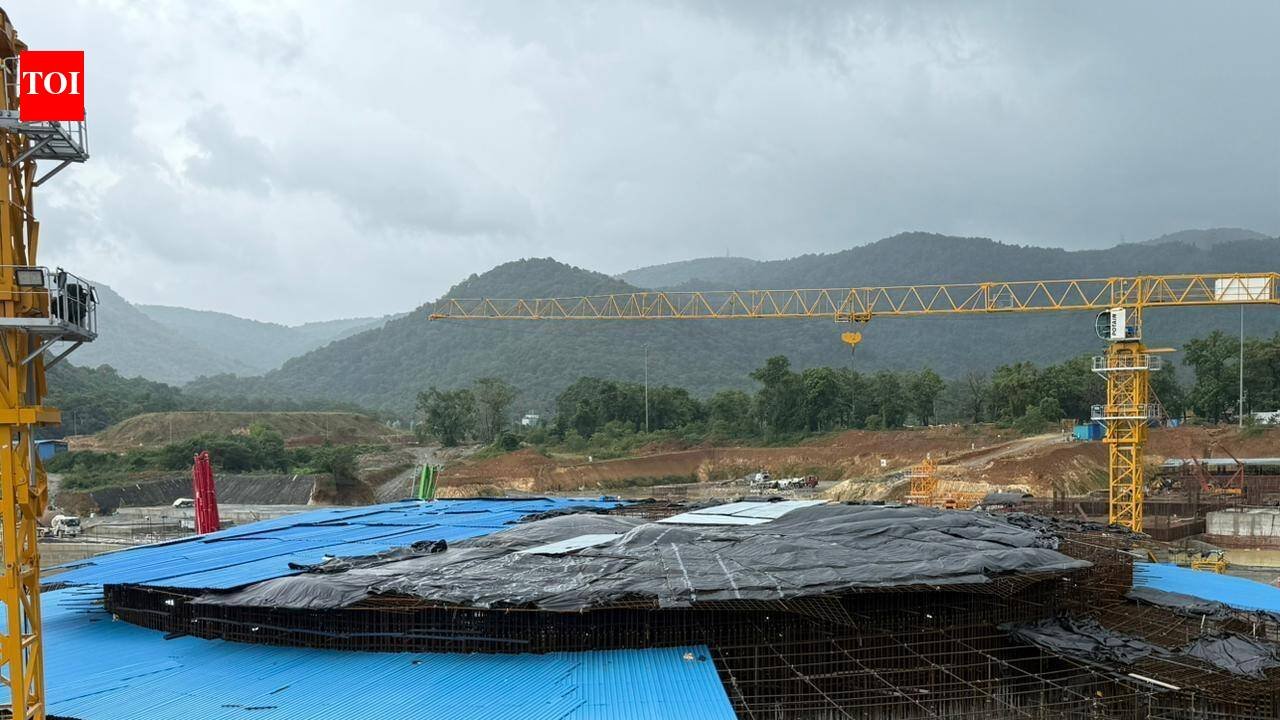
Bengaluru: Rain and concrete rarely go together. Construction engineers usually defer major concreting works during the monsoon or rainy conditions as excess water can impact the concrete mix, affect its strength, delay curing and compromise structural integrity. But at the Kaiga Units 5 and 6 Nuclear Power Project—India’s expanding nuclear power programme, in Uttara Kannada district of Karnataka, engineers did exactly the opposite—successfully completing one of the largest continuous monolithic concrete pours in the Nuclear Power Corporation of India Limited (NPCIL) history despite relentless southwest monsoon showers in the Western Ghats.Sources in NPCIL told TOI that the operation involved the uninterrupted placement of nearly 7,250 cubic metres of concrete into the reactor foundation—an engineering feat that demanded meticulous planning, precision logistics and round-the-clock coordination in one of the country’s wettest regions. The work was executed by engineers of Hyderabad-based Megha Engineering & Infrastructures Ltd. (MEIL). Executing a continuous concrete pour of this magnitude is challenging even under normal conditions. At Kaiga, nestled deep in the Western Ghats of Uttara Kannada, the task became even more formidable because of incessant monsoon rains, restricted site access and the stringent quality standards prescribed for nuclear infrastructure,” an engineer associated with the project said.Giant 75-metre canopy kept concrete pour on trackEnsuring uninterrupted pouring of concrete despite heavy rainfall, engineers erected a 75-metre-diameter protective canopy over the construction site. “The exercise involved the continuous placement of around 7,250 cubic metres of concrete with a rebar density of 360 kg per cubic metre (the amount of steel reinforcement embedded within that concrete). The massive canopy allowed concreting to continue without interruption while protecting workers, equipment and freshly placed concrete from rain, thereby safeguarding the structural integrity of the reactor foundation,” another engineer explained.Maintaining the prescribed concrete temperature posed another major challenge amid fluctuating weather conditions during the southwest monsoon. Overcoming the challenge, engineers established a temperature-controlled concrete production facility with a capacity of 360 cubic metres per hour, supported by high-capacity concrete pumps. “A dedicated ice plant capable of producing 510 tonnes of ice per day, along with 400 tonnes of ice storage, was commissioned to maintain the concrete placement temperature at around 19°C, thereby preventing thermal stresses during curing,” a field engineer said.
Civil engineers and construction workers at the Kaiga Units 5 and 6 Nuclear Power Project in Kaiga, Uttara Kannada district, Karnataka, during the execution of one of the largest continuous monolithic concrete pours in the history of the Nuclear Power Corporation of India Limited (NPCIL)
The project also required meticulous supply-chain planning. More than 2,600 tonnes of cement and fly ash storage capacity was created on site to ensure uninterrupted availability of construction material throughout the operation. Hundreds of engineers, quality control specialists, surveyors, safety personnel and skilled workers worked in multiple shifts to complete the record-setting concrete pour. Officials said every stage—from batching and transportation to placement, vibration and curing—was carried out under stringent quality assurance and quality control protocols prescribed for a Pressurised Heavy Water Reactor (PHWR).NPCIL officials said the successful completion of the concrete pour marks a major milestone in the construction of the Kaiga Units 5 and 6 project and demonstrates the engineering precision required to execute critical nuclear infrastructure works under some of the country’s most challenging monsoon conditions.


