






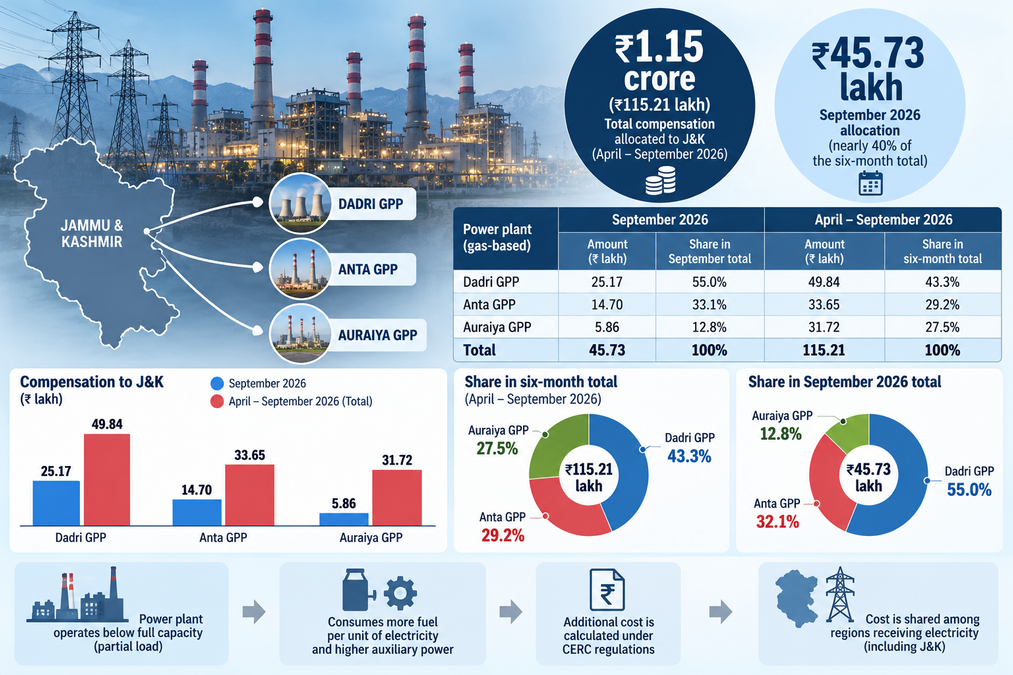
Srinagar, Oct 22: Jammu and Kashmir has been allocated an additional Rs 1.15 crore in electricity generation costs during the first six months of the current financial year, even though the amount is not directly linked to additional electricity supplied to consumers, according to the latest figures released by the Northern Regional Power Committee (NRPC).
The figures raise a question for electricity consumers in Jammu and Kashmir: whether such additional expenses are ultimately reflected in the cost of supplying power and, consequently, in the bills paid by households and businesses.
The official NRPC statement shows that Jammu and Kashmir’s share of compensation for three gas-based power plants outside the Union Territory reached Rs 115.21 lakh between April and September 2026.
Of this, Rs 45.73 lakh was allocated in September alone, accounting for nearly 40 per cent of the six-month amount.
The additional costs arise when electricity-generating stations operate below their normal capacity. Under such conditions, the plants may consume more fuel to produce each unit of electricity, increasing their operating expenses.
Under electricity regulations, eligible generating stations receive compensation for these additional expenses, with the costs distributed among the regions that receive power from them.
For Jammu and Kashmir, the largest share was linked to the Dadri Gas Power Plant, accounting for Rs 49.84 lakh during the six-month period. The Anta Gas Power Plant accounted for Rs 33.65 lakh, while the Auraiya Gas Power Plant accounted for Rs 31.72 lakh.
In September alone, Dadri accounted for Rs 25.17 lakh, followed by Anta at Rs 14.70 lakh and Auraiya at Rs 5.86 lakh.
The figures indicate that a substantial portion of the additional compensation was allocated in a single month, although the document does not explain the specific reasons behind the September increase.
For ordinary consumers, the significance of these figures lies in the overall cost of purchasing electricity.
Electricity supplied to homes, shops and industries involves several expenses beyond the basic price of power, including transmission charges and certain regulatory compensation payments.
These expenses can form part of the overall financial burden on power utilities. However, the NRPC document does not establish whether the Rs 1.15 crore allocation has been passed on to Jammu and Kashmir’s electricity consumers or whether it will affect future tariffs.
The compensation is calculated under regulations framed by the Central Electricity Regulatory Commission (CERC), which allow generating stations to recover specified additional costs arising from reduced operating efficiency.
The NRPC has provided a 15-day period for concerned entities to report discrepancies in the calculations, after which the accounts will be treated as final if no objections are received.
The statement also does not clarify whether Jammu and Kashmir’s allocated amount has already been paid or remains to be settled.
With winter approaching and electricity demand expected to rise across Kashmir, the figures bring attention to the various costs involved in meeting the Union Territory’s power requirements.
While the Rs 1.15 crore allocation does not automatically mean higher electricity bills, it highlights an additional expense within the power procurement system.


