









Srinagar, Oct 12: Jammu and Kashmir aims to become the first Himalayan territory to have a Mountain Development Policy, Chief Minister Omar Abdullah said on Monday, cautioning that the framework must not be developed in isolation. He flagged changing weather patterns, water shortages, the pressures of tourism on fragile destinations, plastic use and the need for environmental responsibility among citizens and the government alike.
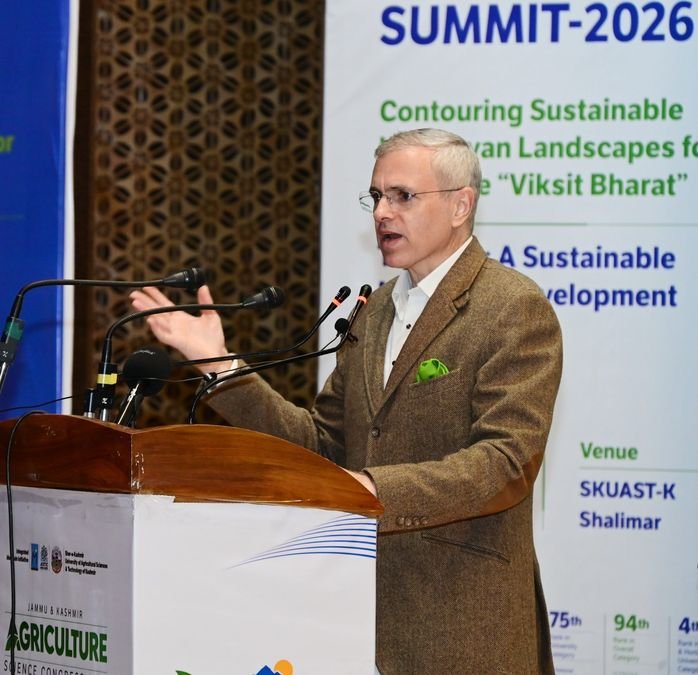
Speaking at the 13th Sustainable Mountain Development Summit at SKUAST-Kashmir, Omar said his government would “love to implement” such a policy but stressed that it must be developed through wider consultation.
The summit is being organised by SKUAST-Kashmir and the Integrated Mountain Initiative (IMI), alongside the J&K Agriculture Science Congress-2026. The proposed Sustainable Mountain Development Policy for J&K is among the main agenda items.
The Chief Minister said changing weather patterns were already affecting the Valley, with irregular rainfall and uneven snowfall contributing to water shortages during the spring months.
“Over the past couple of years, Kashmir has been witnessing a shortage of rainfall and uneven snowfall. Kashmir is also witnessing an unusual series of cloudbursts,” he said, describing it as a “new reality”.
He said Jammu and Kashmir could not stop global warming on its own, even at the national level, as tackling it required a worldwide effort. However, the region continued to bear its consequences.
Abdullah said snowfall often arrived late and in smaller amounts, leaving people worried about water availability in March, April and May. Heavy rainfall, cloudbursts and floods then created fresh challenges, he said.
He said environmental protection was essential for survival and not merely an environmental concern. He also questioned the perception that tourism was the mainstay of J&K’s economy, saying agriculture and horticulture contributed more.
On restricting tourist numbers, the CM said the government could discuss limits but implementing them abruptly would be difficult because many families depended on tourism for their livelihoods.
“In closed rooms, we are discussing limiting the number of tourists, but in reality, we cannot restrict them to limited numbers because many families in Jammu and Kashmir are dependent on the tourism sector,” he said.
He asked how families dependent on tourism could be affected by an immediate reduction in visitor numbers from three lakh to 50,000 at a destination. Such a transition could happen gradually, he said, but not immediately.
The Chief Minister acknowledged that some tourist destinations had reached their carrying capacity. However, he said the answer was not to stop visitors from going to Gulmarg, Pahalgam or Sonamarg, but to develop new destinations sustainably, with waste disposal and other necessary facilities in place before visitors arrived.
Omar said environmental damage could not be blamed solely on tourists and pilgrims, pointing to littering in areas that visitors rarely frequent.
“We need to look at ourselves and see how much plastic bag usage and other hazardous things are being used by people of Jammu and Kashmir,” he said.
The CM urged residents to carry bags from home when shopping instead of taking plastic bags from shopkeepers. He asked people to avoid wasting water and electricity by turning off taps, lights, fans and heaters when they were not in use.
“The biggest responsibility is the government’s,” he said, adding that residents also had a responsibility to protect the environment.
The Chief Minister said development in agriculture, horticulture, infrastructure and tourism was essential but had to follow sustainable practices.


