





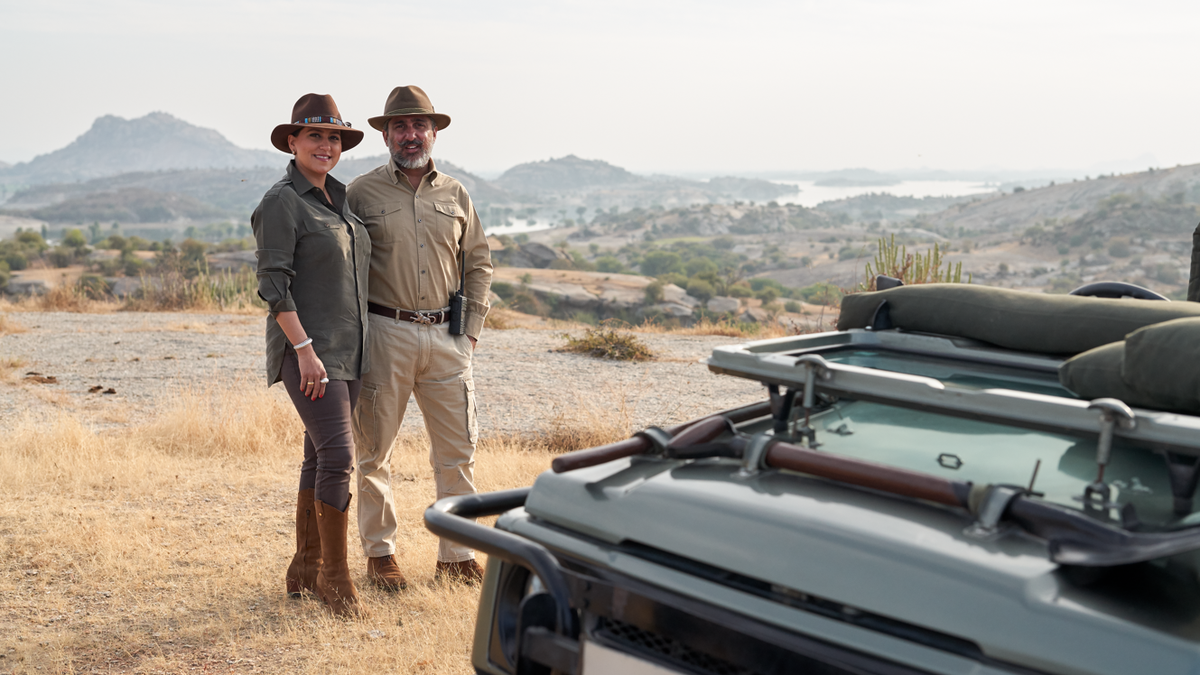
Jaisal Singh remembers spending his school holidays walking the length and breadth of Ranthambore National Park. There was never a person in sight, and living there meant no running water or electricity. His parents, both filmmakers, had fallen in love with the area and had pitched camp under a grand banyan tree near Jogi Mahal, an erstwhile hunting lodge turned forest guest house, along with his uncle, wildlife conservationist Valmik Thapar.
That rudimentary lifestyle was the biggest luxury, he says, along with his early exposure to conservation efforts (his parents and uncle ran the NGO, Ranthambore Foundation), and became the core of his being. So, in the year 2000, before leaving for the School of Oriental and African Studies in London for a degree in the history of art, he pitched a business plan to his parents — to convert the farm they had rewilded at the edge of the park into Sujan Sher Bagh, a luxury tented safari camp like the ones he had seen in Africa. They were all for it, and he started it the same year.
Sujan Sher Bagh
“It was [one of] the first luxury tented camps in India,” he states, and it kickstarted the luxury hospitality segment that Ranthambore is synonymous with today. Jaisal explains that tented camps for wildlife can be traced back to the old days of shikar, when it was popularised by the Mughals. From the 15th or early 16th century onwards, there are records of such camps. “The Africans actually got the idea of tents from India. They now believe that they gave India the idea,” he says. “But the Africans developed the tents, and photographic safaris really took hold in the continent before it did in India.”
Big cats in Delhi
Next month will see the first edition of the International Big Cat Summit in New Delhi (June 1-2). It is aimed at strengthening global cooperation on the conservation and protecting of the big seven — tiger, lion, cheetah, leopard, snow leopard, jaguar and puma — and is inviting industry leaders to play an active part through corporate funding and partnerships. “I think anything where you bring global minds together that have done a good job and have excellent work to show can do no harm,” says Anjali. The summit will bring together over 400 conservationists, policymakers, scientists, multilateral agencies, financial institutions, corporate leaders and community representatives from across the globe.
Leopards in Ranthambore
Wedding parties and reserves
Over 25 years later, the 12-room camp that Jaisal now runs with his wife Anjali Singh has won many accolades and is a part of Relais & Châteaux, an association of luxury boutique hotels across the world. At the heart of his hospitality business, which has two more hotels, Jawai and Jaisalmer, is his continued effort to keep alive his family’s keen concern of conserving wildlife, supporting local communities and protecting India’s rich heritage.
Sujan Sher Bagh
But the days of spending a leisurely few days enjoying the slow life and photographing tigers have now given way (in the region) to safari jeeps laden with tourists expecting guaranteed big cat sightings and the mushrooming of hotels in the vicinity. Social media throws up reels of a tiger surrounded by tourists in jeeps nonchalant about the decorum to be maintained while on safari. “While photographers have always visited the park, I think social media and expressway connectivity have really destroyed the slow pace [needed] to explore a park,” says Anjali.
Spotting tigers
| Photo Credit:
Omkar
Jaisal adds that while the number of jeeps entering the park has remained the same, there are more visitors now. Much like what is being seen in the Maasai Mara National Reserve in Kenya, where the number of vehicles has quadrupled. This is causing severe ecological damage, including habitat degradation, wildlife stress, and disrupted migration patterns. “In our parks, the government does not do any zoning like in the cities. This has led to an influx of hotels that are not serious about wildlife or conservation,” he says, adding, “Groups that run hotels in cities are coming up with properties with large numbers of rooms that can capture the wedding market next to wildlife reserves.”
For Jaisal, conservation is not about a little card placed on towels to save water, or a CSR project that builds a toilet and thinks they have done their work. “Hospitality can be a big driver of conservation, if done right. We charge every guest a sustainability fee that goes towards running our healthcare initiatives, community outreach and our rewilding projects,” he explains. “They visit to have a good time, but leave by making a contribution to the local community. If every hotel did that, it would be a game changer.”
Tracker academy in the works
Having worked towards strengthening the local community for 25 years, Jaisal and Anjali are looking at starting a training academy for trackers and guides next. “If every driver and tracker can undergo basic training, there will be a huge change. They will be able to conduct themselves in the proper way, and that will help spread [good wildlife etiquette] in the parks,” says Jaisal. “We hope to get the project off the ground next year and, hopefully, partner with a State government to issue certificates to those who leave the academy.”
Need for special zones
Currently, the husband-wife duo’s mission is to get as much land as possible as a stable habitat for wildlife. “We are building our own conservation organisation and are not planning to localise ourselves to any one continent or region,” says Jaisal. “The reason for that is because it is a touchy topic in India. But hopefully governments will see that conservation can be done via special wildlife zones, which are basically the degraded land at the edges of a park that you can rewild. We will probably do this abroad first and then show the Indian government how this is a workable model.”
Jaisal and Anjali are in advanced talks with a Central Asian country at the moment and have signed an MOU for private conservation. “There will be a tourism angle to it, but the main focus will be conservation and having a safe reserve for wildlife,” he concludes.
Published – May 16, 2026 06:06 am IST


