



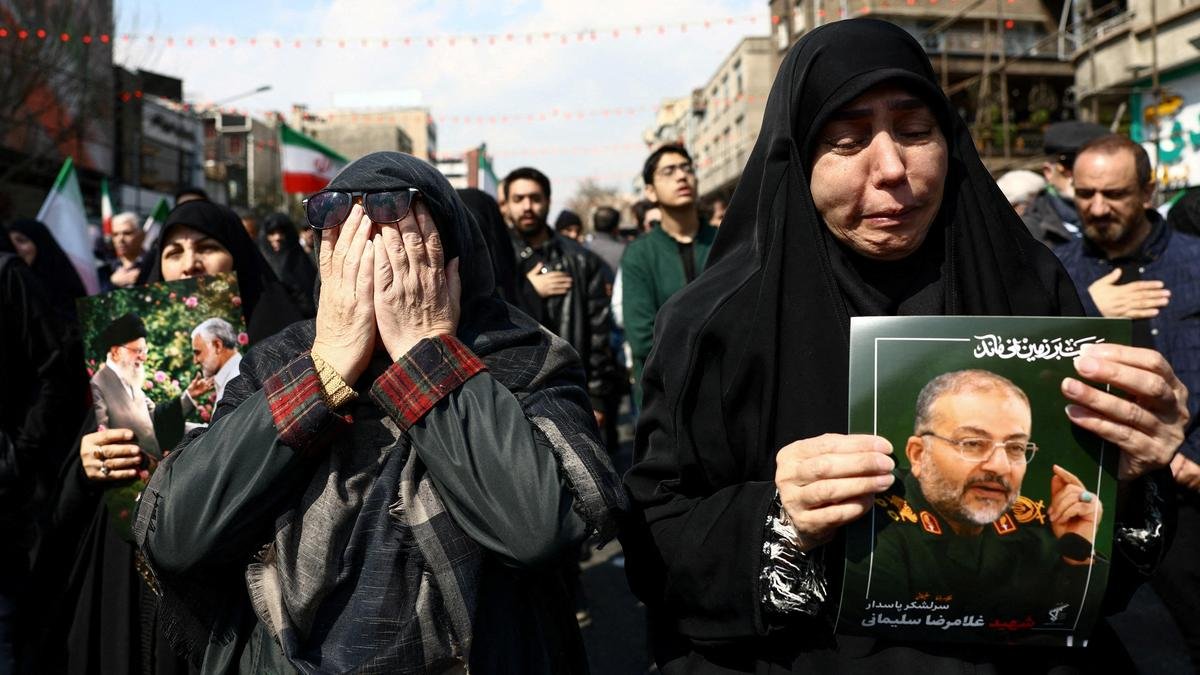
On February 28, the U.S. and Israel assassinated Ayatollah Ali Khamenei, the 86-year-old Supreme Leader of the Islamic Republic of Iran, along with a number of other leaders. On March 17, an Israeli air strike killed Ali Larijani, Secretary of Iran’s National Security Council. The next day, Iran’s intelligence minister was killed. This is not the first time Iran’s senior military and political leaders getting killed.
In January 2020, the U.S. assassinated Qassem Soleimani, one of the most prominent commanders in the Revolutionary Guards. On June 13, 2025, Israel killed a host of Iranian military leaders and nuclear scientists, on the first day of the 12-day war. These killings are clear setbacks to Iran. But despite losing its top leaders and commanders, the Iranian state continues to function while its military refused to stop fighting against the U.S.-Israeli aggression. If Israel and the U.S. thought the decapitation strikes would lead to a state collapse in Iran, it doesn’t seem to be working.
Iran has a long tradition of statecraft, and the core tenets of Shia Islam has remained a defining factor of state behaviour for centuries. Since the Safavid dynasty adopted Shia Islam as the official religion of the Persian empire, Iran (Persia) has been majority Shia. And since the 1979 Islamic revolution that overthrew the Pahlavi monarchy, the revolutionary state came to rest on two pillars: political Shiism and nationalism. In Iran, martyrdom lies at the heart of both. Shias venerate their martyrs, beginning with Imam Ali. By assassinating Khamenei, Larijani and others, the U.S. and Israel have elevated them, in the eyes of their supporters, to a higher realm of martyrdom.
The first martyr
After Prophet Mohammed’s death, his followers split over who should lead the ummah (the Muslim community). One faction backed Ali, the Prophet’s cousin and son-in-law, arguing that the leadership should remain within his family. The other supported Abu Bakr, a close companion of the Prophet, who became the first Caliph. Ali later became the fourth. Those who rallied behind Ali came to be known as Shias [Shi’at Ali], while the followers of the Rashidun Caliphs (Abu Bakr, Umar, Uthman and Ali) formed the Sunni tradition. Ali’s rule was marked by internal strife and he was assassinated, becoming the first martyr in Shia memory. His son Hassan, the second Shia Imam, briefly assumed the Caliphate but abdicated under threats from the Umayyads. Hussein, Ali’s younger son, refused to pledge loyalty to the Umayyad ruler, Yazid. In 680, Hussein and 72 of his followers were killed in Karbala, in today’s Iraq, by the forces of Yazid. Hussein, the third Shia Imam, was beheaded and his head was taken to Damascus, the Umayyad seat of power.
The Battle for Karbala holds enormous significance in both Shia faith and political Shiism. For believers, Hussein, the Imam who refused to compromise even at the cost of his life, embodies the highest ideal of sacrifice. For political Shias, his defiance of the “corrupt” Yazid caliphate represents moral courage in the face of tyranny. (Eash year, Shias around the world mark Ashura, on the 10th of Muharram, with processions commemorating the martyrdom of Hussein.) During the Islamic revolution, Ayatollah Khomeini invoked both sacrifice and courage to mobilise opposition to Shah Mohammad Reza Pahlavi. The monarch, Khomeini argued, was the new Yazid. He called on Hussein’s followers, “the oppressed”, to rise. And they did. Millions, cutting across political currents, joined the uprising, forcing the Shah to flee. After the monarchy’s collapse, the Islamists captured the state in 1979, and established the Islamic Republic.
Ideological core
After the revolution, many experts and world leaders doubted that the theocratic state would endure. Within a year, Iraqi President Saddam Hussein launched invaded Iran, hoping to hasten the collapse of the fledgling republic. The new state was struggling to stabilise a fractured post-revolutionary order. Leftists, trade unionists, Islamists and liberals had all opposed the Shah, and the clergy’s consolidation of power deepened divisions within this coalition.
But Saddam’s invasion changed the equation. Iranians rallies behind the flag; Saddam was cast as the modern-day Yazid. The Islamic Republic moved to purge leftists and liberals at home without provoking any regime-threatening backlash, while the war was under way. In effect, the conflict helped the clergy tighten its grip on power. After Khamenei was killed on February 28, 2026, Larijani repeatedly invoked the ideas martyrdom. He said, “the children of Imam Hussein fear nothing”. After Larijani was killed, Mojataba Khamenei, Iran’s current Supreme Leader, said, “shedding the blood of such people at the foot of the mighty tree of the Islamic system will only make it stronger”. Iran’s leaders know the post-revolutionary state faces its gravest challenge in 47 years. But their response is not to give up the fight and flee, but to embrace the ideological core of the revolutionary state — martyrdom, sacrifice and vengeance.
Published – March 20, 2026 07:03 pm IST


