



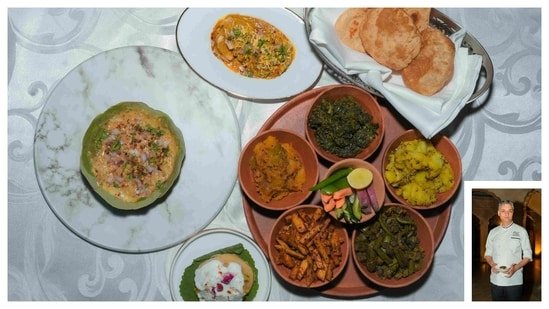
About 25 km north of Jaipur city, roughly 45- 60 minutes by car near the Aravalli Hills, there’s a kitchen doing things differently. Every morning, it smells of fresh herbs and spices while the team works. Vegetarian and non-vegetarian areas are kept completely separate. It’s not just for hygiene. Diners care about that now, and the kitchen’s built around it.
Don’t Delay Your Upgrade
Explore personalized EMI offers for your next purchase
I recently got a chance to explore the restaurant kitchens at Fairmont Jaipur. I saw how the vegetarian and non-vegetarian sections are kept separate. The reason is simple: customers ask for it, and people want strict hygiene standards. In India, food choices are often tied to culture, so kitchens have to account for that. Chef Anal Uniyal, Director of Culinary, Fairmont Jaipur, tells Health Shots in an interview why they keep vegetarian kitchens separate. He has spent 20 years in luxury hotels across India and says guests care a lot about this, health restaurants have to adapt if they want that trust.
Contamination risks in mixed kitchens vs dedicated vegetarian setups
The two biggest contamination risks in mixed kitchens are cross-contact via oil and utensils, the same kadhai, tawa, or fryer used for vegetarian and non-vegetarian, plus shared ladles or spatulas. Airborne or steam cross-contact during cooking and in a common kitchen can carry non-vegetarian particles, which is a concern for strict Jain guests.
“Cross-contamination can pose serious health risks dedicated kitchens allow restaurants to maintain high safety standards by preparing vegetarian meals without the risk of contamination,” Pariksha Rao, Nutritionist and Food Safety Expert, tells Health Shots.
Managing Jain or allergy meals
The Green Kitchen is a dedicated vegetarian facility with separate entry, storage, prep stations, utensils, and oil. This eliminates cross-contact at the source. “For Jain and allergy-specific meals, we follow a no-onion-no-garlic protocol, use separate cutting boards or knives, and tag each order end-to-end. The chef team is briefed on the severity of allergies, it’s medical for Jain, it’s spiritual. Both are non-negotiable,” says Chef Anal Uniyal.
“And yes, luxury guests, especially for weddings, now specifically ask ‘Do you have a pure vegetarian kitchen?’ before booking. For 70% of our celebrations, it’s a deciding factor. We didn’t create this to push a trend we built it because guests were demanding it,” says the chef.
Is vegetarianism healthy or a big myth?
“The two biggest calorie traps in typical hotel vegearian food are refined carbs with cream or ghee overload. Most gravies, dal makhani, and malai kofta are calorie-dense due to the use of heavy cream, butter, and refined oil. Deep-fried starters plus refined carbs samosas, koftas, naans made with maida add empty calories,” highlights the chef.
How does Green Kitchen balance it?
“We’ve eliminated refined oil hotel-wide and moved to cold-pressed plus mustard oil. For dishes like malai kofta, we use cashew- or yoghurt-based gravies instead of cream, roast rather than deep-fry where possible, and control portions. The idea isn’t ‘diet food ’ it’s ‘conscious indulgence’, same rich taste, cleaner ingredients. Guests shouldn’t feel they’re eating hospital food. We keep the flavour, lose the guilt,” explains the Chef.
“We build 20g+ protein mains without relying only on paneer, examples quinoa-lentil khichdi with tempered sprouts, rajma-chawal reimagined with black bean and millet, and tofu or millet kebabs. We combine dals, grains, and seeds to ensure complete amino acid profiles,” he explains.
“We cut salt by layering flavours, roasted spices, fresh herbs, amchur, kokum, lemon, so guests don’t notice the reduction. For sugar, we avoid it entirely in gravies and salads and use dates or jaggery in desserts only when needed,” answers the Chef.
“No refined oil has been available across the hotel since last year. We use cold-pressed groundnut, sesame, and mustard oil. Higher smoke point, better flavour retention, heart-health benefits. It was tedious every recipe was reworked, but that’s how Green Kitchen delivers ‘healthy veg’, not just ‘veg ’small steps, big impact on guest wellness,” says Chef Uniyal.
The rise of ‘healthy vegetarian’
Particularly for destination weddings, 90% of businesses are vegetarian, driven by two main factors . First, cultural practices from the Jain and Marwadi communities require 100% vegetarian prep, often with their own chefs due to shared kitchen concerns. Second, health-conscious High Net-Worth Individuals (HNIs) and Non-Resident Indians (NRIs) are opting for vegetarian choices for wellness and sustainability.
“I’ve transitioned to pure vegetarianism over the past four years, which inspired our dedicated vegetarian kitchen, Green Kitchen. We focus on clean, thoughtfully prepared food without refined oil. As guests become more health-conscious, our staff highlights the nutritional benefits through storytelling. Green Kitchen meets cultural demands and sets a new standard for luxury by prioritising respect, health, and indulgence,” Cluster General Manager overseeing both Fairmont Jaipur and Raffles Jaipur tells Health Shots.
“Creating a unique vegetarian menu in a dedicated kitchen allows for full creativity and respect for ingredients. This focused environment helps maintain freshness and flavour without compromises,” says Chef Uniyal.
(Disclaimer: At Hindustan Times, we help you stay up-to-date with the latest trends and products. Hindustan Times has an affiliate partnership, so we may get a part of the revenue when you make a purchase. We shall not be liable for any claim under applicable laws, including, but not limited to, the Consumer Protection Act, 2019, arising from the products. The products listed in this article are in no particular order of priority, and the brands have not been directly suggested by the expert mentioned.
This article is for informational purposes only and is not a substitute for professional medical advice. Always seek the advice of your doctor with any questions about a medical condition.)


