


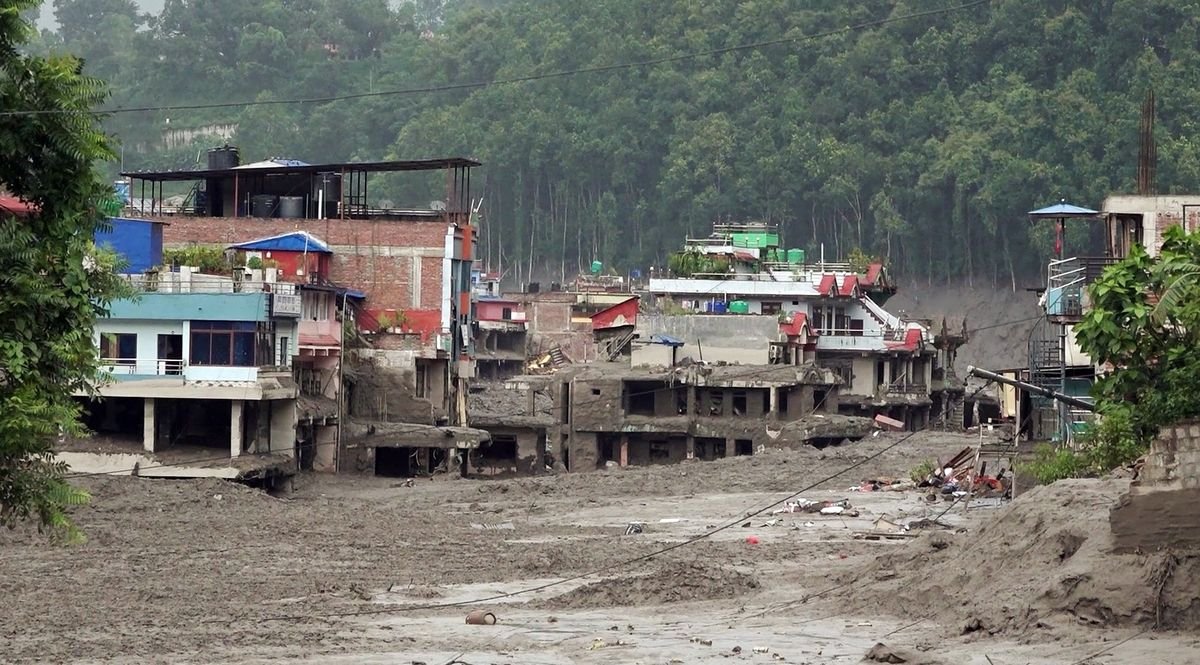
Srinagar, Aug 29: The devastation in Nepal has sent a chilling warning across Jammu and Kashmir: when a warming climate meets fragile mountain terrain and unchecked human intervention, an extreme weather event can rapidly turn into a catastrophe.
For J&K, the question is no longer whether climate change is altering the Himalayan environment. It is whether the Valley is adequately prepared for the increasingly erratic and intense weather events being witnessed across the region.
Nepal recently witnessed a devastating flash flood in the Lhende Khola area near the Nepal-Tibet border after an ice-and-rock avalanche entered the river system.
The torrent swept away homes, roads, bridges and critical infrastructure, leaving a trail of destruction and triggering a major rescue operation.
The disaster has once again drawn attention to the growing vulnerability of Himalayan communities to glacial, geological and weather-related hazards.Kashmir, meanwhile, has been experiencing its own alarming pattern.
J&K has witnessed 40 cloudbursts, flash floods and landslides this summer, with incidents reported from Kishtwar, Doda, Ramban, Pahalgam, Shopian, Kulgam, Bandipora and Kupwara.
In several cases, streams that normally remain relatively calm have transformed into torrents within minutes, damaging roads, bridges, homes and agricultural land.
Climate expert Dr Tauseef Ahmad Bhat said the developments in Nepal should be viewed as a warning for the entire Himalayan region.“Kashmir should not wait for a Nepal-like catastrophe to understand the seriousness of what is happening in the Himalayas.
We are witnessing increasing climate volatility, where prolonged dry periods can be followed by short-duration, extremely intense rainfall. In mountainous terrain, even a few minutes of extreme precipitation can trigger flash floods, landslides and debris flows,” Bhat said.
He said the concern was not simply about whether Kashmir receives more or less rainfall.“The bigger concern is the changing character of rainfall and the increasing intensity of extreme events.
A warmer atmosphere can hold more moisture, while warming can also contribute to instability of snow, ice and mountain slopes. Kashmir needs to prepare for compound disasters rather than treating every cloudburst as an isolated incident,” he said.
Senior environmentalist Dr Tanveer Ahmad Khan said Kashmir’s vulnerability was being compounded by human pressure on an already fragile ecosystem.
“Nepal is a warning, not merely a tragedy happening in another Himalayan country. Kashmir shares many of the same vulnerabilities—steep slopes, fragile geology, changing climate and increasing pressure from construction and infrastructure development.
If drainage channels, river buffers, wetlands and unstable slopes continue to be disturbed, the impact of extreme weather will become much more severe,” Khan said.
He said development planning had to take future climate risks into account. “We cannot continue to build as if the climate of the past is going to remain unchanged. Roads, hydropower projects, tourism infrastructure and settlements in mountain areas must be planned according to future climate risks.
Every blocked natural drainage channel and every disturbed vulnerable slope reduces our margin of safety,” Khan added. The Nepal disaster has also underlined how quickly a single extreme event can cripple mountain infrastructure.
Roads, bridges and power installations can be destroyed simultaneously, cutting off entire communities and making rescue operations far more difficult.
For Kashmir, where highways, hydropower projects, tourism infrastructure and settlements are steadily expanding into mountain areas, experts say the lesson is particularly relevant.
Afreen Khurshid, PhD research scholar at the University of Kashmir, said the focus must shift from responding to disasters to anticipating them.
“The biggest lesson from Nepal is that vulnerability is created long before a disaster actually occurs. Climate change may intensify the hazard, but exposure and poor planning determine how devastating the final impact becomes.
Kashmir urgently needs detailed hazard mapping of slopes, streams, flood channels and settlements, particularly in rapidly developing mountain areas,” she said.
Khurshid stressed that early-warning systems must reach vulnerable communities on the ground.“An early warning is useful only when it reaches the last person living near a stream, a shepherd in the upper reaches, a tourist, a pilgrim or a person travelling through a vulnerable mountain corridor.
Community preparedness, clearly identified evacuation routes and local response mechanisms can make the difference between an extreme weather event and a mass-casualty disaster,” she said.