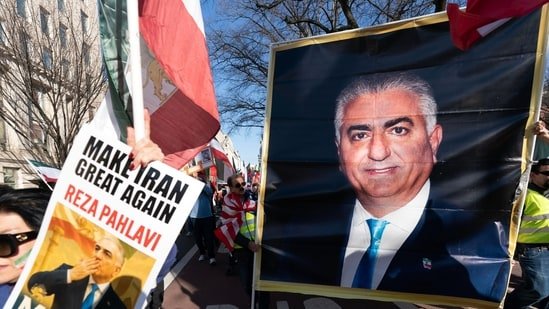
A month ago, Iran’s opposition in exile was punch-drunk on war fever. Many Iranians looked to America and Israel for salvation after the regime’s thugs slaughtered protesters by the thousands in January. Exiles thronged the streets of London, Los Angeles and Toronto to celebrate the killing of Iran’s supreme leader, Ayatollah Ali Khamenei. At home and abroad, tens of thousands rallied behind Reza Pahlavi, son of the last shah and a self-proclaimed leader of a would-be transition, who described the bombing as “humanitarian”.
Demonstrators carry a photograph of Reza Pahlavi as people who support the US and Israel strikes on Iran, rally near the White House in Washington. (AP)
Today, diehards still liken the bombardment to chemotherapy. Some march in London with banners of the Israeli army alongside royalist flags. Others harass Persian restaurants, demanding they pin displays of support in their windows. Iran International, an opposition satellite channel based in London, backs the war and the restoration of the Pahlavis to the throne.
But many have become queasy. The rallies are now dwindling in size. A broader range of diaspora voices is speaking up. Iranian musicians pack concert halls, stirring sympathy for civilians buried beneath the rubble. Doctors, teachers and academics stage vigils for Minab, a southern Iranian town where an American missile struck a school, killing over 160 people, most of them schoolgirls.
As America and Israel expand their target lists from regime strongholds to national infrastructure, fears for relatives left behind are mounting. Mr Pahlavi has been accused of showing greater sympathy for fallen American soldiers than for more than 1,500 civilians who have been bombed to death at home. Some say his alignment with Israel makes him “a useful idiot” and that he has acquired an autocratic streak akin to the ayatollahs’.
So some of the fractious opposition is looking elsewhere. On March 28th an unusually broad coalition of Iran’s political, ethnic and religious groups met in London to launch the Iran Freedom Congress, which says it will keep its distance from America and Israel. Speakers denounced attacks by those countries on oil facilities and defence installations. The war, one said, was a catastrophe that had strengthened the regime just as domestic unrest had begun to push for a democratic transition. “Regime change should not happen like this—it should be an Iranian project, not an Israeli one,” said another organiser. Some even expressed pride in Iran’s resistance to the world’s most formidable fighting force. The organisers appealed to Iran’s pluralist mix. To appear inclusive, they displayed monarchist and republican flags on stage. Kurdish and Baluchi representatives won applause.
Any attempt at unity will be challenged. Pahlavi fans protested outside the new congress, deriding the gathering as a front for leftists and covert regime sympathisers. Pro-regime voices objected to the absence of the Islamic Republic’s flag, with its inscription to Allah, and reposted a report saying that the group was being promoted by publicists that back Israel. Attitudes to the war created such rancour that the final communiqué omitted any reference to it.
Such disarray must surely hearten the regime. Ongoing mass protests inside Iran that were promised by Mr Pahlavi and his foreign backers have not materialised. Instead, city squares are filled each night with pro-regime zealots. Yet when the fighting ends, the questions that dogged the ayatollahs before the war will persist. The economy will be shattered and dissent more harshly suppressed. Even in wartime, executions of detained protesters have resumed. Demonstrations could reoccur, as they did six months after the last war with Israel. If they do, Iranians could benefit from a united democratic opposition to rally behind. It has yet to emerge.
Sign up to the Middle East Dispatch, a weekly newsletter that keeps you in the loop on a fascinating, complex and consequential part of the world.