



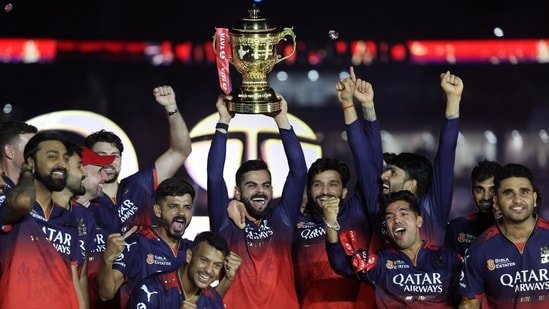
The Indian Premier League has firmly established itself as the breadwinner for cricket, with RCB and RR’s mega-money sales and the media rights pointing towards the incredible valuation of the league. With 10 teams already and a 74-match schedule, the IPL’s future will be one where it only grows bigger and richer – but the roadmap to getting to that point isn’t easy.
IPL chairman Arun Singh Dhumal revealed what the considerations for the governing council and the BCCI are, and even pointed towards the range of options being considered for the IPL’s next steps. These might only come about following the conclusion of this set of FTP scheduling, but would fall in line with the IPL’s fresh cycle – but expansion isn’t on the cards beyond the 10 current teams.
“When we go into the next cycle of bilaterals, we will try to see whether we can get a bigger window during this period so we can go from 74 to 94 games,” said Dhumal in an interview with the Financial Times.
Bilaterals an endangered species
“That is also why we are not thinking of extending the number of teams right now. With the current number of teams, you can still increase the number of matches. If you add more teams and then calculate home-and-away, it becomes difficult to make it work,” he explained.
The IPL’s future growth also premeditates the further shrinking of bilateral tours, which have certainly seen the focus shift away, but used to rule the roost in global cricket until very recently.
“If you look at the transition over the last few years, there is definitely less interest in some bilateral games. That is why countries are coming up with their own leagues: the England and Wales Cricket Board’s The Hundred, Australia’s Big Bash League, the UAE’s International League T20, South Africa’s SA20 and the Caribbean Premier League,” pointed Dhumal.
September-October window entices IPL, BCCI
The reduction of bilaterals isn’t the only path forward for Dhumal: while he indicated stretching into June was not a feasible move for the IPL, he did indicate that the September-October portion of the calendar is something that the governing council has an eye on. A potential second window in the year for the IPL.
“There are different possibilities. One is reducing some bilaterals. Another is carving out a window elsewhere. In case we get some windows during September or October, when you have the end of the English season and before the start of the Australian season, then if we have a few days available there, we can extend at that time,” said Dhumal.
Ultimately, Dhumal had very little doubt that the outlook of international cricket would be very different. He maintained the case for Test series and ICC tournaments, but believed that especially after the 2028 Olympics where cricket makes its debut, global cricket would come to be more similar to the football calendar in structure.
“In case these leagues are to be held regularly, that is the new world order for cricket: fewer bilaterals, more league cricket, and in between you have ICC events, a bit like football,” stated Dhumal.


