



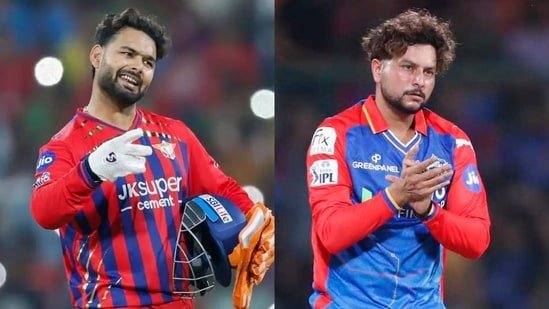
Rishabh Pant going back to Delhi Capitals would have been emotional enough on its own. Kuldeep Yadav moving the other way to Lucknow Super Giants would have made it a significant cricketing trade. But the real story sits somewhere sharper, colder and more revealing: this is not just a player swap. It looks like an IPL market correction.
As reported by Cricbuzz, the proposed deal would see Pant return to DC at a reduced salary of around INR 15 crore, down from his INR 27 crore contract at LSG, while Kuldeep moves to Lucknow on his existing INR 13.25 crore fee. That means Pant is not merely changing dressing rooms. He is potentially returning to his old franchise after accepting an INR 12 crore pay cut – a 44.44% drop from the price that made him the costliest player in IPL history.
That number changes the entire meaning of the trade.
At INR 27 crore, Pant was never being paid only for runs. He was being paid as a franchise face, captaincy bet, wicketkeeper-batter, Indian superstar, left-handed middle-order disruptor and commercial magnet. LSG were not just buying a player; they were buying a new era. But two seasons later, with the franchise looking for a new direction and Pant no longer expected to continue as captain, the valuation has clearly shifted.
Our IPL monetary-performance correlation analysis explains why.
Pant was not a flop, but he was not INR 27 crore either
The harshest mistake in reading Rishabh Pant’s IPL 2026 season would be to call it a complete failure. It was not. He made 312 runs at a strike rate of 138.05, with 30 fours and 11 sixes. He had one fifty, five 30-plus scores and only three single-digit innings. His impact rank in our analysis was also respectable: 39th out of 203 players.
So this is not the profile of a player who has lost all value. It is the profile of a player whose price had moved far beyond his output.
The deeper numbers show the problem. Among batters who faced at least 100 balls, Pant ranked only 51st out of 60 for strike rate and 52nd out of 60 for boundary percentage. That is the real worry. For a player priced as an elite game-breaker, he was not regularly breaking games open.
His phase split tells the same story. Pant’s death-overs returns were strong – 72 runs from 35 balls at a strike rate of 205.71. That remains valuable. But in the Powerplay, he scored 49 off 52 balls at a strike rate of just 94.23. That dragged down his overall impact and made his season look more like a useful middle-order campaign than a franchise-defining one.
Even his wicketkeeping added a similar mixed picture: 10 catches, 4 drops and a catching efficiency of 71.43%. Again, not disastrous. But not premium-proof either.
The monetary side was brutal. Pant’s INR 27 crore cost translated into an estimated worth of INR 14.28 crore, leaving him with a negative P/L of INR 12.72 crore. He recovered only 52.9% of his price and ranked 199th out of 203 players in season P/L.
That is why the reported INR 15 crore revised fee is so interesting. It is not random. It almost matches our calculated value of INR 14.28 crore. In other words, the market may finally be pricing Pant closer to what his current IPL output actually justifies.
Kuldeep’s case is different – his price is not the only issue
Kuldeep Yadav’s side of the trade is more complicated because his problem was not just salary. His cricketing output itself was under serious pressure.
He took 10 wickets in 37 overs, but conceded 381 runs at an economy rate of 10.30. His dot-ball percentage was only 26.13%, while his boundary concession rate stood at 21.62%. For a lead spinner, those are uncomfortable numbers.
The pattern was even more worrying. Kuldeep went wicketless in 6 of his 11 bowling innings, and 8 of his 11 spells went above 10 economy. His best return, 4-0-29-3, came late enough to soften the season profile but not rescue it.
Phase-wise, Kuldeep’s best stretch came between overs 7 and 11, where he took 6 wickets at an economy of 8.75. But from overs 12 to 16, he leaked runs at 11.93, and at the death he went at 13.00. That made him difficult to protect tactically.
Our model punished him heavily. Against a salary of INR 13.25 crore, Kuldeep’s estimated worth was only INR 1.47 crore. His P/L stood at negative INR 11.78 crore, with just 11.1% cost recovery. He ranked 198th out of 203 players in season P/L – one place better than Pant, but with a far weaker performance-recovery ratio.
That is the key distinction. Pant’s issue was inflated price against still-useful output. Kuldeep’s issue was poor output against a still-significant price.
Why DC may still come out smarter
From Delhi’s perspective, the trade has a clear emotional pull. Pant played 111 matches for DC between 2016 and 2024 and captained the side in 43 of them. A return would immediately restore a lost identity link between player and franchise.
But the smarter reading is financial. DC would not be getting back the INR 27 crore version of Pant. They would be getting back a corrected-price version. At around INR 15 crore, Pant becomes much easier to justify: Indian wicketkeeper, left-handed middle-order option, brand value, fan connection and late-overs upside.
And importantly, they would be moving out Kuldeep after a season in which his numbers made the INR 13.25 crore fee look deeply uncomfortable.
For LSG, the logic is riskier but still understandable. If they are moving on from Pant as captain and franchise centrepiece, they need to reset their structure. Kuldeep gives them a specialist Indian wrist-spin option, and wrist-spin remains one of the hardest skills to buy when it comes good. But they would be taking him at a price where 2026 performance gives very little comfort.
That makes this trade fascinating.
DC would be betting on Pant’s corrected valuation. LSG would be betting on Kuldeep’s correction in form.
Verdict: This is not a homecoming story alone
Pant’s potential DC return is not just nostalgia. It is the IPL admitting that INR 27 crore was too heavy for the output he delivered. At INR 15 crore, Pant becomes a much more logical asset. At INR 27 crore, he was a burden unless he dominated. At INR 15 crore, he can be imperfect and still valuable.
Kuldeep, meanwhile, becomes the bigger cricketing gamble. His ceiling is obvious, but his 2026 numbers were too poor to ignore. Ten wickets, 10.30 economy, 21.62% boundary rate and only 11.1% salary recovery do not scream safety.
So the trade is not really Pant vs Kuldeep. It is two franchises trying to correct different mistakes.
Delhi may be trying to fix a relationship and recover an identity. Lucknow may be trying to fix a leadership bet and rebuild their tactical core. But the numbers say something even sharper: Pant’s value has been cut to size, while Kuldeep’s value still needs to be proven again.
That is what makes this rumoured trade bigger than a swap. It is a public price correction of one star and a high-risk rehabilitation bet on another.
Method note
The monetary valuation is based on a performance-value model that weighs player output, match impact, role value and salary recovery against the player’s IPL 2026 cost.
The model is an analytical estimate, not an official IPL or franchise valuation. Trade details and salary adjustments are based on reported information and remain subject to formal approval.


