


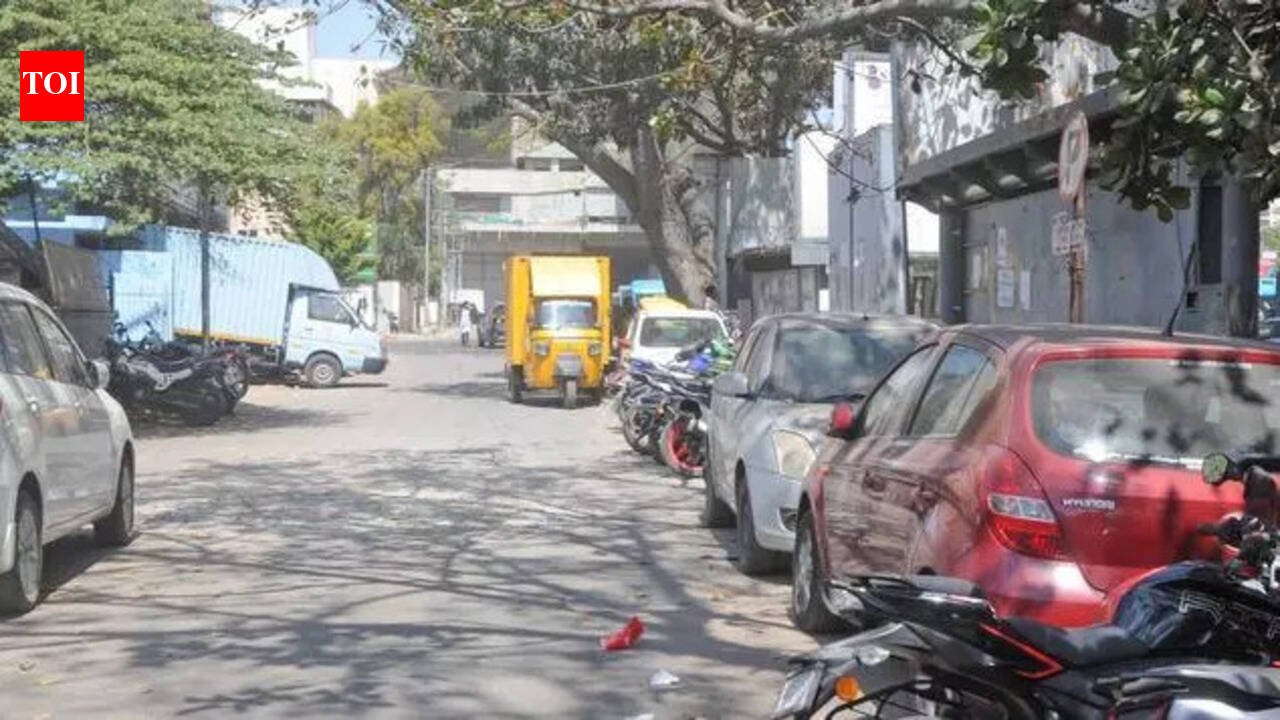
Bengaluru: As Namma Metro‘s much-awaited Pink Line inches closer to launch, a ground visit along Bannerghatta Road presents a starkly different picture — one marked by potholes, barricades and broken access.A reality check by TOI along the stretch from the NICE Road–Kanakapura Road junction to Dairy Circle found commuters negotiating what feels like an obstacle course. Several sections remain scarred by dug-up patches and crater-like potholes. Motorists swerve across uneven surfaces, while pedestrians are pushed onto the main carriageway as footpaths lie obstructed by stacked concrete pipes, construction debris and mounds of garbage.
Residents say that unless these basic civic issues are urgently addressed, the Metro’s promise of seamless mobility may ring hollow. Many also point to the absence of a clear first- and last-mile connectivity plan. Without safe pedestrian crossings, reliable feeder services and well-laid access roads linking neighbourhoods on either side of Bannerghatta Road to the upcoming stations, they fear the Pink Line may fall short of significantly easing their daily commute.BMRCL plans to open the 21-km Pink Line, connecting Kalena Agrahara to Nagawara, in 2 phases. In the first phase, the elevated stretch from Kalena Agrahara to Taverekere (Swagath Cross Road) is likely to be thrown open to the public in May this year. The 7.5-km elevated corridor will have 7 stations—Kalena Agrahara, Hulimavu, IIM-B, JP Nagar 4th Phase, Jayadeva, and Taverekere. BMRCL has already began trial runs using the prototype train supplied by BEML. In the initial phase, the line is expected to operate with 4 to 5 trains. The entire Pink Line is likely to become operational by the end of the year, officials said.Here is what the TOI team observed during a ride along the carriageway beneath the Metro corridor:Kalena Agrahara Metro stationOnce operational, this Pink Line station is expected to cater to residents living beyond NICE Road, areas in Gottigere, Doddakammanahalli and Himagiri roads, and neighbourhoods between Kanakapura Road and Bannerghatta Road such as Kothnur and Anjanapura.However, access to the station remains a pressing concern. A nearly 4-km stretch—from Basavanapura bus stop beyond the NICE Road junction to Kalena Agrahara—lacks proper footpaths, forcing pedestrians to walk perilously close to heavy trucks and fast-moving vehicles. Road conditions are equally dismal, with multiple potholes and large craters visible within 100 metres of the first Pink Line pillar from the Gottigere side.Near the Himagiri bus stop, heaps of garbage line the roadside, and commuters wait at a makeshift stop beside an open drain amid a persistent stench.Vaibhav P, a resident of Gottigere, pointed out that Metro construction has dragged on for more than eight years, even as rapid urbanisation transformed the area. “Apartments priced at Rs 4–6 crore are being sold on the promise of Metro connectivity, but the approach roads and footpaths are unusable. Basic amenities must be in place before the line is launched,” he said.Hulimavu Metro StationLocated near educational institutions, a mall and several commercial establishments, Hulimavu station is expected to serve residents of Hulimavu and Arekere on the right side of Bannerghatta Road, as well as neighbourhoods such as Kothnur and JP Nagar 8th Phase.Although the carriageway here is four lanes wide, pedestrian infrastructure tells a different story. Uneven footpaths and debris dumped along the roadside have forced many to walk on the main road, often amid speeding traffic.Siddarath Raj, a pedestrian, criticised what he described as poor-quality road repairs. “Authorities carried out shoddy repairs; potholes were filled without proper planning. Opposite the Christ University campus, pipes were dumped on the road and lay there for months. The footpaths are in bad shape. If the roads are maintained well, it would at least help people park their bikes and use the Metro to travel towards the Jayadeva side,” he said.IIM-B Metro StationLocated near the Indian Institute of Management Bangalore, this station is expected to serve residents of Bilekahalli, neighbourhoods on either side of Brigade Millennium and Sir M Visvesvaraya Road, among others.However, the stretch between IIM-B and the Vega City Mall junction—particularly on the left side of the road—remains one of the worst-maintained sections along the corridor. Commuters contend daily with dust from the neglected carriageway, while concrete pipes dumped along the footpath have rendered it unusable. The road was dug up years ago by civic agencies to lay utilities, but restoration work has dragged on.Ravikiran Reddy, a resident, said: “The road has been in bad condition for years, but no one seems to care about restoring it. Footpaths are encroached upon by debris and concrete pipes, and pedestrians are ignored. These issues should be fixed before the Metro station is opened.” JP Nagar 4th PhaseLocated over 2 km from IIM-B, this station comes up along one of the most congested stretches of Bannerghatta Road — the junction near Vega City Mall where the Outer Ring Road intersects. The bottleneck routinely witnesses heavy traffic, especially during peak hours.The JP Nagar 4th Phase station is expected to benefit commuters from various parts of JP Nagar. In future, it is also set to become an interchange, linking with the proposed Orange Line from JP Nagar 4th Phase to Kempapura. However, the lack of proper footpaths on either side of the road is a major drawback.Jayadeva Metro StationThe city will get its third interchange station at Jayadeva. The station — the tallest Metro structure in Bengaluru — was partially opened last year with the inauguration of the Yellow Line connecting RV Road to Electronics City. Unlike several other stations along the corridor, Jayadeva enjoys relatively better bus connectivity, with stops located close by. This is expected to benefit commuters travelling from Bilekahalli, the Outer Ring Road and JP Nagar areas.However, authorities will need to plan robust last-mile connectivity to ensure seamless access to the station. Once fully operational, the interchange is also likely to serve thousands of patients and attendants visiting Jayadeva Hospital. Taverekere StationThe terminal station of the elevated stretch of the Pink Line will benefit residents of Jayanagar, Tilak Nagar, Taverekere and surrounding areas. However, access to the Taverekere station remains in poor condition, with debris dumped along the Metro median creating an eyesore.At several points, garbage piled up on vacant sites and burnt plastic waste have led to suffocating conditions, particularly near Jal Bhavan Road. Apart from these garbage blackspots, poorly maintained bus stands are adding to commuter inconvenience.Pothole-ridden roads make the stretch between Jayadeva Hospital and Dairy Circle especially difficult to navigate. Even in sections where underground Metro work is under way, road conditions remain dismal — barring stretches where BMRCL has laid concrete roads. At busy junctions such as Dairy Circle and Lakkasandra, pedestrians face significant challenges while attempting to cross the road.


