



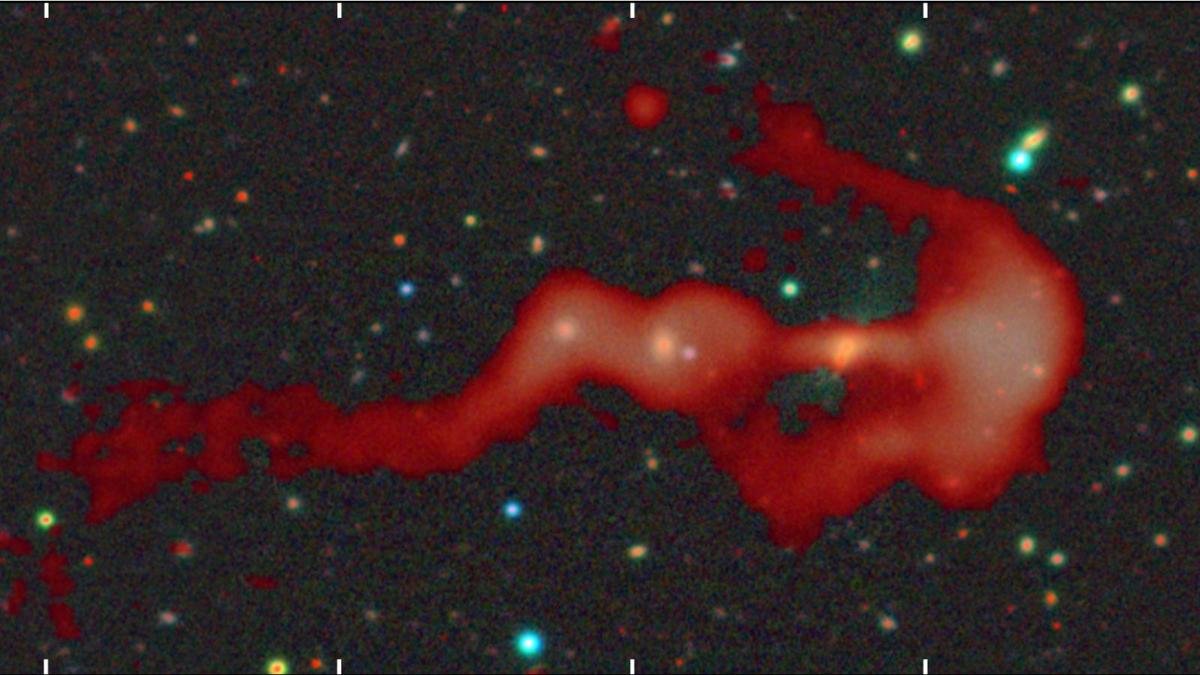
Twelve Indian researchers across three countries have discovered a rare, nonconformist radio galaxy, shaped like a bow and arrow and 1.8 million light years wide, located approximately 2 billion light years from Earth.
A light year is about 5.88 trillion miles. A radio galaxy, powered by supermassive black holes at its core, is a type of active galaxy that emits very high amounts of energy in the form of radio waves.
The newly discovered arc-like system has been named RAD-BAARG, where RAD stands for RAD@home Astronomy Collaboratory, India’s first citizen science research platform in astronomy based at Kharghar in Navi Mumbai. BAARG expands to Bow And Arrow Radio Galaxy.
The research team’s paper, titled “RAD@home discovery of a bow-and-arrow radio galaxy tracing a ∼560 kpc bow-shock structure in a multi-halo environment”, was published in the journal Monthly Notices of the Royal Astronomical Society on June 22. According to the paper, the “highly unusual” and asymmetric structure is unlike those seen in standard radio galaxies.
Kpc is short for kiloparsec, a unit of astronomical distance equal to 1,000 parsecs, or about 3,260 light-years.
The lead author of the study is Ananda Hota of the University of Mumbai and the founder-director of the 13-year-old RAD@home, which enables university students and others to conduct extragalactic research and make astronomical discoveries from the comfort of their homes.
The other authors — all associated with RAD@home — are Pratik Dabhade of the Poland-based National Centre for Nuclear Research; Shubhrangshu Ghosh of Sikkim’s Shri Ramasamy Memorial (SRM) University; Mitali Damle of New York University Abu Dhabi; Souvik Manik and Sabyasachi Pal of West Bengal’s Midnapore City College; C. Konar of Noida-based Amity University; Sagar Sethi of Poland’s University of Warmia and Mazury; and Pranim Limbo, Aditya Sahasranshu, Sravani Vaddi, and Arundhati Purohit.
Supersonic fall
The RAD-BAARG was found using ultra-sensitive images from the LOFAR (Low Frequency Array) Two-metre Sky Survey, one of the deepest radio surveys ever conducted at low frequencies. Its discovery follows the team’s 2025 identification of the farthest and most powerful Odd Radio Circle known at that time.
According to Mr. Ghosh, the huge black holes in radio galaxies launch enormous jets of relativistic magnetised plasma into intergalactic space. In the RAD-BAARG, one of the jets appears to interact with a large bow-shock-like structure formed as the host galaxy falls through the surrounding hot gas toward a nearby cluster of galaxies.
“Similar to the shock wave formed ahead of a supersonic aircraft, a galaxy moving faster than the speed of sound in the surrounding intra-cluster medium can compress the ambient gas and generate a large-scale shock front. The radio-emitting plasma from RAD-BAARG appears to illuminate this otherwise extremely faint structure, making it visible in low-frequency radio images,” Mr. Ghosh told The Hindu.
“The western side of the source contains a narrow jet feeding a sector-shaped emission region and a giant arc-like feature extending over nearly 560 kpc (1.8 million light years). On the opposite side, the jet develops a distorted S-shaped morphology followed by a faint offset tail extending to almost 600 kpc. The overall structure suggests strong interaction between the radio plasma and the surrounding large-scale environment,” he said.
The research team found that the host galaxy resides in a dynamically complex environment containing nearby cluster-scale systems at similar distances. The morphology was observed to be consistent with interaction between the radio jets and large-scale environmental gradients, bulk gas motions, and possible shock-related compression associated with the galaxy’s infall.
An infall refers to the gravity-induced inward movement of gas, dust, or cosmic bodies toward a massive object.
Also read | Mumbai-led team helps reveal mysterious twin rings around galaxy
Clearest radio signatures
“Although theoretical studies and computer simulations have long predicted bow shocks around infalling galaxies, detecting them directly has proven extremely difficult because the surrounding gas is extraordinarily diffuse and faint. The RAD-BAARG provides an unusually detailed radio view of such a phenomenon,” Mr. Ghosh said.
“The structure of this source is unlike that of any radio galaxy I have seen in 25 years. Its remarkable morphology appears to display signatures of interaction between relativistic radio plasma and a large-scale shock generated during the galaxy’s infall into a nearby cluster environment,” Mr. Hota said.
“BAARG is exciting not just because of its striking bow and arrow shape, but because it sits in a complex multi-halo environment where gas flows, infall, and possible shocks can reshape radio plasma,” Mr. Dabhade said.
The researchers said LOFAR helped them see the faint, low-surface-brightness emission from the RAD-BAARG in “remarkable” detail. They hoped that next generation radio astronomy facilities, including the Square Kilometre Array Observatory under construction, would facilitate a better understanding of how radio galaxies evolve within the large-scale cosmic environment.
The team also suggested using Artificial Intelligence and machine learning techniques to identify additional unusual radio galaxies hidden within the enormous data volumes expected from upcoming radio sky surveys.
Published – July 03, 2026 12:36 am IST


