





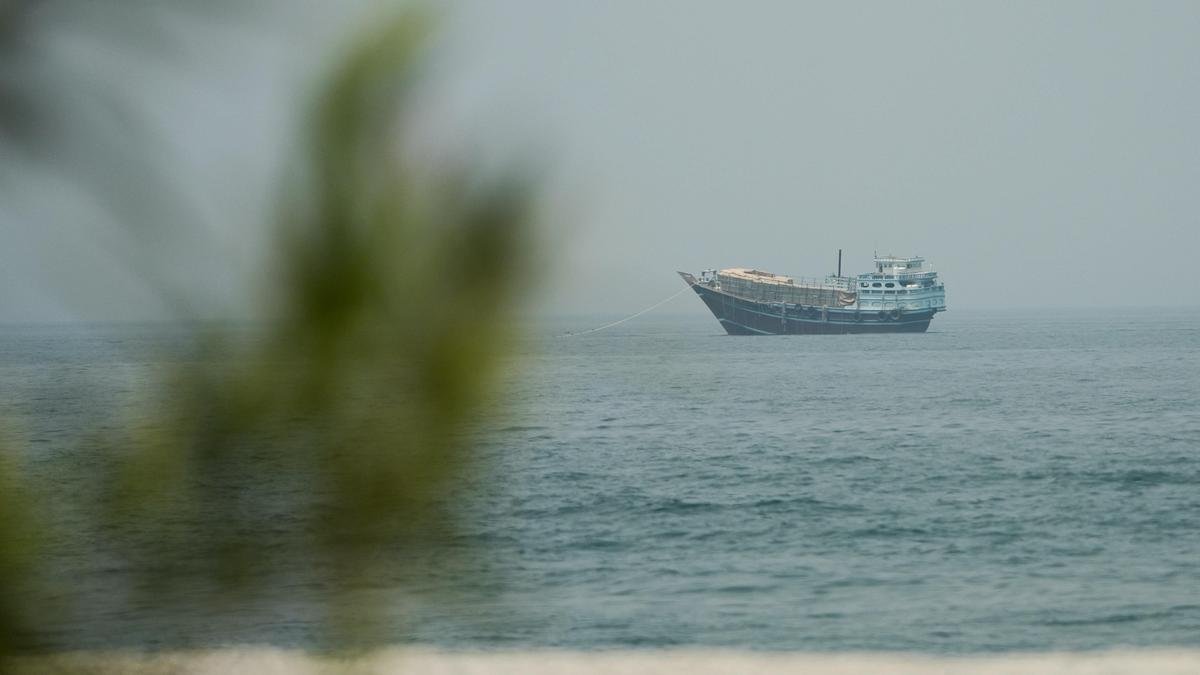
“It was a psychological warfare, and the conflicting authority at play, not knowing whom to trust, was the most jarring aspect of the journey,” the sailor said. File
| Photo Credit: Reuters
Chaos, uncertainty, numbness, and conflicting orders marked the ordeal of an Indian seafarer aboard a tanker that transited the Strait of Hormuz on Monday (July 13, 2026).
Speaking to The Hindu, the seafarer, who requested anonymity, explained how the fully-loaded Very Large Crude Carrier (VLCC), carrying more than two million barrels of crude oil, and its crew were caught between the threats from the Iranian Navy and encouragement to move forward from the U.S. while transiting the strait through the southern route close to the Oman coast.
The situation was relatively normal when they went into the Persian Gulf to load at Basrah in Iraq, but it deteriorated rapidly as they finished loading and started to return, with ships coming under attack near Oman and warnings from the Joint Maritime Information Centre moving from medium to substantial and severe threat levels. The sailor said the company instructed them to halt, and they drifted along Abu Dhabi out of port limits (OPL) for around four days.
Pressure from company
While the company respected the consent of the seafarers to make the risky return journey, there was also “immense pressure” from it to make the transit, the sailor said. The incentive offered was “too good to pass”, and the crew decided to take the risk. “There are limited ports for a VLCC tanker to load around the world, and how long could one say no and wait for permanent peace in the region,” he asked.
The transit was planned to begin the morning of July 12, and he described the scene on the morning as “absolute chaos” following an attack on GFS Galaxy, whose crew, Indians among them, were forced to abandon ship. The initial call was to halt their transit and turn back, but the company offered to “double its incentives” to move on, he said. Things were normal till the entry of Hormuz, a 12-hour journey from Abu Dhabi OPL, and regions like the periphery of Abu Musa Island which usually welcomed ships, he said.
The entry to Hormuz, abeam of Mina al Saqr hub, was different. There were around six smaller vessels in front of their tanker at this point, and warnings began flooding in through the very high-frequency radio system, with Iran urging vessels not to enter as the strait was “closed”. The Iranian Navy was naming the smaller vessels, repeating that they were within its target range and would “blow them up” if they do not alter their course.
‘Scared, numb’
“We were not just scared; we were numb. We had reached the entrance and now had no idea what to do,” the sailor said. The dilemma was whether to abort the transit or not. The smaller vessels replied that they were on their way to the port hub and altered course, he said. However, the U.S. Navy began broadcasting messages in reply to Iran, asking ships to move forward, reiterating that they were in “international waters and would be protected”. But this was not reassuring to the crew, with Iran asking them “not to trust” the U.S. side. “They cannot protect you, but we value your life and take the warning and turn back,” he quoted the Iranian warning.
“It was a psychological warfare, and the conflicting authority at play, not knowing whom to trust, was the most jarring aspect of the journey,” he said.
There were two other ships along with the tanker on the strait, and he could hear choppers and jets flying past. He said the transit could not have been possible without the support of the U.S. Navy. The ship was in contact with the U.S. Navy throughout the journey, updating its position every 10 minutes and looking out for signs of threat and reporting in detail every 10 miles. While both rival navies broadcast messages, the sailor said his crew was advised to use email instead of radio or satellite phones for one-on-one communication with the U.S. Naval Computer and Telecommunications Command.
Acknowledging that the U.S. support was “crucial” for the transit, the sailor said that he felt there was support from Iran as well. He said the tanker was huge and easier to target. While vessels were struck on the day his ship began the transit and the day after, he wondered why his ship and the two others were left alone. The fact that an attack on a fully loaded oil tanker could lead to serious environmental consequences in the region could be a reason, he said while also not writing off the possibility of unknown U.S. interventions.
Now miles off the dangerous territory and en route to entering the international waters in the Arabian Sea, he recalled the moment the warnings started flooding the radio at the entrance to Hormuz and explained how he felt he would settle with just “getting to safety alive instead of the insane incentives”.
Published – July 14, 2026 10:53 pm IST


