






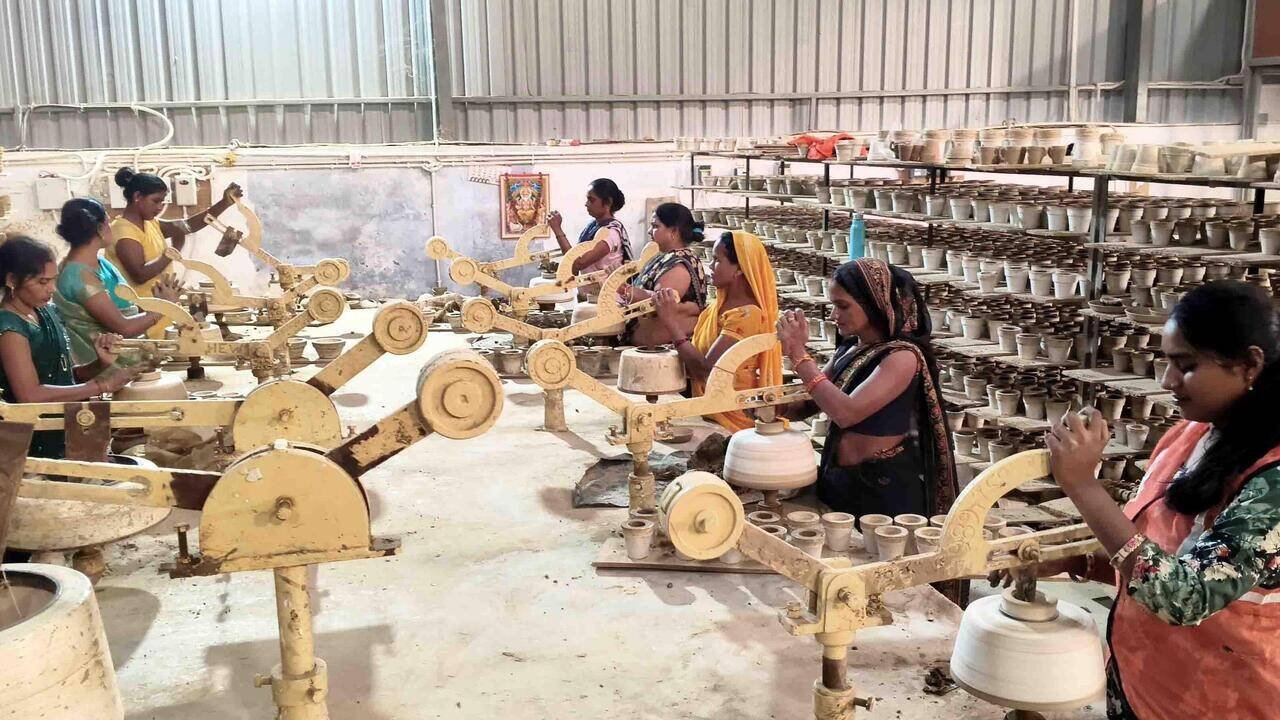
Prayagraj: The state government is breathing new life into the dying tradition of clay craftmanship. In the Prayagraj division, more than 7,000 families, who had previously distanced themselves from the ancestral craft due to declining market demand and competitive pressures, are now rapidly embracing it due to government-led innovations.The state government is actively working to boost livelihood of traditional artisans engaged in making clay-based items—such as idols, diyas (lamps), toys and household utensils—that are both artistic and functional. The ‘Mukhyamantri Matikala Rojgar Yojana’ (Chief Minister’s Clay Art Employment Scheme) is serving as the vehicle for this transformation.Senior manager (Khadi and Village Industries) for the Prayagraj division, Jawaharlal said that under this scheme, over 200 artisans in the district have received free electric potter’s wheels and tools over the past three years. To diversify their product range, artisans have also been provided with free moulds for making idols. Additionally, coloring machines have been distributed to ensure the products have a glossy sheen and a superior finish.To enhance their skills, artisans have been given training and access to low-interest loans. A major shift in the production and marketing of these clay crafts happened with the inauguration of a Common Facility Centre (CFC) in Phaphamau in September 2021, set up at a cost of ₹3 crore.Ashok Kumar Singh, general manager of ‘Manav Kalyan Seva Samiti’—the organization operating the CFC—explains that the centre aims to streamline terracotta production by providing artisans with modern technology, raw materials, and facilities at a low cost. Seven to eight pottery-making machines are installed at CFC.The centre does not merely manufacture clay products but it also provides training on contemporary, trending designs to keep pace with the times. More than 450 people have received training at the centre. More than four dozen artisans work here regularly. Those working regularly earn between eight to ten thousand rupees per month. Artisans here do not have to worry about marketing, as the centre itself purchases the products from them.Following the ban on plastic, public awareness has increased manifold, and people now prefer various clay-based products over plastic or paper-coated cups and plates.Singh, meanwhile, states that the clay products are now being supplied to retail shops as well as weddings and big events. There is a significant market demand for designer clay bowls for ‘chaat’, designer water bottles, designer pots (matkas), and designer glasses for lassi and milk. Apart from Prayagraj, the highest number of orders have been received from Sonbhadra, Jaunpur, and the Sidhi district of Madhya Pradesh.Recently, a team from NIFT Raebareli inspected the unit . The team has also proposed using AI for product design and color combinations and a decision regarding this will be taken by the department soon.Tanya Banerjee, Assistant Director (Handicrafts), explains that the government’s promotion of Swadeshi (indigenous products) has helped revive the market for these artisans. The CFC addresses the challenges artisans previously faced regarding production, storage of wet clay, and firing during the monsoon and winter seasons. The production capacity of artisans has increased through the machinery installed at the CFC, leading to a rise in their income. ===eom


