






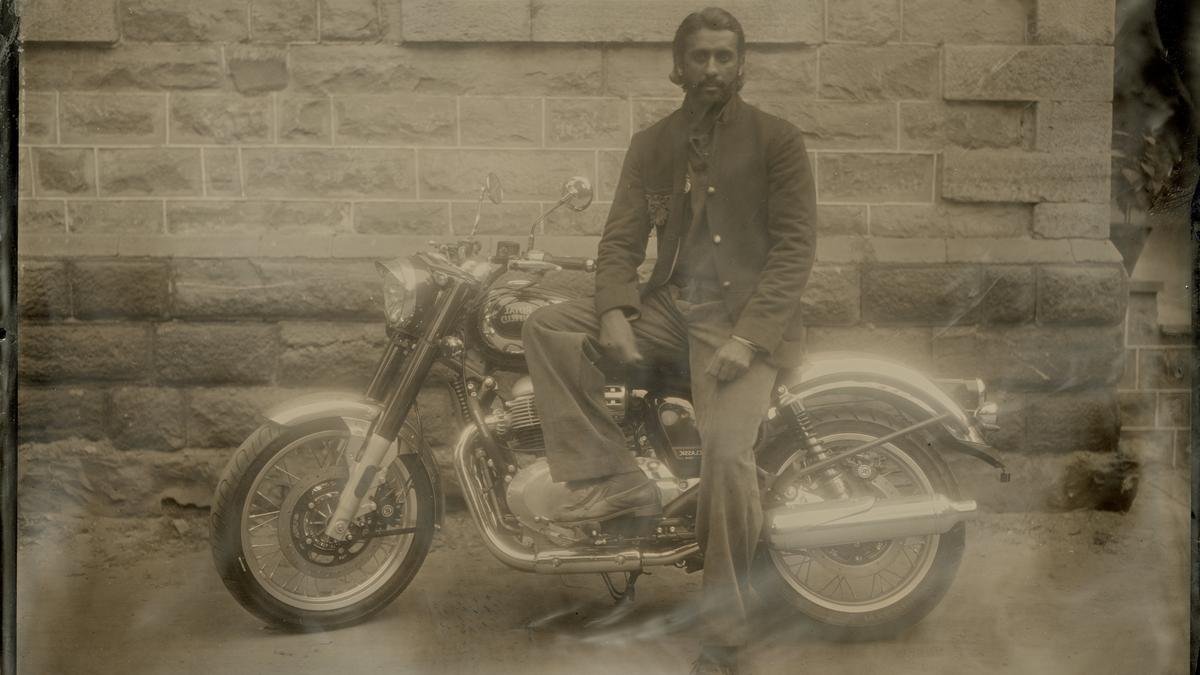
In an age when a portrait can be made in a fraction of a second, Vibhav Kapoor, artist and assistant professor at O.P. Jindal Global University, Sonipat, spends several minutes making one photograph, much of the time spent negotiating with chemistry.
In his Delhi-NCR studio, Mr. Kapoor works with tintype, a 19th-century photographic process in which an image is created directly on a metal plate.
The French photographer Adolphe Alexandre Martin is credited with developing the technique in 1853, two years after Frederick Scott Archer invented the wet-plate collodion process.
Chemically demanding
Unlike processes that produced glass negatives or paper prints, tintypes created a positive image directly on a dark metal plate.
Mr. Kapoor takes a plate with collodion, a syrupy solution of nitrocellulose dissolved in ether and alcohol. He pours it onto a metal plate to form a thin, sticky film, and sensitises it in a silver-nitrate bath in which the iodides and bromides react with silver nitrate to form light-sensitive silver iodide and silver bromide.
Finally, he exposes these light-sensitive compounds through a large-format camera, and develops the images in a dark room using a ferrous sulphate solution acidified with glacial acetic acid and thinned with alcohol; it amplifies the latent image by converting more exposed silver halides into visible metallic silver.
The entire sequence from coating to fixing must be completed while the plate remains wet. There is also no negative to reprint from, so duplicating tintypes is equally arduous.
19th century process
In the mid-19th century, the tintype process was valued for being relatively inexpensive and durable. The dominant photographic process of the era was the daguerreotype. It was costly because it required silver-plated copper sheets as the base material plus iodine and mercury vapour to develop images. Together with the labour-intensive crafting process, each daguerreotype was a luxury item.
Tintypes, however, afforded portraits outside the more formal, expensive photographic studios of the period. In India as well, the process formed part of the early history of photography.
In 1864, a British photographer named T. Murray introduced Sawai Ram Singh II of Jaipur to the tintype camera and documented his court, architecture, and lives of women in the royal zenana. Murray is also known to have helped the ruler develop a royal archive of visuals.
According to Mr. Kapoor, the Jaipur royal photographer Ram Singh also used the process.
“It is a very traditional, hand-made process,” Mr. Kapoor said. But its apparent simplicity conceals a process that demands scientific precision.
A portrait in tintype. Photography arrived in India in the 19th century, and the wet-collodion processes became ubiquitous as tintypes circulated in Indian towns in the late 19th and early 20th centuries. Today, however, ‘only a handful of photographers in India practice tintype’.
| Photo Credit:
Vibhav Kapoor/Special arrangement
Mr. Kapoor first learnt tintype photography during his master’s degree at the Rochester Institute of Technology, New York, which he spent coating plates, photographing, developing, drying, and finally varnishing the finished image.
The way tintype works also affects the photographer and the subject. The CMOS sensors in today’s digital cameras are so fast that a person needs to pose for just a second. On the other hand, the light-sensitive compounds in tintype photography ‘record’ the light over 8-10 seconds, so the subjects need to present themselves still for that period.
For a portrait, as Mr. Kapoor put it, “The person is performing …, presenting themselves.”
The image emerges in 10 to 15 minutes thereafter.
Weather and chemistry
That said, the photograph’s most unpredictable component is the weather.
“The chemistry is very volatile and humidity plays a crucial role,” Mr. Kapoor said.
“During the monsoon, the humidity causes the tintypes to develop spots,” Matthew Fossier, a U.S. tintype practitioner in Texas, said.
Dust is another serious problem. As dust particles settle on the wet collodion layer, they interrupt the formation of silver halide crystals. When the plate is developed, the affected area produces metallic silver differently from the surrounding film, and which appears as an opaque or transparent spot.
Temperature fluctuations can create other artefacts as well, per Mr. Fossier. The collodion contains volatile solvents and heat makes them evaporate faster, leaving the film to become sticky. The plate must be moved quickly to the silver-nitrate bath, where silver ions react with the halides in the collodion to form the light-sensitive silver-halide layer. If the collodion has begun to set unevenly by then, however, the resulting layer can be uneven as well.
He added that the effect is pronounced when pouring the collodion, which reduces the time available to get the plate into the silver bath.
According to Mr. Kapoor, the Delhi-NCR temperatures require him to adjust his solutions: “Heat acts as a catalyst [and] more heat means reactions are faster. The developer has to be managed.”
The developer is a chemical solution that reveals the image captured on a sensitised metal plate after exposure. But in warmer weather, the developer works faster, causing streaks or an uneven fog to appear in the picture.
To avoid this, Mr. Kapoor dilutes the developer to change its strength and how long it stays on the plate, slowing the reaction, and allowing the picture to develop clearly.
Unique images
Mr. Kapoor has worked with a fashion brand called rkive.city to photograph the Maharaja of Jaipur Sawai Padmanabh Singh.
He is now looking to make more tintypes, particularly portraits, from his new studio in Shahpur Jat in the national capital.
Photography arrived in India in the 19th century, and the wet-collodion processes became ubiquitous as tintypes circulated in Indian towns in the late 19th and early 20th centuries. Today, however, Mr. Kapoor said “only a handful of photographers in India practice tintype”.
Mr. Kapoor’s tintype camera is a large-format antique that uses a 5×7-inch plate. The camera is built of polished dark wood with metal parts, and a leather bellow that folds in and out like an accordion as the cover.
“When I am taking tintypes of people,” Mr. Kapoor said, “I think they are very fascinated, first of all by the camera, and by the spectacle of the process.”
Aditya Ansh is an independent media writer based in New Delhi.


