






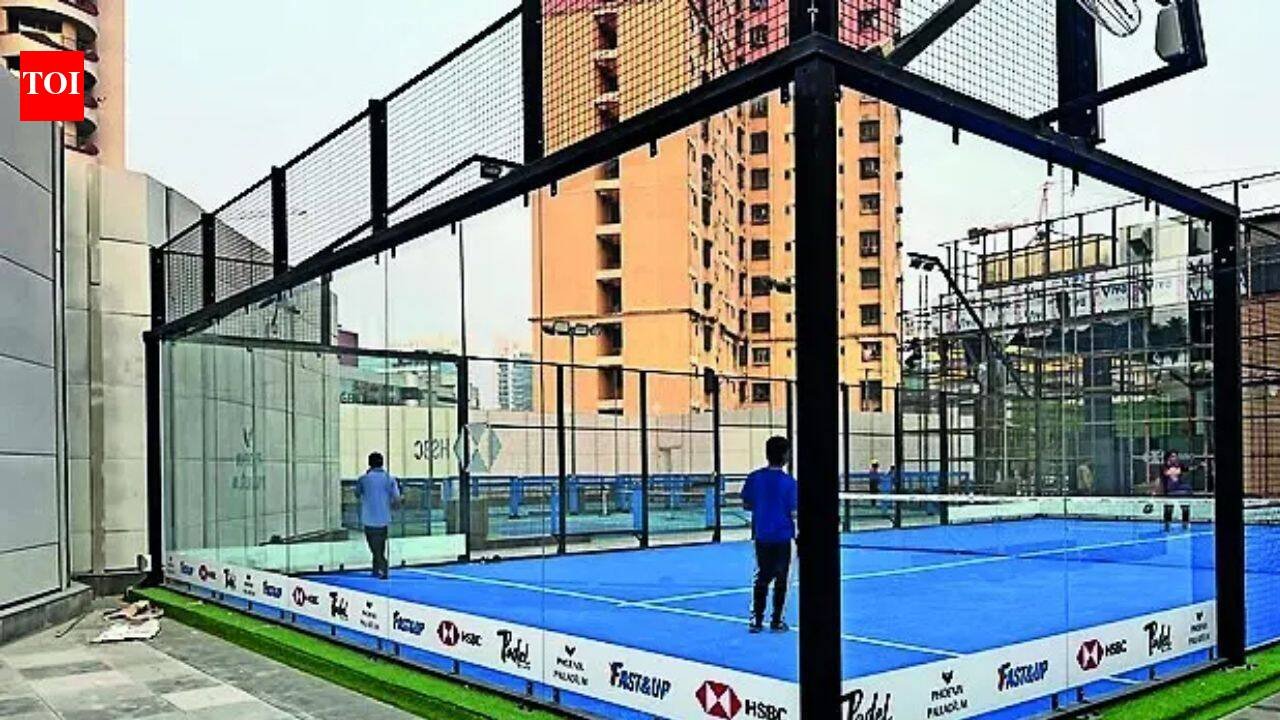
MUMBAI: In a city where every square foot is fiercely contested, even recreation must learn to adapt. As Mumbai’s playgrounds shrink and open spaces become increasingly scarce, padel is finding room to flourish. The fast-paced racquet sport that is a mix of tennis and squash, played on compact enclosed courts, is drawing a growing following among young professionals, fitness enthusiasts and groups looking for an activity that combines sport, socialising and leisure. As of now, there are about 400-500 padel courts set up across the country, with 150 courts across 40 venues in Mumbai.Easy to pick up, and less demanding on space than many traditional sports, padel is emerging as an unlikely answer to a question Mumbai has long grappled with: how do you play in a city running out of room?Ronak Daftary, the co-founder of Padel Park says, “Padel is like the coffee of sports. People are playing on weekday evenings. It becomes part of a routine. Instead of going out for a coffee with your friends, you are instead opting to meet over a game of padel.”Being both an outdoor and indoor sport, finding locations to set up courts hasn’t been all that difficult. At the heart of Powai’s Hiranandani district, in their Business Park, a court has been set up. Lower Parel’s Phoenix Palladium became India’s largest integrated rooftop racquet sport hub.“Padel is a sport where the court itself is the product. You’re selling the sport addiction,” says Daftary.Yet, not everyone sees padel’s rise as an unequivocal success story. Urban planning critics argue that the sport’s growing footprint also highlights deeper inequalities in access to recreation. While padel courts require less land than many traditional sports facilities, playing the sport often comes at a premium, with court rentals, memberships and equipment costs placing it beyond the reach of large sections of the city’s population. Prerna Yadav from Urban Design Research Institute says, “Accessibility in sports is necessary when Mumbai already has land constraints”.The sport’s popularity reflects the increasing privatisation of leisure spaces in the city, where recreational opportunities are becoming concentrated among affluent neighbourhoods and upper-income groups. In a metropolis where millions still lack access to basic public playgrounds and open spaces, Yadav contends that the padel boom raises uncomfortable questions about who gets to play, and at what cost. “Because while a few might be able to afford going to a gymkhana to play padel, for those who can’t, a playground becomes the space which can be accessed freely…irrespective of where they’re coming from, they should be able to play any sport they want. It has to be a recreation space for everybody,” she says.Ujwal Deole, the co-founder and COO of KheloMore, the sports venue booking platform, says the cost is a challenge which padel has to solve. “Padel has to be affordable. If it grows popular, many more people will also be willing to play”. On the flip side, Deole also states that the cost of setting up a Padel court is high. “Padel infrastructure is close to Rs 20 lakh,” he says, and hopes that schools adopt the sport to bring it to the mainstream.


