






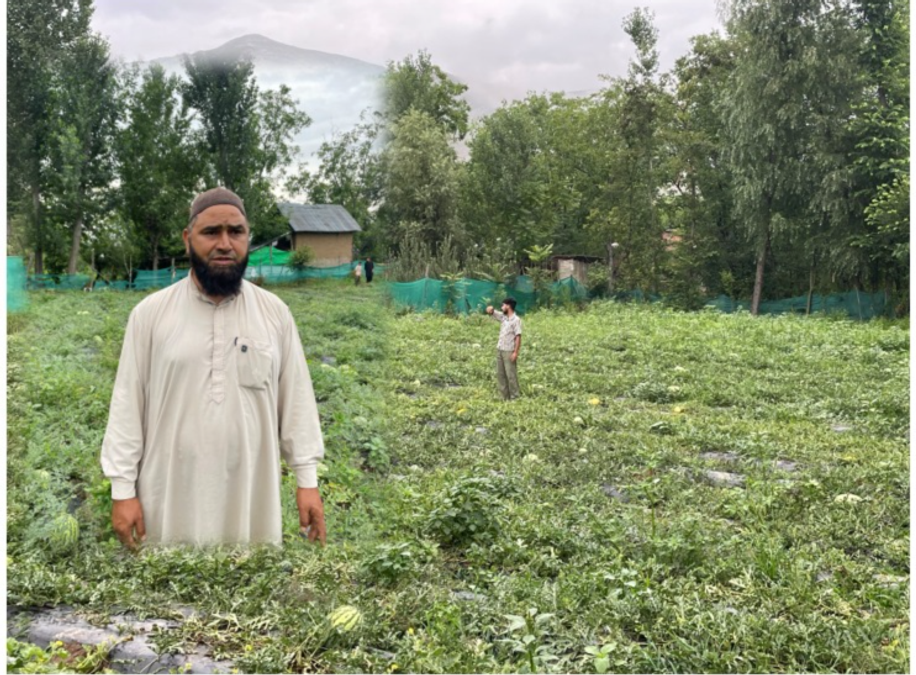
Anantnag, Jul 13: In Cheki-Ishardas, a village about 14 kilometres from Anantnag, watermelon has grown into more than a crop. For a large section of the village, it has become the main source of livelihood.
Cheki-Ishardas is known locally for its Pashtun roots, home to families believed to have settled there generations ago after coming from Afghanistan. Residents of the village still speak Pashto among themselves, alongside Kashmiri and Urdu, a feature that sets the settlement apart in south Kashmir.
Farmer Muhammad Aslam Khan began cultivating watermelons in the village in 2008. He now grows the crop across 70 to 75 canals of land, with the harvest measured in quintals.
“I started four times in 2008,” he told Rising Kashmir, recalling the repeated attempts it took before the venture found its footing.
When Khan first began, the response from fellow villagers was not encouraging. “In the beginning, they made fun of us,” he said. That changed as the farm expanded and the returns became visible to others.
Khan said 80 to 85 per cent of families in the village are now involved in watermelon cultivation in some form.
The farm currently employs six workers throughout the year. Each is paid Rs 20,000 a month, taking the total monthly wage bill to Rs 120,000, Khan said.
Five varieties, new colour
Khan said the farm started with a single variety of watermelon and has since expanded to five. This year, for the first time, it has introduced a yellow watermelon, yellow on the inside, in addition to the red variety more familiar to buyers. He said the change came in response to shifting demand.
“People’s demand has changed,” he added.
An organic claim, backed by barcode
Khan said all the watermelons grown at his farm are 100 per cent organic, at a time when he says most of the market is filled with chemically grown produce. To support the claim, the farm has started placing a sticker on each watermelon under the name “Pakhtoon Agriculture”, along with a barcode that buyers can scan to verify where the fruit came from.
“No one in the market can identify it,” he said, referring to the difficulty buyers usually face in telling organic watermelons apart from chemically treated ones. He added that the farm’s location is also available on the map for anyone who wants to visit in person.
Support from Agriculture Department
Khan said the farm has support from the Agriculture Department, with officials visiting as part of its oversight of the project. He named Agriculture Zone Tailwani, District Anantnag, as the channel through which the support reached him.
Path for unemployed
Khan described watermelon farming as a strong cash crop with room for more people to take it up. He said the new farm set up by his team is meant to make it easier for new farmers to join, with advice and guidance available to anyone who contacts the local agriculture zone.
“Anyone who wants to do this work can do it easily,” he said, adding that the venture could offer a livelihood option for unemployed youth in the area.


