








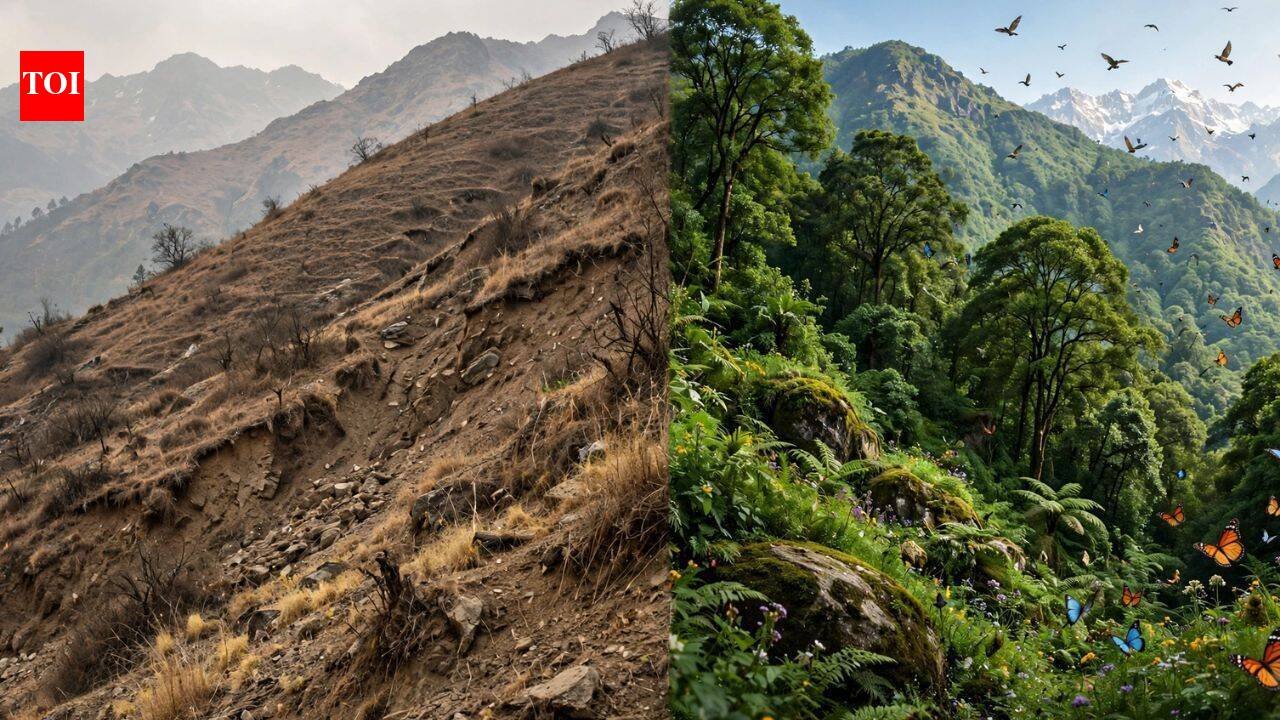
In 1992, researchers began restoring a degraded Himalayan slope in Almora, Uttarakhand. Thirty years later, the site had transformed into a biodiversity-rich landscape where trees were regenerating naturally and more than 160 bird species had been recorded. It is known as the Surya-Kunj restoration model; the 71-acre site was developed on degraded land at the G.B. Pant National Institute of Himalayan Environment.Researchers planted multipurpose species, introduced basic measures to conserve soil and water, and worked with local communities to protect the area. A 2025 study published in ‘Frontiers in Conservation Science’ recorded 88 successfully established plant species, with most planted tree species showing healthy natural regeneration through seedlings and saplings. The restored site also supported more than 100 butterfly species, 86 bryophyte species, and over 30 lichen species.
How did the Surya-Kunj restoration project begin in 1992
The Surya-Kunj restoration project began in 1992 at the G.B. Pant National Institute of Himalayan Environment in Almora. At the time, the area was a degraded stretch of gentle slopes with only a small number of ‘Pinus roxburghii’ trees and shrubs. The site spans 71 acres, or 28.73 hectares, and lies between 1,100 and 1,250 metres above sea level. Researchers began rehabilitation and plantation work to restore the degraded land.Researchers started with the planting of 172 multipurpose plant species, followed by ongoing gap-filling plantation work through 2014. Over the full three decades, about 190 tree species were planted in total, including 136 native Himalayan species. As restoration progressed, the area developed into a diverse landscape supporting trees, shrubs, medicinal plants and wildlife.
PC: AI Generated
What methods helped restore the degraded Himalayan slope
Researchers used several measures to help the degraded slope recover. Plant species were selected based on the site’s conditions. Before planting, pits were prepared and filled with manure. Terracing, bunding, gully plugging, and small check dams were introduced to control soil erosion and retain moisture. Staggered contour trenches were also created to collect rainwater.Since water was scarce, underground tanks lined with polyethylene were built to support irrigation. The researchers also worked with nearby villages to protect the area from open grazing. Seeds collected from plants growing at the site were used to fill gaps through direct sowing or nursery development, helping the restoration continue over time.
How did natural regeneration change the restored Himalayan slope
The restoration site gradually developed strong natural regeneration. The study recorded 125 woody species, including 98 trees and 27 shrubs, with an average tree density of 323 individuals per hectare. Seedlings and saplings were also found in large numbers. Twenty-two tree species showed good regeneration, including Celtis australis, Cinnamomum tamala, Quercus glauca and Quercus leucotrichophora.Pinus roxburghii remained the dominant tree, with a density of 144.1 trees per hectare. Overall, most of the planted tree species were regenerating naturally, with healthy numbers of seedlings and saplings. These findings indicate that the restored site was gradually developing towards a more stable and self-sustaining ecosystem.
Which species returned as Surya-Kunj became greener
Surya-Kunj also became home to a wide range of wildlife as the restoration progressed. The study recorded more than 160 bird species and over 100 butterfly species at the site. It also supported 86 bryophyte species and more than 30 lichen species. The medicinal plant garden contained more than 90 species. Several plants at the site provide food for birds through their flowers and fruits. These include Berberis asiatica, Rubus ellipticus, Pyracantha crenulata, Morus alba, Prunus cerasoides and Pyrus pashia. The growing variety of plants and food sources helped create suitable conditions for a diverse range of wildlife across the restored landscape.
How did local communities help restore the Surya-Kunj landscape
Community participation was an important part of the restoration effort. Researchers worked with villagers to promote the plantation and recovery of degraded or abandoned land. Local people were also employed for plantation and other activities and received wages for their work. Scientists shared technical knowledge with villagers to support the restoration process. Villagers could also collect naturally growing grasses from the site for fodder. To strengthen conservation education, the institute established a Nature Interpretation Learning Centre near Surya-Kunj. Over three decades, the programme held 62 conservation education workshops involving more than 5,331 stakeholders and students.


