






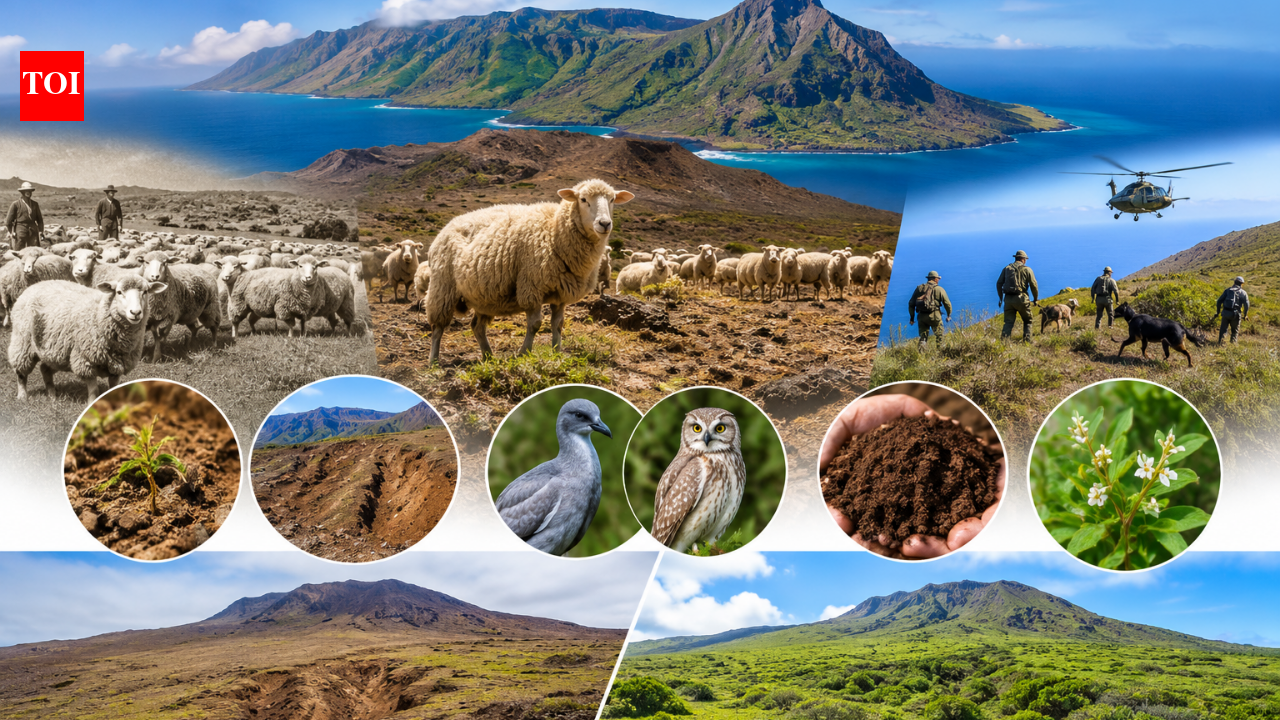
Imagine an island where a herd introduced for ranching gradually became one of the biggest threats to its native ecosystem. That is what happened on Mexico’s Socorro Island, where about 100 sheep introduced in 1869 eventually became feral and reached an estimated 5,000 animals by 1960. Over decades, overgrazing contributed to severe vegetation loss and erosion across the island. A 2016 study published in Forests, titled “Recovery of Vegetation Cover and Soil after the Removal of Sheep in Socorro Island, Mexico”, documented how the landscape began recovering after the animals were removed. A separate 2019 study on the island’s ecological restoration recorded the eradication of 1,762 feral sheep between 2009 and 2012.
How 100 sheep became an ecological problem
Socorro Island is part of Mexico’s Revillagigedo Archipelago in the Pacific Ocean. Covering about 132 square kilometres, it is a volcanic island with a high level of biological endemism. The 2016 study notes that around 27% of its 117 vascular plant species are endemic, meaning they are found nowhere else. The island also has native terrestrial fauna that evolved in isolation from large herbivorous mammals.The sheep were introduced in 1869 for ranching. With no natural predators capable of controlling their numbers, they became feral and adapted to the island. Their population was estimated at around 5,000 by 1960. Hunting by the Mexican Navy later reduced the population to about 2,000 by 1988, but sheep remained a major source of ecological disturbance. The problem was not simply the number of animals. Their repeated grazing removed vegetation, damaged seedlings and disturbed the litter layer covering the soil. Sheep trails and resting areas also contributed to soil compaction. Once vegetation disappeared, the exposed soil became more vulnerable to erosion, particularly during heavy rainfall and tropical storms.According to the 2016 study, sheep were associated with the loss of soil and vegetation cover across about 30% of the island’s surface. More than 2,000 hectares of native vegetation had been lost over the period of degradation.
Why the island was especially vulnerable
Socorro’s geography made the consequences of vegetation loss more serious. The island lies in the path of tropical cyclones, meaning heavy rainfall could turn already exposed and compacted ground into channels of runoff and erosion. The researchers explained that reduced plant cover increased runoff, while sheep trails provided pathways through which water could move. This contributed to the formation of deep erosion gullies in some areas. Over time, the combination of grazing, soil disturbance and storms altered habitats that had previously supported native vegetation.The sheep also affected the composition of the plant community. Their grazing reduced native vegetation while helping some introduced plant species spread. The resulting landscape therefore was not simply a forest with fewer trees; it was an ecosystem whose vegetation structure and species composition had changed.The ecological consequences extended beyond plants and soil. According to the 2019 study, feral sheep destroyed roughly one-third of the island’s habitat, while feral cats created another major threat to native wildlife. Together, the two invasive mammals contributed to the disappearance of the Socorro dove and Socorro elf owl from the wild.
The long campaign to remove the sheep
Efforts to eliminate the feral sheep intensified in the late 2000s. The eradication programme ran from 2009 to 2012 and combined aerial and ground-based methods. During the aerial phase, hunters removed 1,257 sheep. The campaign then shifted to ground hunting and trapping, with another 505 animals dispatched. The final stages also involved specially selected “Judas sheep”, which were fitted with radio-telemetry collars and released to help locate remaining animals. Hunting dogs were subsequently used to track the last few sheep. In total, 1,762 sheep were removed during the three-year eradication campaign.The goal was not merely to reduce the population but to eliminate the feral sheep from the island. Once grazing pressure disappeared, researchers could observe whether the damaged ecosystem was capable of recovering naturally.
Vegetation returned surprisingly quickly
The results provided a striking indication of the island’s ecological resilience. Researchers compared vegetation using satellite imagery from 2008 and 2013 and also conducted field assessments across 20 transects. The satellite analysis identified about 1,452 hectares where vegetation cover had increased between the two periods, equivalent to roughly 11% of the island’s surface. The field measurements were even more striking in some habitats. In forest sites examined by the researchers, average vegetation cover increased from 29.29% in 2009 to 85% in 2013. Mixed scrub areas rose from 19.17% to 72.5%, while eroded surfaces increased from 14.29% to 50.29%. The number of plant species recorded also increased across the studied habitats.The recovery was not limited to the amount of vegetation. Soil conditions also began to improve. Researchers found that areas with recovering vegetation showed improvements in several soil properties. Nitrogen and organic carbon levels were roughly twice those measured in eroded sites, while phosphorus and calcium values were substantially higher. Soil compaction also showed signs of recovery as vegetation returned.
What the sheep removal revealed
The Socorro Island case demonstrates how quickly an invasive herbivore can alter an isolated ecosystem, but it also shows the potential for natural recovery once the pressure is removed. The researchers described the vegetation recovery as passive, meaning large-scale replanting was not required for the initial rebound. Native, endemic and some introduced plants began colonising areas that had previously been heavily degraded. However, the recovery did not mean that every ecological problem disappeared. The 2016 research found that some exotic plant species also became part of the recovering vegetation. Meanwhile, feral cats remained a serious conservation challenge. A later restoration report recorded continued efforts to eradicate them, with 502 cats removed by December 2016.Socorro Island therefore offers a more complicated lesson than simply “remove the invasive species and nature returns”. The removal of sheep removed one of the strongest pressures on the landscape, allowing vegetation and soil conditions to improve. But protecting an isolated ecosystem also requires dealing with other invasive species and ensuring that recovering native habitats remain viable.More than a century after the introduction of those first 100 sheep, the island’s experience shows how a seemingly small human intervention can have consequences lasting generations. It also demonstrates the remarkable capacity of an ecosystem to begin repairing itself once a major source of disturbance is finally removed.


