






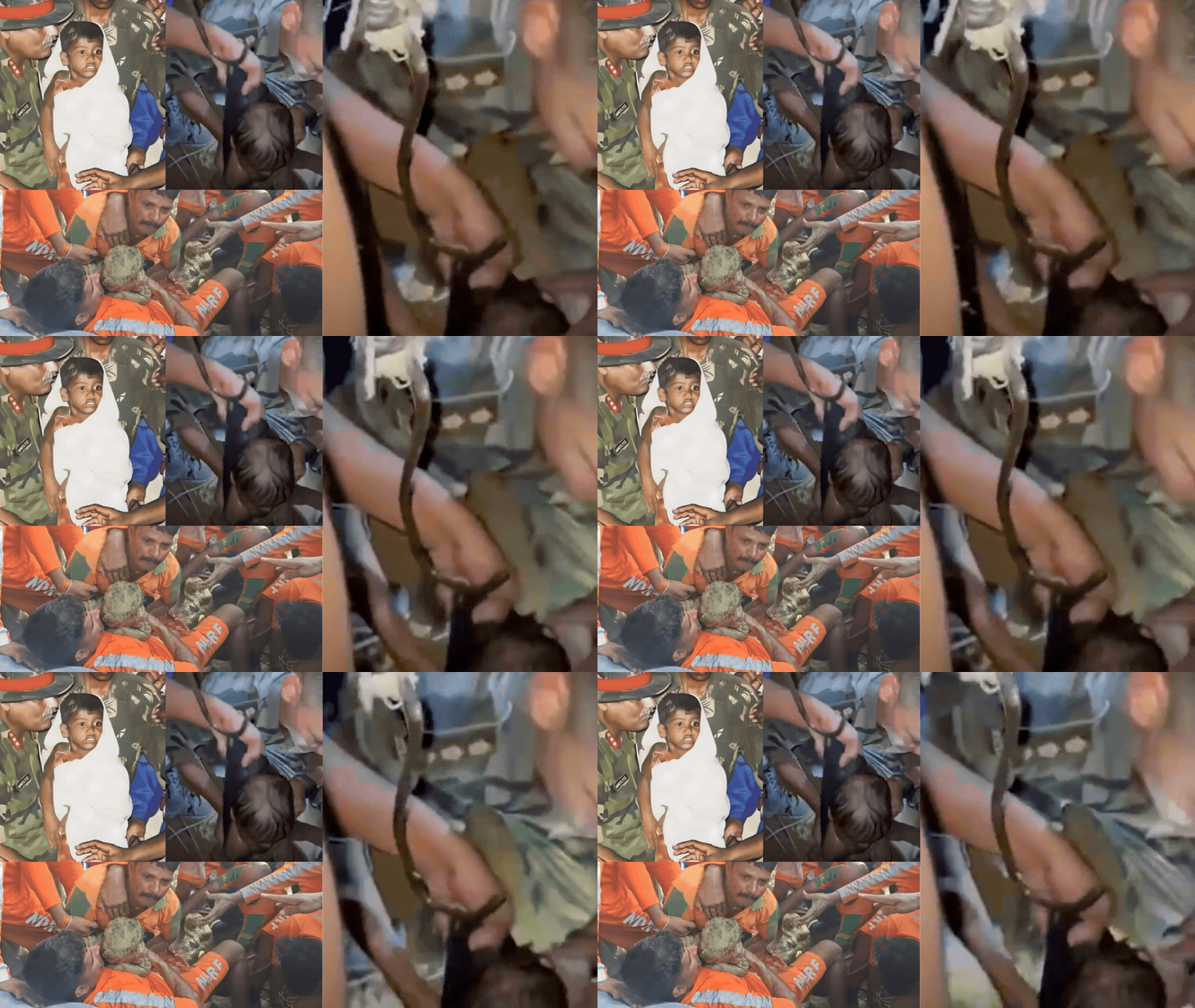
NEW DELHI: In 2006, a six-year-old boy named Prince captured the nation’s attention after falling into a 60-foot-deep borewell in Haryana’s Kurukshetra district. Nearly 50 hours later, after a painstaking rescue operation involving the Indian Army, he was pulled out alive.Nearly two decades later, children continue to fall into open, abandoned or inadequately protected borewells across India. While some are rescued after hours of difficult operations, others have died despite sustained rescue efforts.From an abandoned borewell covered with flooring in a house courtyard in Kanpur to uncovered wells on farmland and borewells dug under government schemes, the incidents show how dangerous unprotected borewells can be.In several cases, rescue teams involving the National Disaster Response Force (NDRF), State Disaster Response Force (SDRF), police, fire services and local administration have worked for hours to reach trapped children. Some have been brought out alive, while others have died despite prolonged rescue efforts.
Haryana, 2006: Prince rescued alive
The cases point to a common problem — borewells that are left open, abandoned or inadequately protected can become death traps, particularly when children are playing nearby. In some cases, families have alleged that authorities or landowners failed to cover the borewells despite warnings. In others, rain and weakened ground have contributed to the collapse of the surface covering the well.Here are some of the incidents that highlight the continuing danger:
Haryana: Prince rescued after 50-hour operatio
In 2006, the case of six-year-old Prince made headlines after he fell into a 60-foot-deep borewell in Haryana. The 50-hour rescue drama began after Prince fell into a borewell hole covered with a cement sack while playing in his village in Haryana’s Kurukshetra district.
Prince was rescued from the borewell in 2006
Rescuers struggled to reach him because of the narrow borewell. The Indian Army joined the operation and dug a parallel shaft before creating a tunnel to reach the trapped boy.Prince was supplied with oxygen, food and water during the rescue. After nearly 50 hours, rescuers finally pulled him out safely on July 23, 2006.The successful operation became one of India’s most widely remembered borewell rescues and highlighted the dangers posed by uncovered and abandoned borewells.
Kanpur: Girl falls into abandoned borewell after courtyard collapses
In Kanpur, an 18-year-old girl died in August 2026 after the courtyard floor of her house suddenly caved in, causing her to fall into a 25-foot-deep abandoned borewell in Purvamir village under the Maharajpur police station area.The incident took place while Yashi was preparing for Raksha Bandhan rituals.Her elder sister initially tried to pull her out using a rope. However, more soil caved in during the attempt and pushed Yashi deeper into the borewell.Police reached the spot after receiving information and began a rescue operation. A fire brigade team arrived around 8am, followed later by NDRF and SDRF personnel.Continuous rainfall made the operation more difficult and hampered the rescue teams’ efforts to reach the girl.The rescuers first used a JCB machine to demolish part of the verandah and dug a 20-foot-deep pit near the accident site. When they could not locate Yashi, a Poclain excavator was brought in and another 10-foot-deep pit was dug.The rescue teams finally reached Yashi around 2.20pm. She was taken to CHC Sarsaul, where doctors declared her dead on arrival.Family members told police that the borewell had failed to yield water and had subsequently been abandoned. It had been covered with flooring in the courtyard. They said continuous rainfall had weakened the ground, eventually causing the surface to collapse.
Hoshiarpur: Four-year-old rescued after nine-hour operation
In Hoshiarpur, Punjab, a four-year-old boy was rescued safely after falling into a borewell in Chak Samana village on May 15, 2026.Gurkaran Singh, son of labourer Harinder and Asha, fell into the borewell in the evening and was trapped at a depth of nearly 30 feet.A joint rescue operation involving the NDRF, SDRF, Punjab Police, administrative officials and local volunteers continued for nearly nine hours.
The case of Hoshiarpur on May 15, 2026
The boy was brought out around 12.40am and taken to hospital in an ambulance accompanied by a medical team.Deputy Commissioner Aashika Jain and SSP Sandeep Kumar Malik supervised the operation. The rescuers dug a parallel pit to a depth of around 25 to 30 feet and then created a narrow tunnel to reach the borewell shaft and safely evacuate the child.The NDRF team, comprising more than 40 officials, also assisted in the operation.Gurkaran was later kept under observation at the civil hospital. Doctors said he was stable but had a mild infection, which they expected after prolonged exposure to soil and dust. He also received treatment for minor eye irritation caused by dust particles.The child was expected to remain under observation for 48 hours.
Ujjain: Two-and-a-half-year-old boy dies after 21-hour rescue
In Madhya Pradesh’s Ujjain district, a two-and-a-half-year-old boy from Rajasthan died after falling into a borewell in Badnagar tehsil in April 2026.Bhagirath, son of Pansaram alias Praveen Devasi of Gudanala village in Pali district, was playing near a borewell on a farm in Jhalariya village when he fell into the well.He became trapped at a depth of around 60 to 70 feet.According to his uncle Paras, the child pushed aside the borewell’s cover and tried to sit with one leg inside. His mother saw him before he slipped into the borewell.A 200-member NDRF and SDRF team from Bhopal, Harda and Indore began the rescue operation by around 9pm.The teams worked on two approaches. One involved trying to extract the child through the borewell, while another involved digging a parallel pit nearby.The pit was excavated to more than 50 feet using earth-moving machines and hammer drills.The Harda SDRF team eventually located the child using an improvised borewell toolkit and an underwater camera. The rescuers looped his hands and pulled him towards the surface with support from below.However, Bhagirath was brought out unconscious after the 21-hour operation, and doctors at Badnagar Civil Hospital declared him dead.A case of unnatural death was registered.
Ambala: Four-year-old dies after falling into 220-foot borewell
In Haryana’s Ambala district, a 21-hour rescue operation for four-year-old Nirvair Singh ended in tragedy on July 1, 2026.
The incident of Haryana’s Ambala on July 1, 2026
The boy had fallen into an open 220-foot borewell in Dhanora village at around 6.30am while accompanying his father to deliver food to his grandfather.Nirvair was pulled out at around 3.30am, but was already dead.A postmortem conducted at Ambala City Civil Hospital indicated that the child had died around 12 hours before rescuers reached him. Medical officer Dr Sumit cited drowning and head and chest injuries as the causes of death.The case also raised questions over negligence. Ambala Superintendent of Police Ajit Singh Shekhawat said police registered a case of causing death by negligence under Section 106 of the BNS against the landowner and two contractors.The FIR followed a complaint from the child’s family, who alleged that the borewell had been left uncovered without warning signs.
Bihar: Three-year-old rescued from 300-foot borewell
In Bihar’s Fatehpur block, three-year-old Piyush Kumar was rescued safely after falling into a 300-foot-deep uncovered borewell on July 16, 2026.
Bihar, 2026: Piysuh rescued from a borewell
Piyush, son of Dinesh Kumar, fell into the borewell around 6.30pm while playing in Raghunath Nagar village.Although the borewell was around 300 feet deep, the child was trapped at a depth of nearly 30 to 35 feet.The borewell was being sunk under the Nal Ka Jal scheme but had been left uncovered.The incident brought hundreds of villagers to the spot as rescue teams began efforts to save the child.NDRF, SDRF and district administration teams worked together. Oxygen was continuously supplied to Piyush through a pipe while the rescuers worked to reach him.After nearly seven hours, the rescue teams successfully pulled the child out. He was taken to Fatehpur Community Health Centre for medical examination and primary treatment. Officials said his condition was normal.The incident also led to concerns over negligence. Wazirganj SDPO Sunil Kumar said an FIR would be lodged against those responsible for leaving the borewell uncovered and that an investigation would be conducted.
Nalanda: Three-year-old rescued after eight-hour operation
A similar incident occurred in Bihar’s Nalanda district in July 2023, when three-year-old Shivam Kumar fell into a 40-foot-deep borewell while playing near his house.
The incident of Bihar’s Nalanda in 23rd July 2023
The child remained stuck in the muck inside the borewell for almost eight hours.The district administration immediately began excavation work using JCB machines. Oxygen was supplied through pipes to keep the child safe during the rescue.NDRF and SDRF teams were also called in, while CCTV cameras were used to monitor the rescue operation.After nearly eight hours of continuous efforts, Shivam was successfully brought out alive. He was taken to Vardhman Institute of Medical Sciences for further treatment and kept under observation.The incident highlighted the importance of safety measures around open borewells.
Karnataka: Two-year-old rescued after 20-hour operation
In Karnataka’s Vijayapura district, two-year-old Satvik Satish Mujagond was rescued alive after falling into an open, defunct borewell in Lachyana village in April 2024.Satvik had fallen into the borewell while playing on his grandfather’s farmland. He became trapped at a depth of around 20 feet.NDRF, SDRF and officials from the revenue and health departments joined the rescue operation.The rescuers dug a parallel well to create a passage to reach the child. Satvik was stuck upside down, making the operation more difficult. Hard rock in the area also slowed the work.The rescue team used hand-drilling machines to cut through the rock.Oxygen was supplied through pipes lowered into the borewell for nearly 20 hours.Satvik was eventually pulled out alive at around 1.42pm. He was first given treatment at a taluk hospital and later shifted to the district hospital.
Odisha: Toddler dies after falling into open borewell
In Odisha’s Puri district, a one-and-a-half-year-old girl died in February 2026 after falling into an open borewell on the premises of the district headquarters hospital, where construction of a new five-storey building was under way.The girl, Samayira, was visiting her maternal uncle’s house when she fell into the borewell while playing.Kumbharpada police and fire services personnel reached the spot and launched a rescue operation. The child was rescued within around 30 minutes but was declared brought dead at the hospital.Family members alleged that the borewell, which was more than 50 feet deep and around 10 feet wide, had been left uncovered for five days.The girl’s maternal uncle said he had repeatedly asked construction workers to cover the borewell but alleged that no action was taken.An inquiry was ordered into the circumstances surrounding the incident.
Rajasthan: Five-year-old dies after three-day rescue operation
In Rajasthan’s Dausa district, a five-year-old boy died after being trapped in a 150-foot borewell in December 2024.
The incident of Rajasthan in 2024 December
The child fell into the borewell while playing on December 9. Rescue teams carried out an operation lasting more than three days.The boy was eventually retrieved unconscious and taken to hospital. Doctors tried to revive him but declared him dead.The incident showed how the depth of a borewell can make rescue operations extremely difficult and time-consuming.
Madhya Pradesh: Six-year-old dies after 40-hour rescue effort
In Rewa district of Madhya Pradesh, a six-year-old boy died in April 2024 after falling into a borewell while playing.The child fell into a 40-foot-deep borewell in Manika village near the Uttar Pradesh border.SDERF, NDRF and local authorities worked for around 40 hours to rescue him. Oxygen was supplied into the borewell and additional pits were dug to reach the child.The boy was located after the long rescue operation but remained unresponsive. Officials said the narrow borewell made it difficult to save him.
What do these incidents show?
These cases are different, but several of them have a common thread — open, uncovered or abandoned borewells.Some borewells were no longer being used. Others were being constructed but had not been covered. In some cases, the wells were on farmland, while in others they were close to homes or construction sites.The Kanpur incident also shows another danger: even when an abandoned borewell has been covered, the surface covering may not always remain safe. Continuous rainfall can weaken the ground and cause a covered area to collapse.The Ambala case raises the question of accountability when an open borewell is allegedly left without warning signs. In Bihar, authorities also said action would be taken after complaints over an uncovered borewell.
Why do such incidents keep happening?
The repeated incidents suggest that rescue operations alone cannot solve the problem.Once a child falls into a borewell, the rescue becomes a race against time. Teams may have to dig parallel pits, use heavy machinery, provide oxygen and create narrow tunnels to reach the child.The cases from Hoshiarpur, Ujjain, Ambala, Bihar, Karnataka and Madhya Pradesh show how rescue operations can take many hours and sometimes even days.Prevention is therefore crucial.Abandoned borewells should not be left open. Borewells under construction also need to be secured so that children cannot accidentally approach them. Areas around such wells need to be properly protected and warning signs should be placed where necessary.The incidents also show why complaints about uncovered borewells need to be taken seriously. In Odisha, the girl’s family said they had repeatedly asked construction workers to cover the borewell. In Ambala, the family alleged that the open borewell had no warning signs.
What precautions can prevent borewell accidents?
The most basic precaution is to ensure that borewells are never left open or inadequately covered.When a borewell is abandoned, it should be made safe so that children or other people cannot fall into it.During construction, the area around a borewell should be secured and children should not be allowed to play nearby.Warning signs can also help alert people to the presence of a borewell, particularly where the opening cannot immediately be seen.The Kanpur incident also highlights the need to pay attention to the condition of coverings over abandoned wells, particularly after prolonged rainfall. A surface that appears covered may still become dangerous if the ground underneath weakens.The response from authorities is also important. Complaints about uncovered borewells should be acted upon quickly instead of waiting for an accident to happen.
The need to prevent children from falling in
From Prince’s dramatic rescue in 2006 to children rescued or killed in borewell incidents across India in recent years, these cases continue to expose a serious safety concern.Rescue teams often work under extremely difficult conditions, using heavy machinery, oxygen pipes, cameras and specialised equipment to reach children trapped underground. In several cases, their efforts have saved lives.But rescue cannot be the only answer.The repeated incidents across states show that preventing children from falling into borewells is far safer than trying to rescue them after an accident. Abandoned and uncovered borewells need to be secured, construction sites need better protection, and complaints about dangerous openings need timely action.Every successful rescue brings relief, but every tragedy highlights the need for stronger prevention and accountability.The focus must shift from rescuing children after they fall to ensuring they never fall in the first place. Only stronger safety measures, timely action and proper monitoring can prevent these frightening incidents from continuing.


