



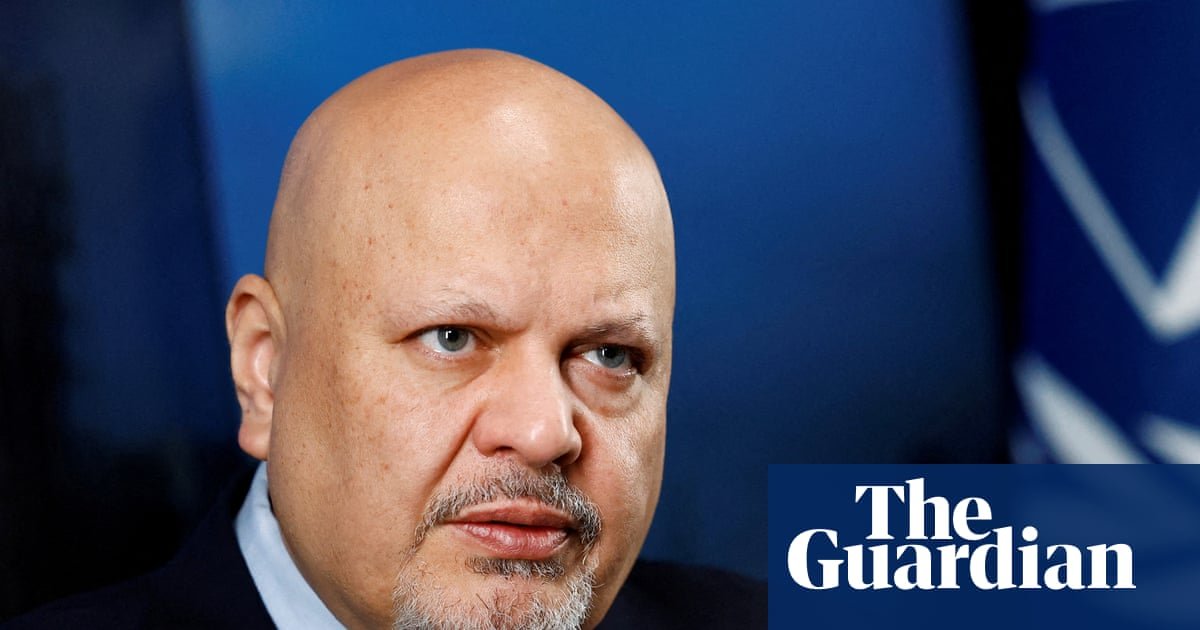
The international criminal court’s governing body is expected to meet on Monday to assess the advice of a panel of judges who have challenged the findings of an investigation into the chief prosecutor, Karim Khan.
Last year a UN inquiry into the allegations about Khan’s behaviour is understood to have established a factual basis for claims of misconduct against him. The senior British lawyer has been accused by a complainant of sexual abuse.
Now three judges commissioned by the ICC have sent it a 85-page report in which they looked at the evidence against Khan and considered whether the claims against him reached the threshold of “beyond reasonable doubt” – a high standard used in criminal cases.
Using this as its benchmark, the judges have advised that the UN inquiry did not establish that Khan’s conduct amounted to misconduct or a breach of his duties.
The report is critical of the UN inquiry’s methodology saying it failed to resolve inconsistencies in the accounts of Khan and the alleged victim.
The panel’s assessment was confined to a strictly legal analysis of the UN investigation into Khan. The judges did not cross-examine the witnesses.
The judges’ advice is understood to have provoked disagreement among a group of the ICC’s member states responsible for overseeing the Netherlands-based court about whether to accept the legal analysis.
Lawyers for Khan will argue that the panel’s advice amounts to an exoneration, claiming it is a “decisive and meticulously reasoned legal finding”. But the process is far from over and he could still face dismissal.
Khan’s fate will depend on how diplomats from the group of states view the conflicting evidence and whether they think the UN report findings on their own merit warrant disciplinary action. Such action could include a vote over whether to remove him from office.
The Guardian understands that Päivi Kaukoranta, the ICC’s president of the assembly of state parties, circulated a note to members this weekend to clarify that “the disciplinary process before the bureau is ongoing and remains confidential”.
The note added: “No decisions have been taken, and no weight should be given to recent media speculation. Currently, the bureau is considering the [UN] report and the report of the ad hoc panel pursuant to its responsibility as the competent decision maker.”
The panel of judges was commissioned by the court’s governing body last year.
They were tasked with reviewing the UN report into Khan, which was compiled by the UN’s Office of Internal Oversight Services.
The UN report set out claims that his behaviour towards a woman escalated over time, resulting in him engaging in non-consensual sexual contact with a woman in his private residence, on trips overseas and at the ICC headquarters.
It included supporting statements that led it to say it had identified evidence establishing a factual basis for the claims made by a complainant. It recommended the ICC consider appropriate action based on the evidence.
The judges, two men and one woman, said they were faced with two diametrically opposed versions of events. They said the UN report had not been able in many instances to resolve conflicting or directly contradictory accounts.
The judges found the UN report often did not reach conclusive factual determinations, or sometimes concluded such determinations were not feasible. Narrative inconsistencies were not resolved nor the motives of witnesses thoroughly tested, and so, in many regards, did not establish the truth, they said.
The judges were unanimous in their opinion that the factual findings by the UN investigation did not establish misconduct or breach of duty under the relevant legal framework.
The panel said it was not able to determine the credibility of the complainant.
Much of the evidence provided, in which the alleged victim complains of being harassed, including in text messages to fellow staff members, is set aside as hearsay evidence by the judges.
In their report, which has been seen by the Guardian, the judges say: “The investigators in the present matter either did not reach conclusive factual determinations or concluded that such determinations were impossible based on the evidence collected … Consequently, the UN report failed to establish where the truth lies with regard to many critical aspects of the allegations.”
Khan has consistently said he did not do anything that could be regarded as abusive or inappropriate. He has been on a leave of absence since May last year when the allegations surfaced and led to a demand for an inquiry.
If the governing body on Monday or at a later meeting makes an initial determination that the factual findings represent some form of misconduct, Khan has a chance to respond.
If it finds serious misconduct has occurred, the 125 members of the court could be required to vote on whether to remove Khan from office.


