



By way of our sharp fascination towards a spaceflight event when it happens, we tend to forget reading into the entire process that led to that moment. Process, in today’s ‘all-instant’ era, seems to lose value unless you are part of it. Going to space in a rocket and coming back sounds simply doable but an astronaut undergoes rigorous training for years just to be physically and mentally capable of doing it. All the complex processes involved in this preparation are what is referred to as ‘Astronaut training’.
Aside from physical training, medical tests, etc. much of these processes involve simulating conditions that an astronaut would encounter in their trip to space.
EVA training.
| Photo Credit:
Wikimedia Commons
EVA training
The term ‘extra-vehicular activity’ means any activity that an astronaut performs in outer space outside of the spacecraft in which they have come. Say, you are exploring a planet or taking a spacewalk outside your spacecraft. This is EVA. Training for this involves submerging into a neutral buoyancy pool where astronauts wear specially designed suits that simulate microgravity. In this training, astronauts learn how to use EVA tools, communicate with EVA crewmates, and develop sharp and full situational awareness. EVA training for ISS often takes place at NASA’s Neutral Buoyancy Laboratory (NBL) at the Johnson Space Center, Houston, U.S. and at Gagarin Cosmonaut Training Center, in Russia.
Dr. E. Dale Jackson, U.S. Survey Geologist, with Astronauts Neil Armstrong, Richard Gordon and Don F. Eisele during Geological Training Grand Canyon, Arizona.
| Photo Credit:
NASA on The Commons/Flickr
Geological field training
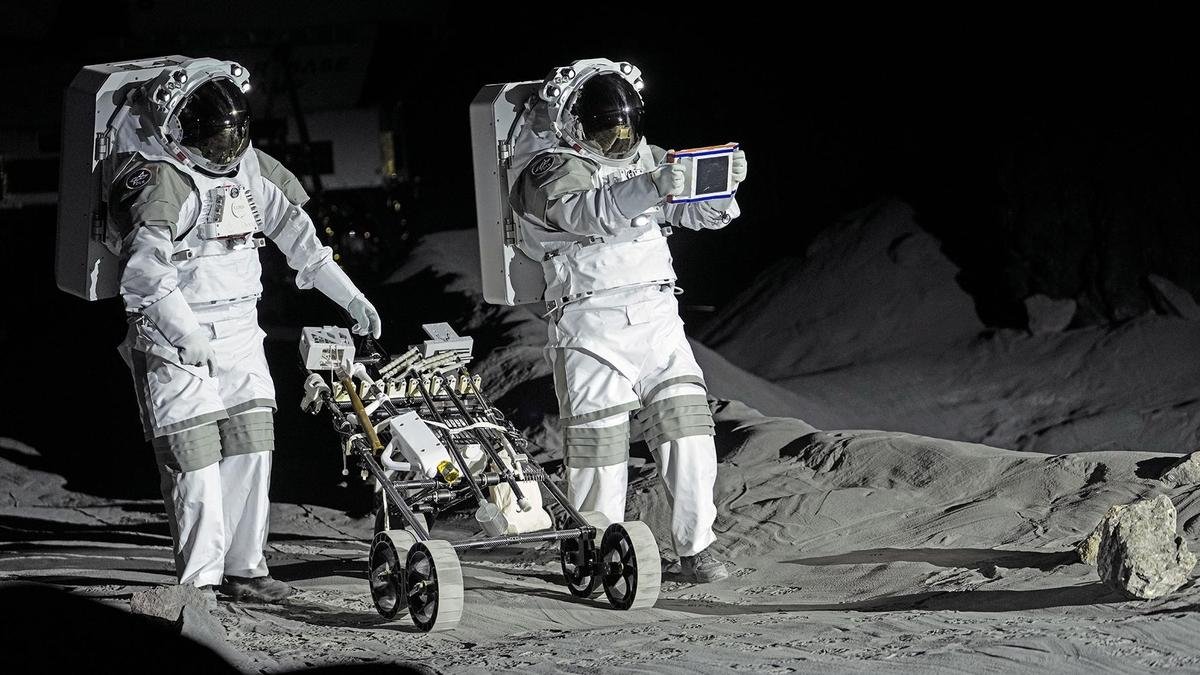
Suppose you are an astronaut tasked to go and explore Mars. How can you go without understanding what the Mars environment is like and how can you scientifically explore without knowing what to look for? Geology and field training helps astronauts with both these. This training includes practice in environments similar to the one that they will go to and teaches them how to look for, collect, and analyse samples. For this, places on Earth with similar geological features such as trenches, volcanic regions, craters, etc. are chosen as training grounds.
Apollo 15 astronauts training on the Big Island of Hawaii, Dec. 1970.
| Photo Credit:
AP
Before the Apollo mission, the astronauts came to Hawaii to train on the Big Island’s lunar landscapes. They rode moon buggy vehicles, collected soil samples as if they were on the moon.
Survival training
Anything can happen when you are travelling to, in, and coming back from space. All of those survival-type space films are just an extension of this idea.
NASA astronaut Karen Nyberg (left), cosmonaut Fyodor Yurchikhin and ESA astronaut Luca Parmitano (with flare) during survival training near Star City, Russia.
| Photo Credit:
europeanastronauttraining/Flickr
Survival training equips an astronaut with skills to survive tough situations. When Sunita Williams came back after being stuck in space, you must have observed how their space capsule landed on sea. Similarly, you can land on a desert, forest, and during emergency conditions, quite literally anywhere and at any time. This training includes camping in wilderness, hunting, swimming, climbing, making gears from scraps and spares, making survival medicine, etc.
Zero-gravity simulator at Johnson Space Center.
| Photo Credit:
PICRYL
Highly-specialised simulators
Like neutral buoyancy which simulates microgravity, there are myriad simulators that simulate different space conditions. NASA’s virtual reality laboratory generates computer generated microgravity. Many space agencies have also created virtual simulators for robotics operations, spacewalk, etc. There are motion-based simulators which replicate cockpits so that astronauts can learn the spacecraft system, flight engineering, etc. Flight simulators help astronuats experience all the forces during liftoff-landing and microgravity. Some simulators also simulate risky and malfunction conditions so as to help astronauts learn how to navigate these conditions.
Astronaut training.
| Photo Credit:
Magnific
Medical training
All astronauts are equipped with basic medical training so that they are able to take care of themselves. They are mentally prepared to tackle stress and isolation. Regular medical examination and stamina training is also done.
Published – July 20, 2026 08:00 am IST


