



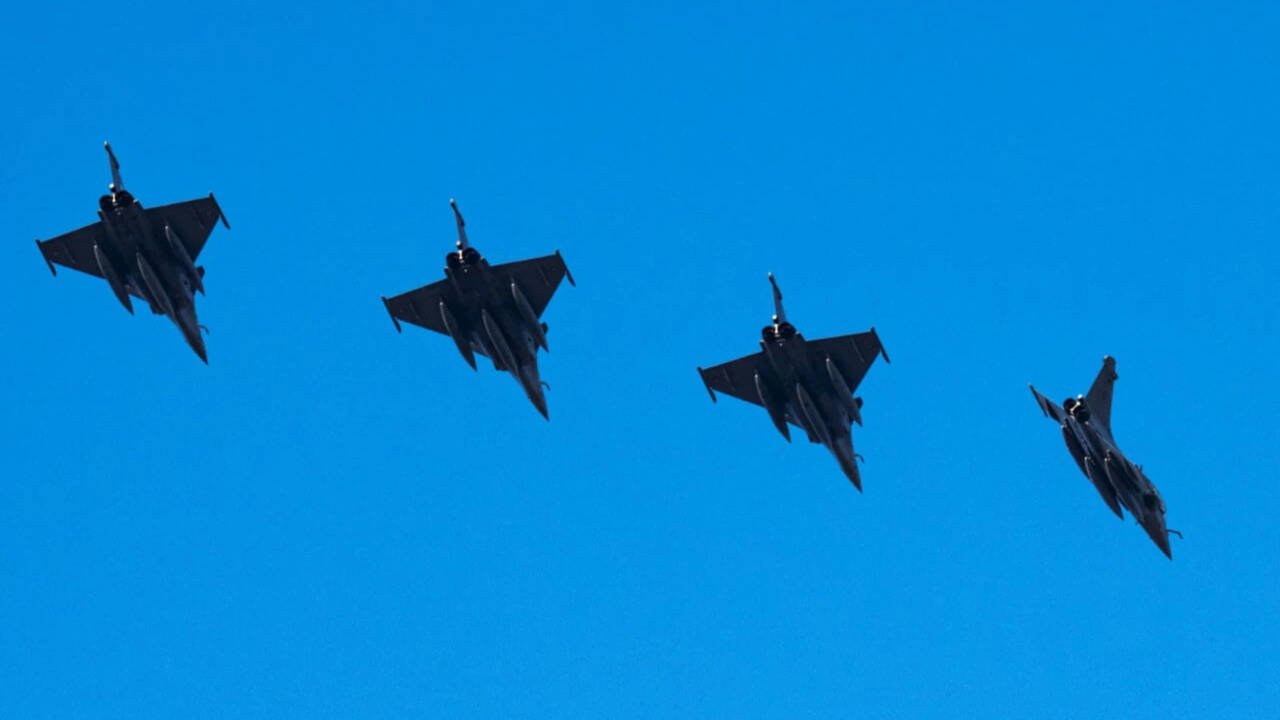
The Indian Air Force’s most advanced fighter aircraft is the Dassault Rafale, of which it has acquired 36 and plans to induct 114 more. Until a stealthy fifth‑generation fighter enters service, this 4.5‑generation platform will remain the IAF’s most potent combat aircraft.Apart from stealth shaping, the Rafale shares many traits with fifth‑generation fighters, including advanced avionics, a high level of sensor fusion that fuses inputs from multiple sensors into a single picture for the pilot, strong network‑centric capabilities that let it both receive and share battlespace data, and the ability to supercruise—maintain supersonic speed without afterburners, which greatly reduces its heat signature.
The Rafale is described as an “omnirole” fighter, meaning it can perform multiple mission types, often within a single sortie.In practice, this allows the aircraft to fly a precision strike mission while carrying air‑to‑air weapons for self‑escort, lase and designate its own targets, provide electronic warfare support through its integrated SPECTRA suite (Self‑Protection Equipment to Counter Threats for Rafale Aircraft), and carry out battle damage assessment by recording the effects on target.Although a single aircraft can theoretically execute this entire stack of roles in one mission, air forces typically deploy multiple aircraft in dedicated packages—strike, escort, electronic warfare and follow‑on battle damage assessment—with their own escorts.Because it lacks full stealth shaping, the primary method of radar evasion since the era of the F‑117 and B‑2, the Rafale relies heavily on electronic means to reduce detectability against hostile radars scanning for it. Its designers have incorporated measures to lower the aircraft’s frontal radar cross‑section, effectively shrinking its apparent size on radar screens.This survivability architecture operates in both passive and active modes. In the passive phase, the SPECTRA system uses distributed sensors to detect hostile radar emissions and build an electronic order of battle.The aircraft is equipped with laser warning receivers and a next‑generation infrared missile warning system, feeding data into an evolving threat library that is continuously updated and cross‑checked.Once the aircraft registers that it is being tracked by a hostile system, SPECTRA shifts to active measures. It employs an active phased‑array radar jammer designed to disrupt radar frequencies, particularly in the X‑band used by most missile guidance radars, including both fighter radars and missile seekers.The system supplements jamming with expendable countermeasures, such as flares to decoy heat‑seeking missiles and chaff to confuse radar‑guided weapons.


