



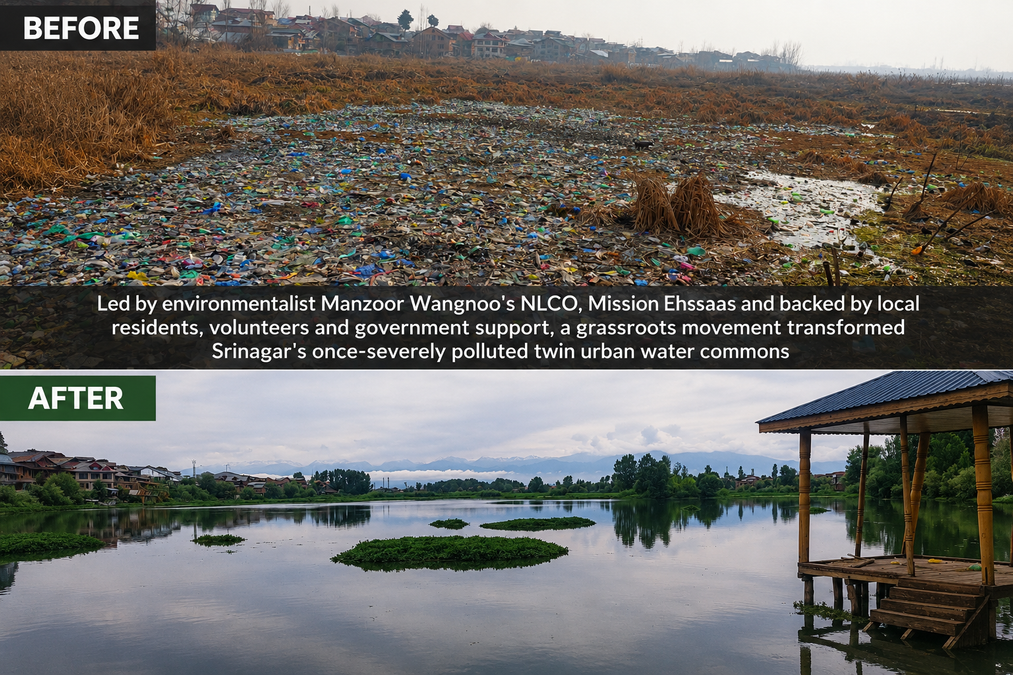
In the heart of Kashmir, Gilsar and Khushalsar are twin interconnected lakes situated in the northern part of Srinagar, Jammu and Kashmir. More specifically, they lie within the city’s old and historic quarters. Their boundaries extend across neighbourhoods from Zoonimar to the Aali Masjid area, and they remain connected to the larger Anchar and Nigeen lakes.
In the past, Gilsar and Khushalsar Water Commons were two undisturbed freshwater lakes and were an integral component of the interconnected lake system of Srinagar. They provided habitat for diverse aquatic life, fisheries, water transportation, and livelihoods, and facilitated flood control and groundwater recharge. In the past these water bodies had been famous for their crystal clear waters and ecological values in the Kashmir Valley. However in recent years, they have been degraded on account of sewage discharge, accumulation of waste and reduction in the water front.
Water Quality and Ecological Health of Gilsar and Khushalsar
According to the study, Evaluating Water Quality and Microbial Contamination in Khushalsar Wetland, Kashmir for Ecosystem Health, published in Springer Nature Switzerland AG (2026), reveals both Gilsar and Khushalsar showed signs of severe ecological stress.
“Several water quality parameters exceeded permissible limits, reflecting increasing human pressure on these lakes. The CCME Water Quality Index classified both water bodies as ‘poor’,” Professor Farooq Ahmed Lone, Head, Division of Environmental Sciences, SKUAST-Kashmir, said. “The highest microbial contamination was recorded during summer, particularly at the lake inlets, highlighting the urgent need for improved sewage management and pollution-control measures.”
From Foul Smell to Fresh Hope
Standing on the banks of the restored Gilsar–Khushalsar lakes, 56-year-old Mohammad Hussain remembers when these waters were the lifeline of the neighbourhood. Residents drank from the lakes, swam in them, and depended on them in their daily lives. But over the years, the twin water commons became choked with garbage, plastic waste and sewage, turning into foul-smelling water bodies that many had given up on.
At that time, the government wasn’t doing much for the lakes. When many had accepted the lakes’ decline as inevitable, Manzoor Wangnoo refused to. Not a government official or a public authority, but an environmentalist from Srinagar driven by a deep attachment to Kashmir’s water heritage, he took the first step. His conviction soon encouraged residents to stand beside him, turning one person’s concern into a shared mission
Before the restoration, the foul smell was unbearable and there were polythene bags and garbage everywhere. Today, the lakes are clean and beautiful again. More importantly, the restoration changed us too. We became more aware of our responsibility towards the environment and realised that we, as a community, had also played a role in polluting these lakes.”
Keeping the Waters Alive
“We formally took over Gilsar and Khushalsar from the Revenue Department in 2025, and since then the restoration process has been underway. Cleaning operations have already begun in both water bodies. Our Watermaster machinery has been deployed, solid waste collection is ongoing and embankment works have also been initiated at several locations,” Lakes and Conservation Management Authority (LCMA), Vice Chairman, Khursheed Ahmed Shah said. “This is not intended to be a short-term intervention. These water bodies are now under our jurisdiction and our responsibility is to ensure that conservation becomes continuous and sustainable.
“Our mandate at LCMA is clear to protect, conserve and maintain these lakes so they can continue serving ecological and public purposes. Similar to the work carried out in Dal and Nigeen, we have already initiated cleaning and waste management measures in Gilsar and Khushalsar and will continue to strengthen those efforts in the coming years. We are also planning improvement and beautification of the embankments.” Shah added.
Where the Restoration Began
The restoration journey began in 2000, when Manzoor Ahmad Wangnoo, environmentalist, businessman and Chairman of the Nigeen Lake Conservation Organisation (NLCO), was confronted with the deteriorating condition of Srinagar’s Nigeen Lake.
After returning from Delhi in 2000, Wangnoo recalled visiting Nigeen Lake. “The lake, once celebrated as the Queen of Lakes, was buried under polythene, dead animals and encroachments. I could not sit there for more than fifteen minutes. I went home, called my friends and asked, ‘What have we done to this lake, and why are we waiting for the government to fix everything?’ That moment became the beginning.”
Wangnoo said that although the situation in Kashmir was difficult at the time and taking up a public environmental cause was not easy, houseboat owners, local residents and friends joined hands to restore Nigeen without funding or expectations.
“Within months, we restored parts of Nigeen by cleaning it to the pristine beauty people remembered. I even compensated those using floating gardens because conservation cannot happen without community,” he said.
“Then came resistance, land interests, criticism and obstacles, but we continued. One morning, I woke up to see a newspaper headline appreciating the restoration of Nigeen. That was when I realised this effort needed an identity. With support from the then Vice Chairman of LAWDA, the Nigeen Lake Conservation Organisation (NLCO) was born,” Wangnoo said.
NLCO & Nigeen Lake Conservation
Wangnoo said he formally founded the Nigeen Lake Conservation Organisation (NLCO) in 2000 with the belief that protecting Kashmir’s lakes could not remain the responsibility of the government alone.
“Restoring Nigeen Water Common was not just about cleaning the lake; it was about changing mindsets. We encouraged residents, houseboat owners and local communities to see the lake as their shared heritage. Conservation cannot survive without community.” He added.
Mission: Ehsaas
Recalling the origins of Mission Ehsaas, Wangnoo said a Doordarshan interview in 2020 became a turning point. Given just 20 seconds to address the public, he chose one word: “Ehsaas.” It was a call for a shared sense of responsibility among people, stakeholders and the government. If all of us work towards one goal, anything is possible.
During the programme, footage of Khushal Sar and Gilsar left a lasting impression. “People were walking over them, animals were grazing and polythene bags were everywhere. You could not even spend two minutes there,” he said.
Recalling the beginning of the restoration, Wangnoo said he visited Khushal Sar the very next morning with two cousins.The condition of the lake was heartbreaking. We decided to begin the restoration immediately. Local residents gathered around us. Some laughed and asked, ‘What are you doing?’ We told them we were trying to clean the lake. They replied, ‘Many people have come here before, even higher authorities. They stay for one or two days and then leave.
“I told them, ‘Give us a chance.’
Main akela hi chala tha janib-e-manzil magar, log judte gaye aur karwan banta gaya.”
Wangnoo said that as local residents gradually began supporting the initiative, administrative backing also followed.
Anticipating challenges ranging from encroachments to vested interests, Wangnoo approached the then Divisional Commissioner, P. K. Pole, seeking coordinated support for the restoration of Khushal Sar and Gilsar. Pole subsequently convened a meeting of all concerned departments, including SMC, LAWDA and the police, directing them to support the initiative.
How Locals Support the Ehsaas Movement
Ghulam Nabi (name changed), a local resident of Gilsar, recalls how the restoration effort gradually became a shared responsibility for the entire community. “It may have begun with one man’s determination, but over time it became everyone’s mission. We, the local residents, stood with Mission Ehsaas in whatever way we could. Some of us contributed money, others volunteered our time, and many simply encouraged the effort because we wanted to see these lakes live again.”
“Today, when I look at Gilsar and Khushalsar, I feel proud that our small contributions became part of something much bigger. We only hope the government continues to protect and maintain what has been restored so that future generations never have to see these lakes in the condition they once were.”
Conservation Needs Policy, Participation & Persistence
“Long-term conservation of Gilsar and Khushalsar requires effective sewage and solid waste management, strict control of encroachments, and sustained wetland restoration efforts. Regular ecological monitoring and dedicated policy support are essential to maintain the health of these wetlands.
Equally important is community participation and awareness, which can play a key role in reducing pollution and ensuring the sustainable management of these valuable ecosystems,” Professor Farooq Ahmed Lone said. “I would also like to acknowledge the invaluable contribution of civil society activist Manzoor Ahmad Wangnoo, whose relentless efforts have significantly supported the preservation and conservation of the Gilsar and Khushalsar wetlands. Through his initiative, EHSAAS, he has carried out remarkable work in the desiltation of the twin lakes and the removal of excessive aquatic weeds, contributing substantially to their ecological restoration and revitalisation.”
The Green Man
“Initially, the restoration was expected to be completed within three or four months. But after the Prime Minister acknowledged the Khushal Sar–Gilsar initiative, it became clear that the effort could not remain a one-time clean-up. Restoration had to be sustained”, Wangnoo said.
He said that while restoring the lakes required immense effort, protecting them proved to be an even greater challenge, one that demanded continued support from local communities and the administration.
Recalling the restoration days, Wangnoo said the biggest challenge was not cleaning the lakes but protecting them from encroachment. He alleged that a “midnight mafia” would illegally dump soil and plant willow trees to convert wetlands into valuable land across parts of Khushal Sar and Gilsar.
As encroachment pressure intensified in the Nadir area of Sazgaripora, Wangnoo sought the intervention of LG Manoj Sinha. The visit helped accelerate restoration efforts, with the administration, police and other departments extending their support.
Wangnoo said the restoration continued for nearly four years before the responsibility was gradually transferred to the authorities for long-term management.
Reflecting on the journey, Wangnoo said the restoration ultimately belonged to the people who embraced it. For three to four years, we stayed with the work. Later, “I requested that the restored water bodies be handed over to an authority for long-term management, which eventually happened. My only concern is that the work and effort invested over the years should not go to waste. I remain hopeful that continued action will strengthen what has already begun.”
Reflecting on the journey with a heavy heart, Wangnoo said Mission Ehsaas was never just about him. “It started with two cousins and grew because people joined. Residents contributed money, friends arranged machines and fuel, and everyone gave whatever they could. Today, the lakes no longer bear the signs of neglect they once did. Public awareness has changed people’s behaviour, showing what a community can achieve together.”
(The author is a recipient of the Promise of Commons Fellowship 2026, on the significance of Commons and its community stewardship)


