



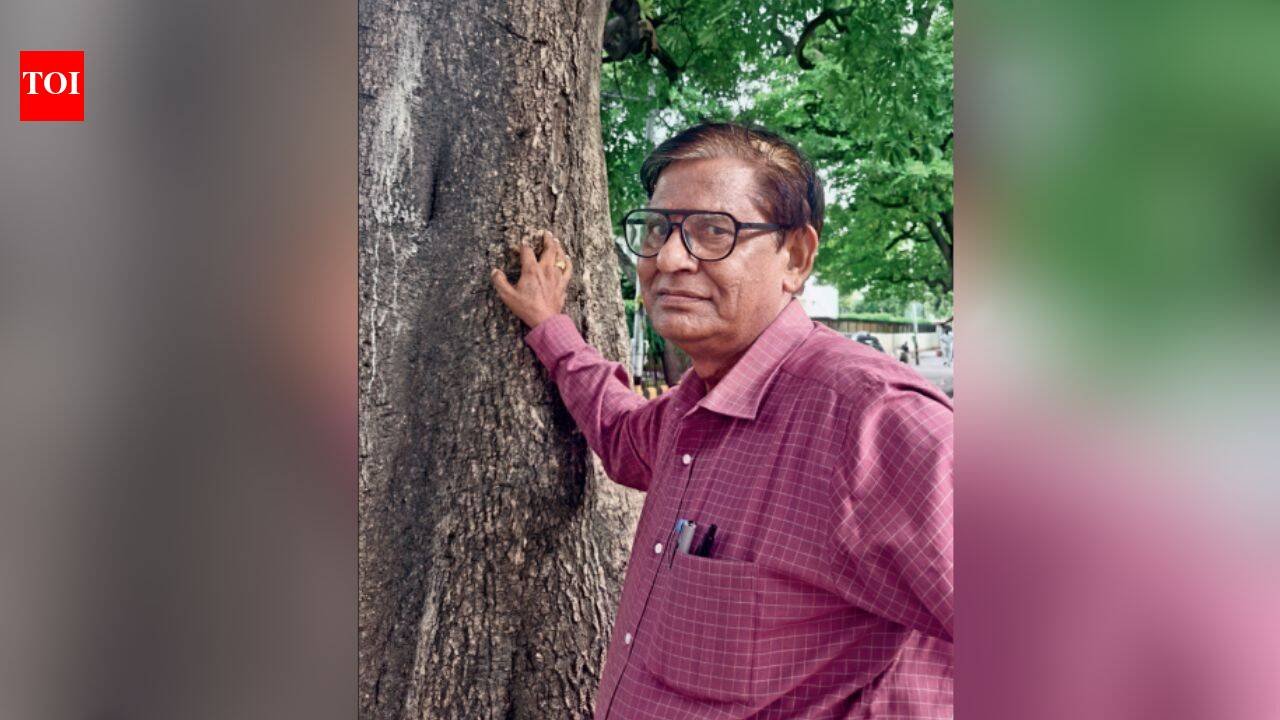
Sheoraj Singh “Bechain” was five years old when his father, who cobbled shoes for a living, went to attend a wedding. He kept vomiting on return.The general view at his basti in western Uttar Pradesh was that an evil spirit had taken over his body. He wasn’t taken to a doctor. Among other things, he was flogged to exorcise him of the ghoul. He died four days later.“Superstition claimed his life,” recalls Sheoraj, now an award-winning author who lives in Vasundhara, Ghaziabad.The 66-year-old Hindi litterateur talks in a steadfast tone without self-pity or rancour. He writes the same way.His famous short story, ‘Asthiyon ke Akshar’ (The Alphabet of Bones), which noted writer-editor Kamleshwar included in his selection of representative post-Independence Hindi stories, is harrowing in content but written with restraint.Reading his work, including short stories like Sister’ and his searing memoir, ‘Mera Bachpan Mere Kandhon Par’, one feels that writing is a form of liberation for him. It’s gut-wrenching because it’s hammered out of a life that’s impossible for those from middle-class backgrounds to imagine.Struggle means different things for people from different backgrounds. “For me, it meant survival. Which is why I laugh when privileged people talk about ‘merit’,” he says.When just six, a schoolteacher told his stepfather that Sheoraj was good at studies, unlike his own son. This had an opposite effect.“He broke my wooden slate, tore my books and burned them. He kicked my mother when she intervened,” Sheoraj recalls. For years, he couldn’t go to school.But Sheoraj had a love for reading. Once he even stole a rupee — not a small amount in 1966 — hoping to buy books, but it was a failed venture that brought more misery to his mother.Worse would follow. When seven, his stepfather would mortgage his sister and him to a brick-kiln owner. But other relatives rescued them, bringing them back to his native village, Nadroli, in Badaun district.To haul him out of misery, Sheoraj’s mother would leave him with his maternal uncle, who crafted shoes at home in Rajouri Garden. His uncle had a simple proposition: you stay here but earn for yourself.At eight, Sheoraj started hawking lemons. He would take an early morning bus to Azadpur Mandi, buy a kilo of the fruit and peddle them across his locality. He created a jingle:“Ras ke bhare raseele nimboo / Dus ke do, 15 ke do (depending on size) / Hans ke lo bhai hans ke lo.”“It was my first poem,” he says.Sheoraj’s life would take many twists and turns. He was admitted to the municipal school, thanks to a sightless rich benefactor, but that, too, failed.He would leave the capital, work at a farmhouse in Nainital district and polish shoes near a railway crossing in Bulandshahr. This was also the time he started reading folktales and other books. And he developed a felicity for poetry without realising it.Then, serendipity smiled on him.In a village gathering during Holi, Sheoraj recited poems on family planning, the evils of smoking and addiction — and one on an anklet, based on the true story of a teacher, who had pawned his wife’s, to meet his gambling debts.Among those who heard them was one Prem Pal Singh Yadav, an Arya Samajist and a farmer. He offered Sheoraj a place to stay and eat, in return for work.Many years ago, the young Dalit had taken an entrance test for Class 6. On the basis of that performance, he gained admission to a school.A cousin studying to be a doctor in Delhi’s Maulana Azad Medical College sent him a copy of Harivansh Rai Bachchan’s ‘Madhushala’.“It was the first serious book of literature I read. I saw ‘Madhushala’ as a form of protest against hypocrisy, against class, caste and religion,” he says.In search of a peon’s job in Delhi, Sheoraj was late for admission to Class 11. The principal, a poet himself, told him to win an August 15 school debate for admission. The teenager prepared a seven-minute speech and won. Around the same time, he participated in a major kavi sammelan.“I wrote a poem which I had modelled on ‘Madhushala’. My principal said, ‘It’s time you got ‘Madhushala’ out of your system. Find your own voice’.”Sheoraj took the suggestion to heart.In time, Sheoraj would graduate from SM College, Chandausi, taking the pen name, “Bechain (Restless)”, from poet Kunwar “Bechain”, who had been to the same college.He would start writing in magazines, complete his PhD from Rohilkhand University on the subject ‘Hindi Dalit Patrakarita par Patrakar Ambedkar Ka Prabhav’ (The Impact of Journalist Ambedkar on Hindi Dalit Journalism).Among his early mentors was the reputed Hindi editor-poet Viren Dangwal. But it was ‘Asthiyon ke Akshar’, published by editor-litterateur Rajendra Yadav in ‘Hans’ magazine in Feb 1996, that would earn him notice and acclaim.Sheoraj would debate with Yadav on democratising space for all voices.“Yadav would make me Hans’s guest editor for their first Dalit special in Aug 2004,” he says.More recognition would follow, once ‘Mera Bachpan Mere Kandhon Par’ was published in 2009. The Sahitya Akademi award isn’t one of them. But interestingly, Bollywood filmmakers are now showing interest in the book.“Talks are on,” he says.Sheoraj would eventually become the head of the Hindi department in Delhi University.“During an interview for my professorship, one of the panellists asked me, ‘You wrote 400 pages from your childhood by memory; how did you remember everything?’ I said, ‘Everything I couldn’t forget, I wrote’,” he says.Memory, as they say, is a double-edged knife. It can hurt, but it can also console.


