



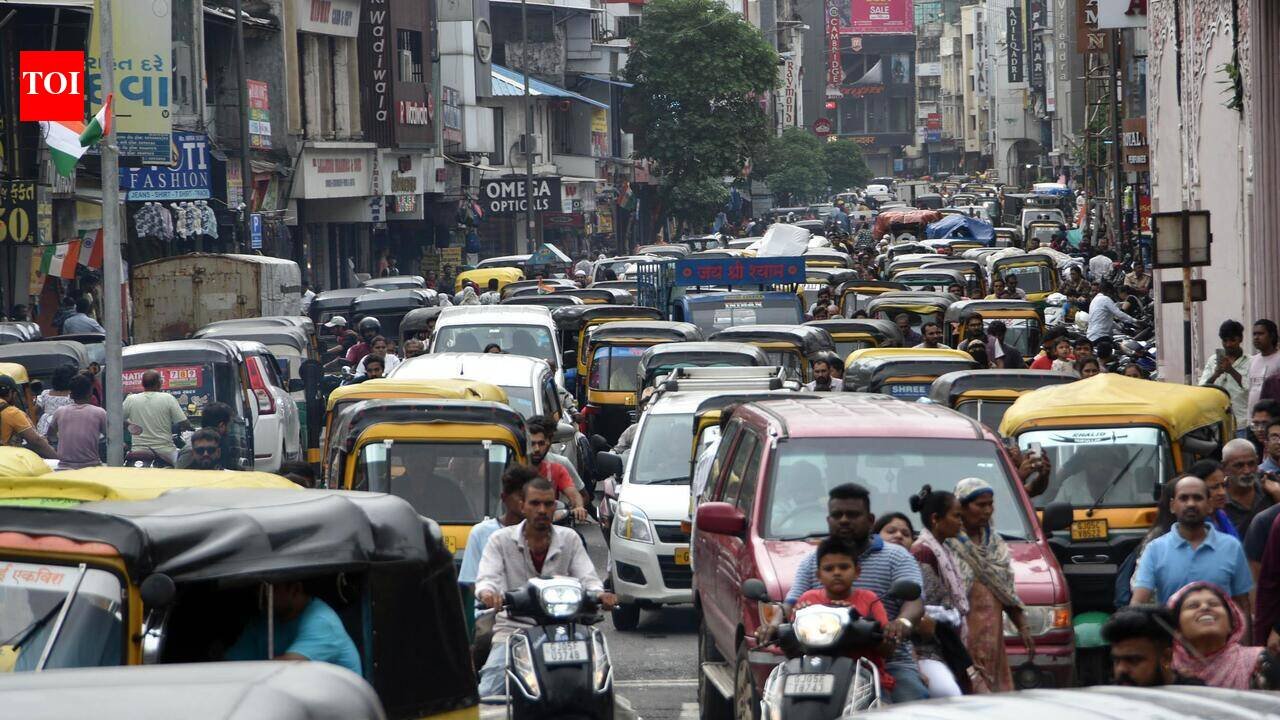
Surat: As traffic snarls and roadworks choke Surat’s expanding roads, residents are pinning hopes on the upcoming metro, with two corridors under construction, even as the city’s heavy reliance on private vehicles exposes gaps in its public transport network while calls to save on fuel are sounded.With no rail-based transit yet operational, the city bus system remains Surat’s primary means of mass transport, carrying around 2.5 lakh passengers daily in India’s ninth-largest city.Surat also runs one of the country’s longest Bus Rapid Transit System (BRTS) networks, spanning 108km. Its public transport fleet includes 775 buses, of which 450 are electric, reflecting a shift to cleaner mobility even as demand grows.Yet, private vehicles dominate. The city has about 45 lakh registered vehicles, including 35 lakh two-wheelers and around 6.30 lakh cars. Commuters say the sheer volume of personal vehicles, combined with road construction and diversions, has led to frequent congestion.Urban transport experts point to a stark gap between capacity and use. In many developed cities, over 40% of people rely on public transport for daily travel. In Surat, however, bus ridership suggests only a small fraction of the 80 lakh population uses public transport.“Developed nations are not where poor travel by car but rich travel by public transport. In some developed cities, around 75% of the population use public transport, and this has developed there due to efforts over several years,” said Gaurang Joshi, professor of transport planning at SVNIT.Experts estimate Surat would need around 3,000 buses to cater to even 40% of its population. They also flag behavioural patterns, noting that dependence on private vehicles remains deeply entrenched.They add that the metro alone will not solve congestion unless last-mile connectivity improves. “Most economic powerhouses of the world with successful public transport have integrated services where single ticket can be used for all modes like bus, metro or train. We need to have a better integrated network,” Joshi said.Residents echo these concerns. “I need to keep a driver so he takes care of the car when I go for a meeting as parking is mostly not available. Surat needs better public transport service with last-mile connectivity to add to its growth prospects,” said chartered accountant Shyamanand Chaudhary.The Surat Municipal Corporation (SMC), which operates Sitilink buses and BRTS, plans to expand the fleet by adding around 600 buses by 2028. Officials said deliveries will begin in Nov and be completed within two years, with additional buses planned for BRTS services.To procure electric buses, a centralised sourcing mechanism has been put in place, under which the central govt assists municipal corporations in acquiring new fleets.


