



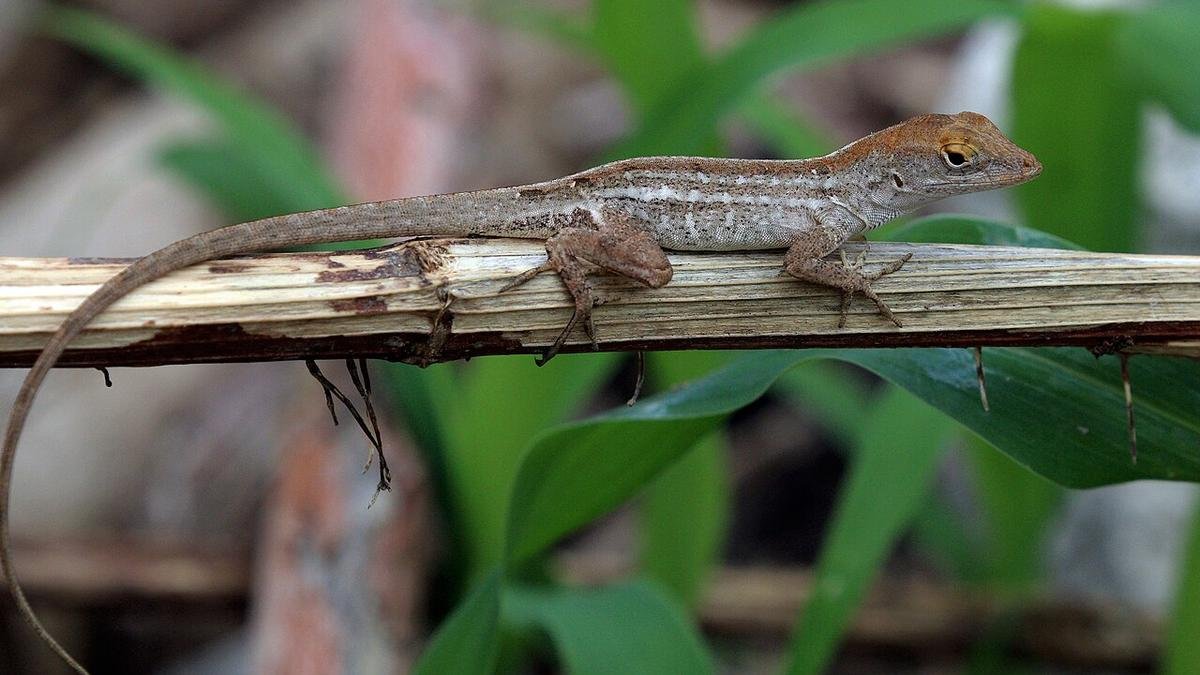
A brown anole.
| Photo Credit: Charles J. Sharp (CC BY-SA)
Picture a lizard the length of your finger clinging to a tree branch. The cause of its desperation is a 265 km/hr wind tearing through the air, threatening to peel it off like a loose sticker.
Just this happened twice in two weeks to a population of small brown anoles in the Turks and Caicos Islands in September 2017. So since then, these lizards have evolved to cling harder.
Two visitors
Four days before Hurricane Irma made landfall, a team of scientists from Princeton and Harvard Universities had wrapped up a routine survey of the Turks and Caicos anole (Anolis scriptus) on two islands, Pine Cay and Water Cay.
They studied the limbs, toes, and toepads, collected tissue samples, and went home. They had no idea a hurricane was coming, leave alone two. Hurricane Irma arrived on September 8 with sustained winds of 265 km/hr. Maria followed on September 22 at 200 km/hr.
Between them, the storms flattened vegetation and, by the look of it, a great many lizards.
Nagging detail
Six weeks later, the team returned to the same two islands and found something peculiar about the lizards that were around. Compared to before the storm, the anoles had longer forelimbs, shorter hind legs, shorter toes on those hind legs, and larger front and back toepads.
They reported these changes in Nature in 2018, describing them as the handiwork of evolution. But one detail from that survey nagged at the researchers: the fourth hind toe, the longest one, had actually become shorter. If longer toes mean better grip, why would evolution shorten one?
The answer has finally arrived, in a new study in Current Biology.
Checking with a cousin
When the researchers again went to Pine Cay and Water Cay, they found five genes on the two islands had become more frequent after the storms — independently. All five genes are known to be involved in muscle and skeletal development.
One in particular, hs6st1, seemed to be responsible for the shorter fourth toe in the surviving Turks and Caicos anoles.
Of course, finding a gene sitting next to a trait is not the same as proving it causes the trait. So the team turned to a lizard better suited to lab work, a cousin called the brown anole (Anolis sagrei). Using CRISPR, they knocked out hs6st1 in brown anole embryos, and they were born with shorter fourth toes, thinner toe cartilage, and, in one unlucky individual, a toe that never developed.
Evolution on steroids
Next, the team built a wind tunnel, placed brown anoles on a wooden dowel, and subjected them to winds of 118 km/hr. When they watched the footage, they found the lizards holding on with their front legs twice as long as with their back legs, on average.
But among all the hind-leg measurements, lizards with a shorter first toe bone clung on much longer than those with a longer one.
Thus, two hurricanes 14 days apart had managed to rewire a wild population’s genome and skeleton in a way that could still be detected in its descendants a year on — a point in favour of evolutionary biology on steroids.
The paper itself ended on a more sober note: extreme weather events are forecast to grow more frequent and severe, and researchers would do well to be mindful of the effects on wild populations, sometimes within a single generation.
D.P. Kasbekar is a retired scientist.
Published – August 05, 2026 09:30 am IST


