



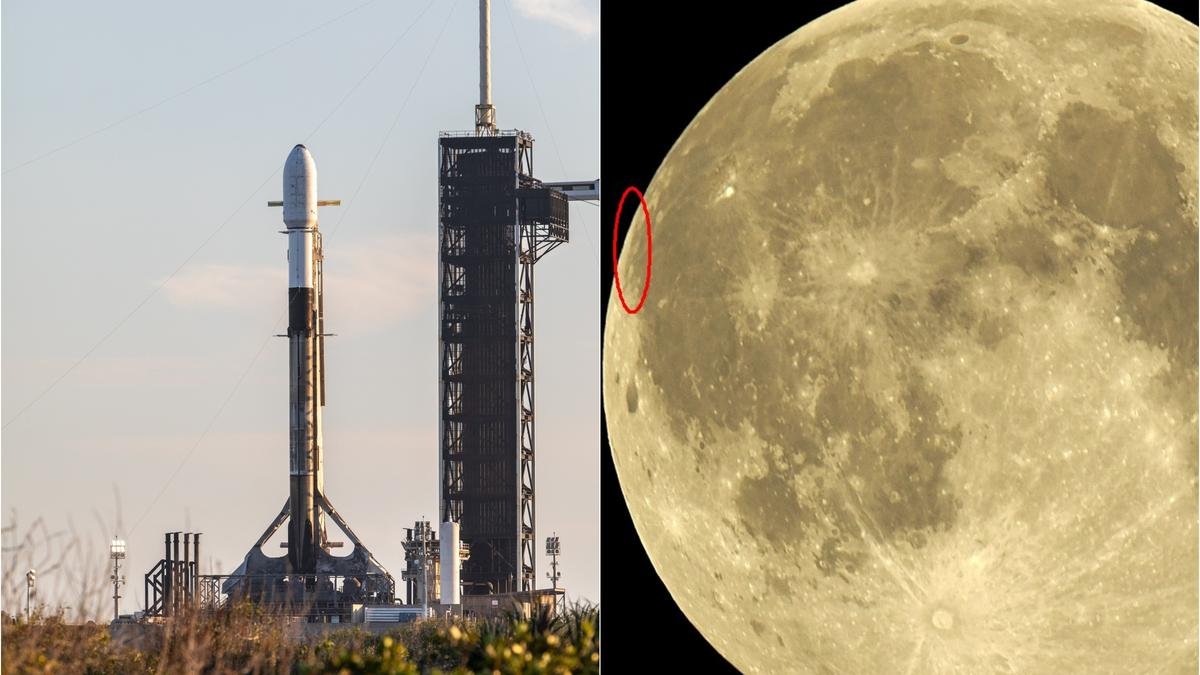
Astronomers are closely monitoring a SpaceX rocket stage that is on the way to striking the moon. This Falcon 9 rocket had launched two satellites towards the moon in January 2025. Then SpaceX abandoned the rocket’s spent upper stage in an unstable orbit as it lacked enough fuel to return to the earth or head into deep space. It is now expected to hit the moon on August 5 at 12:05 pm IST.
The independent astronomer Bill Gray’s calculations showed that the rocket stage is en route to the Einstein Crater on the moon. Mr. Gray said that over the course of a year, any small changes could add up and cause the object to fly close to the moon instead of impacting it. So he gathered more data, with which by January 2026 he was 100% sure that the stage was on a collision course.
“By April, I was confident enough to announce that it would hit near the Einstein crater,” he said, giving scientists roughly 3.5 months to plan observations. All details regarding this event are posted on his website, ‘Project Pluto’.
Since he had tracked the rocket within days of its launch, identifying the debris was easy: “We were somewhat fortunate in this case. If an object isn’t spotted until months or years after launch, identifying it can be quite challenging,” Mr. Gray said.
Accidental opportunity
Rather than threaten astronomy studies, experts said the collision will be an opportunity to study what happens in such events. Specifically, artificial impacts like this are rare. They are also valuable because scientists already know the impactor’s mass, speed, and size in advance, unlike with natural meteoroid strikes, rendering the collision a so-called controlled source event.
The last time a similar event was observed was NASA’s 2009 LCROSS mission, which deliberately crashed a rocket stage near the moon’s south pole and confirmed water ice in the debris it kicked up.
Mr. Gray has estimated the impact speed to be at 8,700 km/hr. During of the collision, astronomers are planning to investigate the behaviour of lunar dust, which can reveal more about the consequences of natural impacts and seismic activity. Since dust on the moon is not the same as dust anywhere on the earth, astronomers can also benefit from knowing how long dust will remain suspended or what kind of dust storms may be expected if humans want to start living on the moon.
What to expect
According to a paper by Johns Hopkins University planetary scientist Benjamin Fernando and colleagues (uploaded to the arXiv preprint server on July 16), three particular effects are expected from the impact.
First is a flash of light at the moment of impact, which may last less than a second. This is produced by material from the rocket stage vaporising on contact with the moon. Second, a cloud of debris or ejecta, possibly vapour, will be thrown up. Finally, a crater 20-30 m across, estimated based on past impacts and computer models.
The researchers wrote in their paper that “a double crater may be produced” if the object breaks apart, “which may occur depending on the stage’s attitude at the time of impact”.
However, catching the flash won’t be easy because it will be on the moon’s sunlit side, and any attempt will require a telescope.
Observers in India also won’t get a chance to see it live as the impact will happen at noon, with the moon below the horizon then.
What if…?
According to Mr. Gray, current estimates of the impact time and location carry an uncertainty of about 5 s in impact time and roughly 20 km in location.
Einstein crater sits at 88° W, 15° N, close to the western edge of the near side. It is far from the equatorial and south-polar regions, where most current and planned lunar landings are concentrated. So the chances of the rocket stage altering any sites that spacefaring nations consider significant are low.
Hypothetically, if this rocket stage or any other debris happened to strike any significant location on the moon — such as the Shiv Shakti point where Chandrayaan-3 landed — there currently is no legal instrument to protect them.
“There is no legal claim,” Ranjana Kaul, partner at Dua Associates & Vice President, International Institute of Space Law, Paris, said. “Our outer space treaty does not recognise sovereignty in outer space.”
She added that just because a country happened to land at a site, it doesn’t own that piece of the moon under current regulations.
Moon as a laboratory
Dr. Kaul also stressed the importance of studying artificial impacts like this one because of how quickly activity on the moon is expanding. With space agencies and private companies both targeting the moon for long-term lunar bases, mining, and satellites, accidental interference between missions may arise. Lunar scientific and cultural heritage are also at risk.
“Debris regulation is a serious problem,” Dr. Kaul added.
At the United Nations, the Action Team on Lunar Activity Consultation (ATLAC) working group is trying to build consensus among spacefaring nations on issues from coordinating on landing sites to lunar dust mitigation and debris rules — which is a scenario the impending impact previews.
The UN discussions will nonetheless take time to come up with new rules
“In the United Nations, decisions are by consensus,” Dr. Kaul said. This means all participating countries must agree before a proposal becomes binding international regulation, a process that can take years.
Mr. Gray also said space agencies handle leftover rocket stages differently. NASA and the European Space Agency, he said, have been careful. The upper stage that launched the Webb telescope, for instance, was placed in an orbit that will keep it away from the earth-moon system for roughly a century. China’s recent stages have similarly been directed toward the Pacific Ocean or orbits around the Sun.
SpaceX has made no public statement on its disposal policy, however.
Shreejaya Karantha is a freelance science writer.
Published – August 04, 2026 09:15 am IST


